Respiration Mind Map (GCSE)
GCSE · Biology · Checked against AQA and Edexcel · Updated 31 October 2026
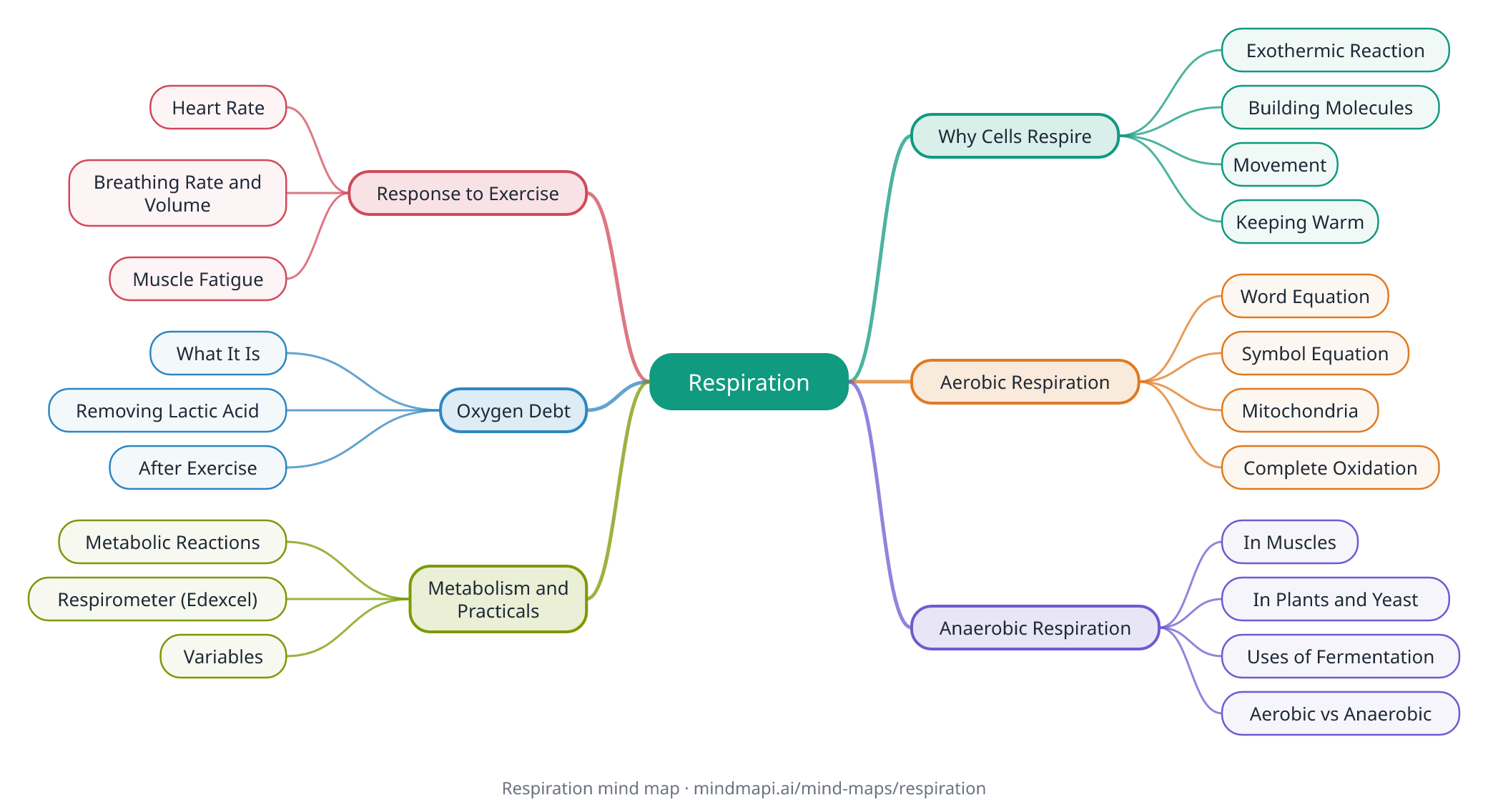
This respiration mind map puts the whole topic on one page (AQA topic 4, Bioenergetics, and Edexcel topic 8): why cells respire, aerobic and anaerobic respiration with their equations, fermentation in yeast, what happens to your body during exercise, oxygen debt and metabolism. Every branch is explained in the notes below the map.
Respiration is easy to mix up with breathing and with photosynthesis, so the map keeps them apart. Use it to check what you know before a test, or as a model when you build your own map from your class notes.
Download this mind map
Print the map with all the notes as a PDF revision sheet, or save the map as an image. Free to use for revision and in class.
Respiration mind map explained
Why Cells Respire
Respiration is a chemical reaction that transfers energy from glucose. It happens continuously in every living cell.
Exothermic Reaction
Respiration transfers energy to the environment, so it is exothermic. It is not the same as breathing, which only moves air in and out of the lungs.
Building Molecules
Energy is used for chemical reactions that build larger molecules, such as proteins from amino acids.
Movement
Energy is needed for muscles to contract.
Keeping Warm
Mammals and birds use energy to keep their body temperature steady.
Aerobic Respiration
Respiration using oxygen. It releases far more energy than anaerobic respiration.
Word Equation
glucose + oxygen → carbon dioxide + water
Symbol Equation
C₆H₁₂O₆ + 6O₂ → 6CO₂ + 6H₂O. It is the photosynthesis equation in reverse.
Mitochondria
Aerobic respiration happens in the mitochondria. Cells that need a lot of energy, such as muscle and sperm cells, have many of them.
Complete Oxidation
Glucose is fully broken down, so all the energy that can be released is released.
Anaerobic Respiration
Respiration without oxygen. The oxidation of glucose is incomplete, so much less energy is released than in aerobic respiration.
In Muscles
glucose → lactic acid. Happens during hard exercise, when the muscles cannot get enough oxygen.
In Plants and Yeast
glucose → ethanol + carbon dioxide. In yeast this is called fermentation.
Uses of Fermentation
The carbon dioxide makes bread rise, and the ethanol is the alcohol in beer and wine.
Aerobic vs Anaerobic
- Aerobic needs oxygen; anaerobic does not
- Aerobic makes carbon dioxide and water; anaerobic makes lactic acid, or ethanol and carbon dioxide
- Aerobic releases much more energy
Response to Exercise
During exercise the muscles need more energy, so the body supplies them with more oxygen and glucose.
Heart Rate
Increases, so blood carries oxygen and glucose to the muscles faster and removes carbon dioxide.
Breathing Rate and Volume
Both increase, so more oxygen enters the blood and more carbon dioxide is breathed out.
Muscle Fatigue
In long periods of hard exercise, muscles become tired and stop contracting efficiently. Lactic acid builds up as they respire anaerobically.
Oxygen Debt
Mainly AQA, higher tier. Why you keep breathing hard after exercise has stopped.
What It Is
The amount of extra oxygen the body needs after exercise to react with the lactic acid that has built up and remove it from the cells.
Removing Lactic Acid
Blood carries lactic acid from the muscles to the liver, where it is converted back into glucose.
After Exercise
Heart rate and breathing stay high until the oxygen debt is repaid.
Metabolism and Practicals
Metabolism is the sum of all the reactions in a cell or the body. Respiration supplies the energy for many of them.
Metabolic Reactions
AQA lists:
- Glucose into starch, glycogen and cellulose
- One glycerol and three fatty acids into a lipid
- Glucose and nitrate ions into amino acids, then proteins
- Respiration
- Excess proteins broken down to urea for excretion
Respirometer (Edexcel)
Edexcel core practical. Small organisms such as woodlice or germinating seeds are sealed in a tube with soda lime, which absorbs carbon dioxide. As they use oxygen, a drop of coloured liquid moves along a scale, showing the rate of respiration.
Variables
- Independent: usually temperature
- Dependent: distance the liquid moves in a set time
- Control: the number and mass of organisms, and the time
How to revise with this mind map
- Learn both equations for aerobic respiration, and the two anaerobic ones. A common exam slip is giving lactic acid for yeast, or carbon dioxide for muscles.
- Keep respiration and breathing separate. Respiration is a chemical reaction in every cell; breathing is moving air in and out of the lungs. Mixing them up costs marks.
- Compare aerobic and anaerobic respiration in a table: whether oxygen is needed, the products, how much energy is released and where each happens.
- For exercise questions, link each change to a reason. Heart rate rises so that more oxygen and glucose reach the muscles, not just because you are working hard.
- Make it yours. Build your own respiration map in Mindmapi from your class notes, and ask the AI about any branch you are unsure of. The answer is saved into that branch's notes for next time.
Frequently asked questions
What is the equation for aerobic respiration?
The word equation is glucose + oxygen → carbon dioxide + water. The balanced symbol equation is C₆H₁₂O₆ + 6O₂ → 6CO₂ + 6H₂O.
What is the difference between aerobic and anaerobic respiration?
Aerobic respiration uses oxygen, produces carbon dioxide and water, and releases much more energy. Anaerobic respiration happens without oxygen and releases less energy because glucose is not fully oxidised. In muscles it produces lactic acid; in plants and yeast it produces ethanol and carbon dioxide.
What is oxygen debt?
The amount of extra oxygen the body needs after exercise to react with the lactic acid that has built up and remove it from the cells. Blood carries the lactic acid to the liver, where it is converted back into glucose.
What happens to your body during exercise?
Heart rate, breathing rate and breath volume all increase, so that more oxygen and glucose reach the muscles and more carbon dioxide is removed. In hard exercise, muscles may also respire anaerobically, producing lactic acid and causing fatigue.
What is fermentation?
Anaerobic respiration in yeast: glucose → ethanol + carbon dioxide. It is used to make bread, where the carbon dioxide makes the dough rise, and alcoholic drinks.
How do I make my own respiration mind map?
Put respiration in the centre and add branches for aerobic respiration, anaerobic respiration, exercise and oxygen debt. To save time, paste your class notes into Mindmapi and it will build a first draft of the map for you to edit.
Turn your own notes into a mind map
Upload your class notes, a PDF or a lecture recording and Mindmapi builds the map for you. Your first map is free.
Try It Free


