Cell Biology Mind Map (GCSE)
GCSE · Biology · Checked against AQA and Edexcel · Updated 28 October 2026
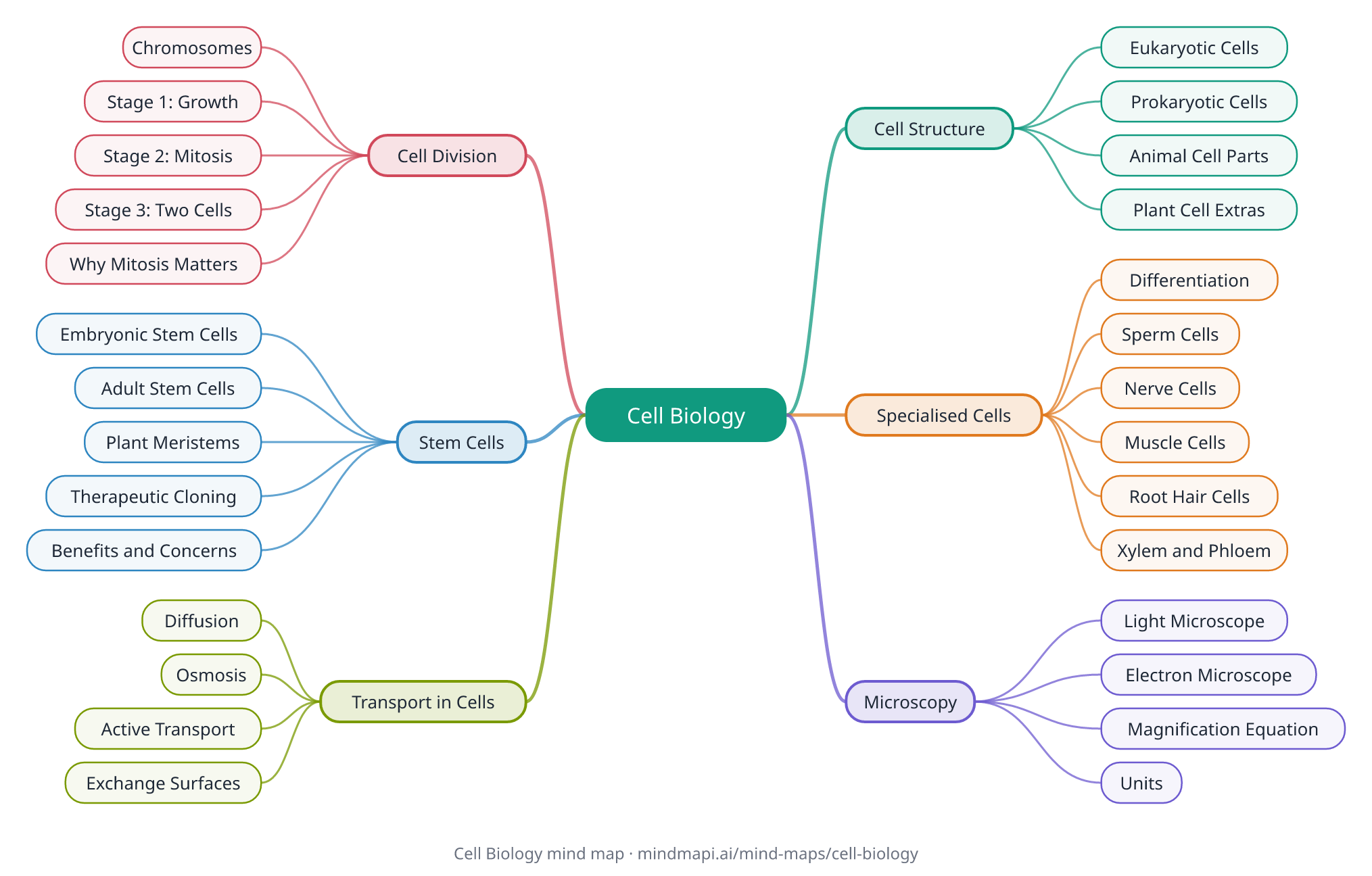
This cell biology mind map puts the whole of GCSE cell biology on one page (AQA topic 1, or B1, and Edexcel topics 1 and 2): cell structure, specialised cells, microscopy, cell division, stem cells and how substances move in and out of cells. Every branch is explained in the notes below the map, including the key definitions and both required practicals.
Use it to check what you know before a test, or as a model when you build your own map from your class notes.
Download this mind map
Print the map with all the notes as a PDF revision sheet, or save the map as an image. Free to use for revision and in class.
Cell Biology mind map explained
Cell Structure
All living things are made of cells. The key split is between eukaryotic cells, which have a nucleus, and prokaryotic cells, which do not.
Eukaryotic Cells
Animal and plant cells. Their genetic material is enclosed in a nucleus.
Prokaryotic Cells
Bacterial cells. Much smaller than eukaryotic cells, with no nucleus. Their genetic material is a single loop of DNA, and they may also have small rings of DNA called plasmids. They have a cell wall, cell membrane and cytoplasm.
Animal Cell Parts
- Nucleus: contains genetic material and controls the cell's activities
- Cytoplasm: where most chemical reactions happen, controlled by enzymes
- Cell membrane: controls what enters and leaves the cell
- Mitochondria: where aerobic respiration happens
- Ribosomes: where proteins are made
Plant Cell Extras
Plant cells have everything an animal cell has, plus:
- Chloroplasts: absorb light for photosynthesis
- Permanent vacuole: filled with cell sap
- Cell wall: made of cellulose, strengthens the cell
Specialised Cells
Each specialised cell has structures that suit its job. Exam questions usually ask you to link a feature to its function.
Differentiation
As an organism develops, cells become specialised for a particular job. Most animal cells differentiate early in life, while many plant cells can differentiate throughout life.
Sperm Cells
A tail to swim, many mitochondria to release energy, and enzymes in the head to get into the egg.
Nerve Cells
Long, with branched connections, to carry electrical impulses around the body.
Muscle Cells
Can contract, and contain many mitochondria to release the energy needed.
Root Hair Cells
A large surface area to absorb water and mineral ions from the soil.
Xylem and Phloem
Xylem cells form hollow tubes, strengthened with lignin, that carry water and mineral ions. Phloem cells carry dissolved sugars, and have end walls called sieve plates.
Microscopy
Required practical: use a light microscope to observe, draw and label plant and animal cells, including a magnification scale.
Light Microscope
Uses light, is cheap, and can be used to view living cells, but has limited magnification and resolution.
Electron Microscope
Much higher magnification and resolution, so it shows sub-cellular structures such as ribosomes and the inside of mitochondria. It helped scientists understand cells in far more detail.
Magnification Equation
magnification = size of image / size of real object
Rearrange it to find the real size: real size = image size / magnification. For example, an image 10 mm wide at x100 magnification shows an object 0.1 mm (100 µm) wide.
Units
- 1 millimetre (mm) = 1000 micrometres (µm)
- 1 micrometre (µm) = 1000 nanometres (nm)
Cells are usually measured in micrometres. Convert both sizes to the same unit before using the equation.
Cell Division
Body cells divide by mitosis as part of the cell cycle, producing two genetically identical cells.
Chromosomes
Found in the nucleus, made of DNA, and each carries many genes. Body cells have chromosomes in pairs: human body cells have 23 pairs.
Stage 1: Growth
The cell grows, the number of sub-cellular structures such as ribosomes and mitochondria increases, and the DNA replicates so there are two copies of each chromosome.
Stage 2: Mitosis
One set of chromosomes is pulled to each end of the cell, and the nucleus divides.
Stage 3: Two Cells
The cytoplasm and cell membrane divide, forming two genetically identical cells.
Why Mitosis Matters
Mitosis is used for growth, for repair, and for asexual reproduction.
Stem Cells
A stem cell is an undifferentiated cell that can divide to make more cells like itself, or differentiate into other types of cell.
Embryonic Stem Cells
Can differentiate into almost any type of cell.
Adult Stem Cells
Found in places such as bone marrow. They can form many types of cell, including blood cells, but not as many as embryonic stem cells.
Plant Meristems
Tissue at the tips of roots and shoots that can differentiate into any type of plant cell throughout the plant's life. Used to clone rare plants, and crops with useful features such as disease resistance.
Therapeutic Cloning
An embryo is made with the same genes as the patient, so stem cells from it would not be rejected by the patient's body.
Benefits and Concerns
Stem cells may treat conditions such as diabetes and paralysis. Against that, there are ethical and religious objections to using embryos, and a risk of transferring viral infections.
Transport in Cells
Substances move into and out of cells by diffusion, osmosis and active transport. Learn each definition exactly: mark schemes look for the key words.
Diffusion
The net movement of particles from an area of higher concentration to an area of lower concentration. Examples: oxygen and carbon dioxide in gas exchange, and urea moving from cells into the blood. It is faster with a steeper concentration gradient, a higher temperature and a larger membrane surface area.
Osmosis
The diffusion of water from a dilute solution to a more concentrated solution through a partially permeable membrane.
Required practical: measure the change in mass of plant tissue, such as potato, in different concentrations of salt or sugar solution.
Active Transport
The movement of substances from a more dilute solution to a more concentrated solution, against the concentration gradient. It needs energy from respiration. Examples: root hair cells absorbing mineral ions from the soil, and sugar being absorbed from the gut into the blood.
Exchange Surfaces
Single-celled organisms have a large surface area to volume ratio, so diffusion is enough. Larger organisms need exchange surfaces adapted with a large surface area, a thin membrane, a good blood supply and, in animals, ventilation.
How to revise with this mind map
- Learn definitions word for word. Diffusion, osmosis and active transport each have a definition with key words, such as "partially permeable membrane" or "against the concentration gradient", that mark schemes look for.
- Practise the calculations. Use the magnification equation in all three arrangements, and practise converting between mm, µm and nm until it is automatic.
- Know the practicals. AQA calls them required practicals and Edexcel calls them core practicals. For microscopy and osmosis, be ready to describe the method, name the variables, and explain the results.
- Revise in pairs. Many questions ask for differences: eukaryotic and prokaryotic cells, light and electron microscopes, diffusion and active transport, embryonic and adult stem cells. Make a quick comparison for each pair from the map.
- Make it yours. Build your own cell biology map in Mindmapi from your class notes, and ask the AI about any branch you are unsure of. The answer is saved into that branch's notes for next time.
Frequently asked questions
What is the difference between diffusion, osmosis and active transport?
Diffusion is the net movement of particles from higher to lower concentration. Osmosis is the diffusion of water through a partially permeable membrane, from a dilute to a more concentrated solution. Active transport moves substances against the concentration gradient, from more dilute to more concentrated, and needs energy from respiration.
What is the difference between eukaryotic and prokaryotic cells?
Eukaryotic cells, such as animal and plant cells, keep their genetic material in a nucleus. Prokaryotic cells, such as bacteria, are much smaller and have no nucleus: their DNA is a single loop, often with extra rings called plasmids.
How do you calculate magnification?
Magnification = size of image / size of real object. Make sure both sizes are in the same unit first. To find the real size, divide the image size by the magnification.
What are the cell biology required practicals?
For AQA GCSE Biology, the cell biology required practicals are using a light microscope to observe and draw cells, and investigating osmosis in plant tissue. Separate (triple) Biology students also investigate the effect of antiseptics or antibiotics on bacterial growth. Edexcel calls them core practicals, and microscopy and osmosis are core practicals there too.
What are stem cells used for?
Stem cells could be used to treat conditions such as diabetes and paralysis, and plant meristems are used to clone rare plants and useful crops. Using embryonic stem cells raises ethical and religious objections, and there is a risk of transferring viral infections.
How do I make my own cell biology mind map?
Put cell biology in the centre and add branches for cell structure, specialised cells, microscopy, cell division, stem cells and transport. To save time, paste your class notes into Mindmapi and it will build a first draft of the map for you to edit.
Turn your own notes into a mind map
Upload your class notes, a PDF or a lecture recording and Mindmapi builds the map for you. Your first map is free.
Try It Free


