Photosynthesis Mind Map (GCSE)
GCSE · Biology · Checked against AQA and Edexcel · Updated 28 October 2026
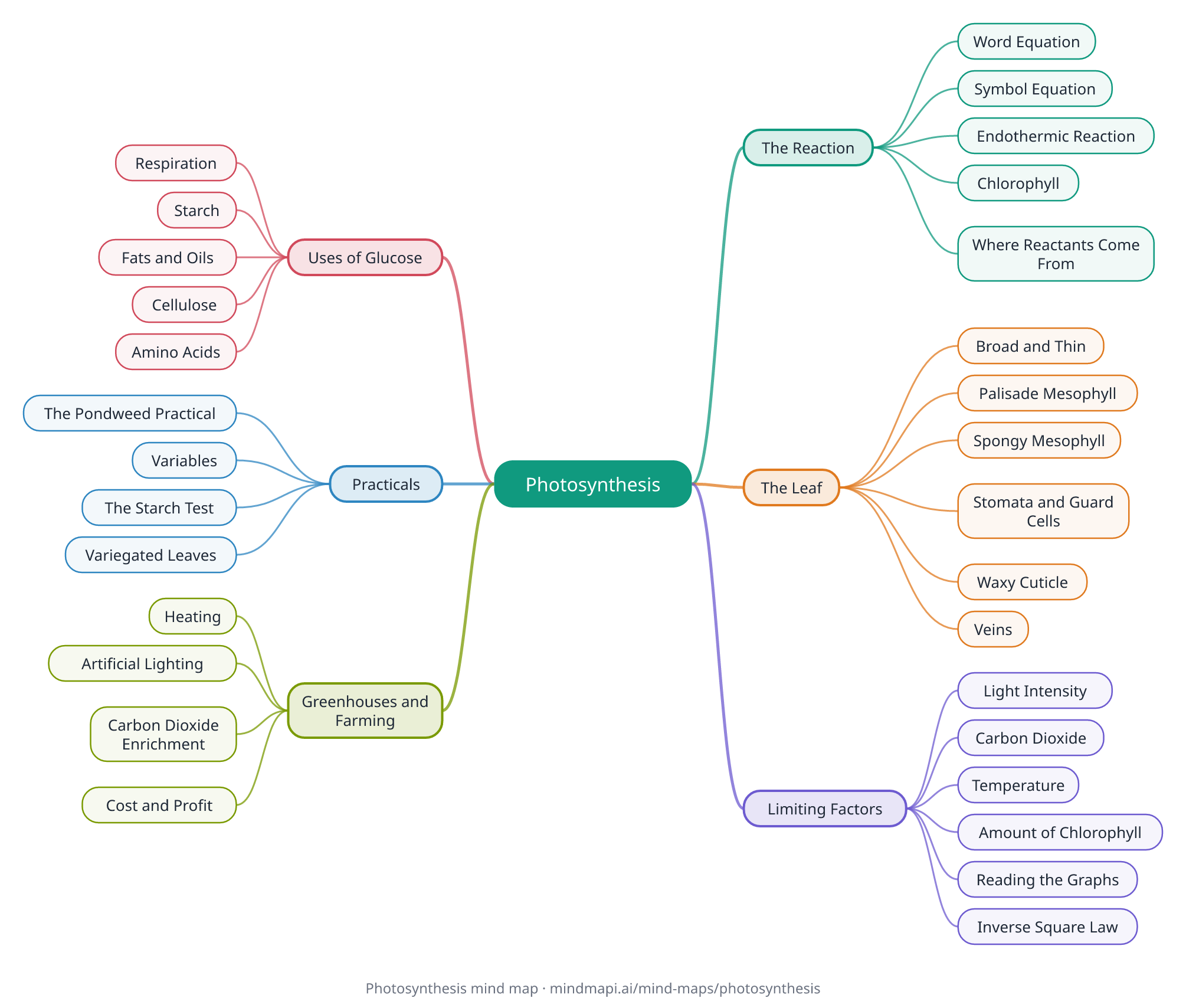
This photosynthesis mind map puts the whole topic on one page (AQA topic 4, Bioenergetics, and Edexcel topic 6): the reaction and its equations, how the leaf is adapted, limiting factors, what plants do with the glucose they make, the light intensity practical, and how farmers use all of this in greenhouses. Every branch is explained in the notes below the map.
Use it to check what you know before a test, or as a model when you build your own map from your class notes.
Download this mind map
Print the map with all the notes as a PDF revision sheet, or save the map as an image. Free to use for revision and in class.
Photosynthesis mind map explained
The Reaction
Photosynthesis is how plants and algae make glucose, using energy from light.
Word Equation
carbon dioxide + water → glucose + oxygen, in the presence of light.
Symbol Equation
6CO₂ + 6H₂O → C₆H₁₂O₆ + 6O₂. Learn it balanced: six of each, except one glucose.
Endothermic Reaction
Energy is transferred from the environment to the chloroplasts by light, so photosynthesis takes in energy.
Chlorophyll
The green pigment in chloroplasts that absorbs the light energy.
Where Reactants Come From
Carbon dioxide diffuses into the leaf from the air through the stomata. Water is absorbed by the roots and carried up to the leaves in the xylem.
The Leaf
Leaves are adapted to absorb light and exchange gases efficiently.
Broad and Thin
A large surface area to absorb light, and a short distance for gases to diffuse.
Palisade Mesophyll
Tightly packed cells near the top surface with many chloroplasts. Most photosynthesis happens here.
Spongy Mesophyll
Air spaces that let carbon dioxide and oxygen diffuse through the leaf.
Stomata and Guard Cells
Pores, mostly on the underside, that let carbon dioxide in and oxygen out. Guard cells open and close them.
Waxy Cuticle
A waterproof layer that reduces water loss while still letting light through.
Veins
Xylem brings water into the leaf, and phloem carries sugars away.
Limiting Factors
A limiting factor is whatever is in shortest supply, so it stops the rate of photosynthesis increasing.
Light Intensity
More light increases the rate, until another factor becomes limiting.
Carbon Dioxide
A higher carbon dioxide concentration increases the rate, until another factor becomes limiting.
Temperature
The rate increases as temperature rises, but above the optimum the enzymes are denatured and the rate falls sharply.
Amount of Chlorophyll
Less chlorophyll, for example from disease or a lack of magnesium, lowers the rate.
Reading the Graphs
The rate rises, then levels off. Where it is rising, the factor on the x-axis is limiting. Where it levels off, a different factor has become the limiting one.
Inverse Square Law
Higher tier. Light intensity is proportional to 1 / distance². Doubling the distance from a light source cuts the light intensity to a quarter.
Uses of Glucose
Plants use the glucose they make in five main ways.
Respiration
Glucose is broken down to release energy for the plant's cells.
Starch
Converted to insoluble starch for storage in roots, stems and leaves. Being insoluble, it does not affect water movement by osmosis.
Fats and Oils
Made for long-term energy storage, especially in seeds.
Cellulose
Used to strengthen the cell wall.
Amino Acids
Made by combining glucose with nitrate ions absorbed from the soil, then used to make proteins.
Practicals
The light intensity investigation is a required practical for AQA and a core practical for Edexcel.
The Pondweed Practical
Place pondweed in water at different distances from a light source. Count the oxygen bubbles, or measure the volume of oxygen given off, in a set time.
Variables
- Independent: distance from the light (light intensity)
- Dependent: rate of oxygen production
- Control: temperature and carbon dioxide concentration
The Starch Test
Boil the leaf in water, warm it in ethanol in a water bath to remove the chlorophyll, rinse it, then add iodine solution. It turns blue-black where starch is present.
Variegated Leaves
A leaf with green and white parts only turns blue-black where it was green, showing that chlorophyll is needed for photosynthesis.
Greenhouses and Farming
Higher tier, mainly AQA. Farmers control limiting factors to grow more crops, faster.
Heating
Keeps the temperature near the optimum for photosynthesis.
Artificial Lighting
Lets photosynthesis continue beyond daylight hours.
Carbon Dioxide Enrichment
Paraffin heaters or added carbon dioxide raise the carbon dioxide concentration.
Cost and Profit
Farmers must balance the extra cost of heating, lighting and carbon dioxide against the extra profit from a bigger, faster yield.
How to revise with this mind map
- Learn both equations. Be ready to write the word equation and the balanced symbol equation from memory: they come up every year.
- Practise reading limiting factor graphs. For each graph, say which factor is limiting where the line is rising, and why the line levels off. This is where most marks are lost.
- Know the practical inside out. For the pondweed practical, be able to describe the method, name the independent, dependent and control variables, and explain how to keep temperature constant.
- Explain, don't just state. Higher marks need the reason: the rate falls at high temperatures because the enzymes are denatured, not just because it is too hot.
- Make it yours. Build your own photosynthesis map in Mindmapi from your class notes, and ask the AI about any branch you are unsure of. The answer is saved into that branch's notes for next time.
Frequently asked questions
What is the equation for photosynthesis?
The word equation is carbon dioxide + water → glucose + oxygen, in the presence of light. The balanced symbol equation is 6CO₂ + 6H₂O → C₆H₁₂O₆ + 6O₂.
What are the limiting factors of photosynthesis?
Light intensity, carbon dioxide concentration, temperature and the amount of chlorophyll. Whichever is in shortest supply limits the rate.
Why does the rate of photosynthesis fall at high temperatures?
Photosynthesis is controlled by enzymes. Above the optimum temperature the enzymes are denatured: their shape changes so they no longer work, and the rate falls sharply.
What do plants use glucose for?
For respiration, to make insoluble starch for storage, to make fats and oils for storage, to make cellulose for cell walls, and, with nitrate ions, to make amino acids for proteins.
How do you test a leaf for starch?
Boil the leaf in water, warm it in ethanol in a water bath to remove the chlorophyll, rinse it, then add iodine solution. Blue-black shows starch is present.
How do I make my own photosynthesis mind map?
Put photosynthesis in the centre and add branches for the reaction, the leaf, limiting factors, uses of glucose and the practical. To save time, paste your class notes into Mindmapi and it will build a first draft of the map for you to edit.
Turn your own notes into a mind map
Upload your class notes, a PDF or a lecture recording and Mindmapi builds the map for you. Your first map is free.
Try It Free


