Inheritance, Variation and Evolution Mind Map (GCSE)
GCSE · Biology · Checked against AQA and Edexcel · Updated 31 October 2026
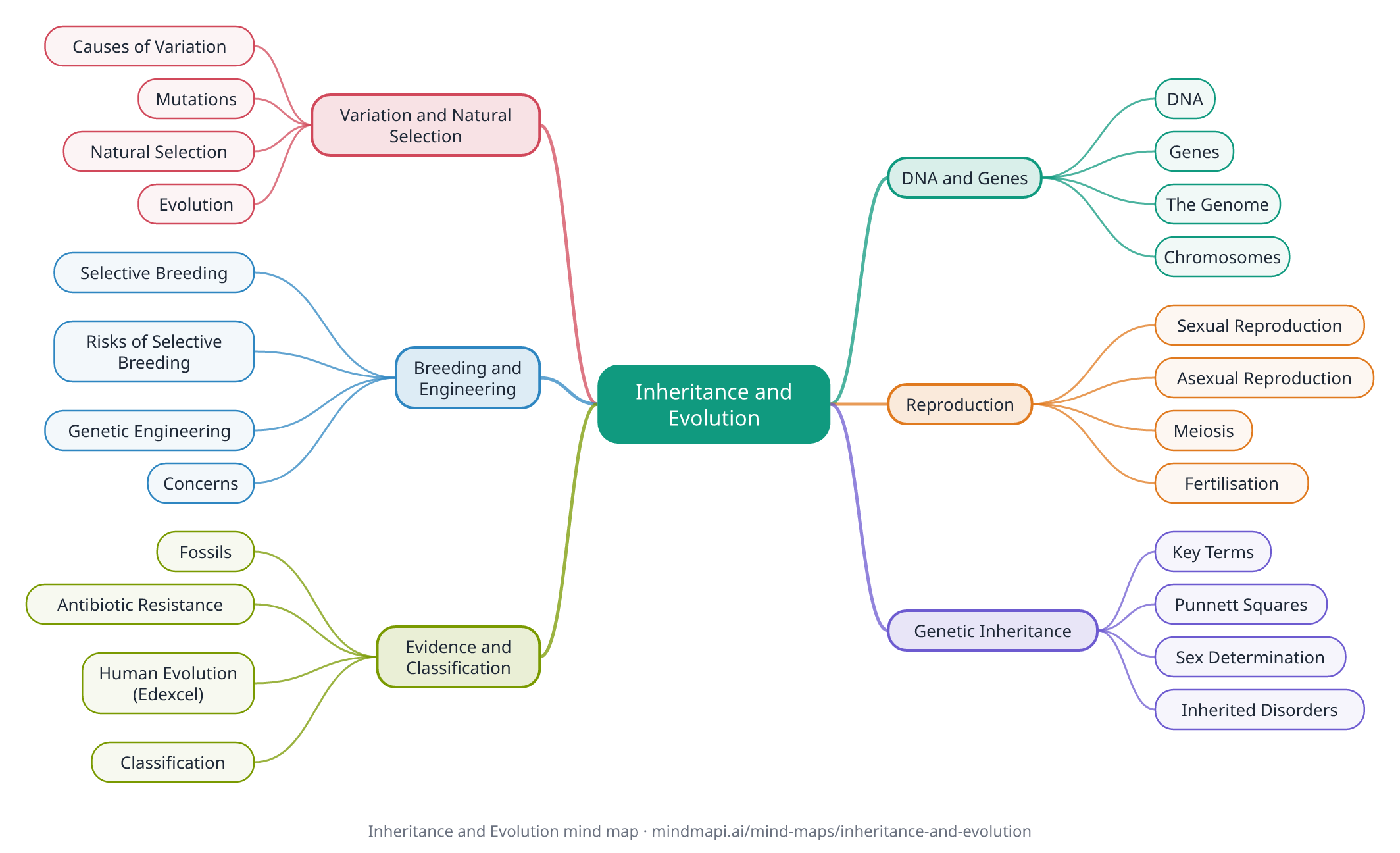
This inheritance, variation and evolution mind map puts the whole genetics topic on one page (AQA topic 6, and Edexcel topics 3 and 4): DNA and genes, sexual and asexual reproduction, genetic diagrams, inherited disorders, variation and natural selection, selective breeding and genetic engineering, and the evidence for evolution. Every branch is explained in the notes below the map.
Genetic diagrams and the explanation of natural selection come up in almost every exam, so those branches spell out the steps you need to show.
Download this mind map
Print the map with all the notes as a PDF revision sheet, or save the map as an image. Free to use for revision and in class.
Inheritance and Evolution mind map explained
DNA and Genes
The genetic material in the nucleus of a cell is made of DNA.
DNA
A polymer made of two strands twisted into a double helix. DNA is found in structures called chromosomes.
Genes
A gene is a small section of DNA on a chromosome. Each gene codes for a particular sequence of amino acids, to make a specific protein.
The Genome
The entire genetic material of an organism. The whole human genome has been studied, which helps identify genes linked to diseases and trace human migration.
Chromosomes
Human body cells have 23 pairs of chromosomes. One pair are the sex chromosomes: XX in females and XY in males.
Reproduction
Organisms reproduce sexually, asexually or both.
Sexual Reproduction
Male and female gametes (sperm and egg cells, or pollen and egg cells) join at fertilisation. The offspring get a mix of genes from both parents, so they vary.
Asexual Reproduction
One parent, no joining of gametes, and offspring that are genetically identical clones. It happens by mitosis.
Meiosis
Cell division that makes gametes. The chromosomes are copied, then the cell divides twice, giving four gametes, each with a single set of chromosomes and each genetically different.
Fertilisation
The gametes join, restoring the full number of chromosomes. The new cell divides by mitosis as the embryo develops.
Genetic Inheritance
Most characteristics are controlled by several genes, but some by a single gene.
Key Terms
- Allele: a version of a gene
- Dominant: always expressed, even with only one copy
- Recessive: expressed only with two copies
- Homozygous: two identical alleles; heterozygous: two different alleles
- Genotype: the alleles present; phenotype: the characteristic shown
Punnett Squares
Show the possible offspring of two parents. Write each parent's alleles along the edges, fill in the grid, and give the outcome as a ratio, a probability or a percentage.
Sex Determination
Crossing XX with XY gives a 50% chance of a boy and a 50% chance of a girl.
Inherited Disorders
Polydactyly (extra fingers or toes) is caused by a dominant allele. Cystic fibrosis, a disorder of cell membranes, is caused by a recessive allele. Embryo screening raises ethical and economic issues.
Variation and Natural Selection
Differences between individuals in a population are the raw material for evolution.
Causes of Variation
Variation comes from the genes inherited, from the environment, or from a combination of both.
Mutations
Changes to DNA happen all the time. Most have no effect, a few change the phenotype, and very rarely one gives an advantage.
Natural Selection
Darwin's theory:
- Individuals vary because of their genes
- Those best suited to the environment are more likely to survive and breed
- They pass on the useful alleles
- Over many generations, the species changes
Evolution
All species of living things evolved from simple life forms that first developed more than three billion years ago.
Breeding and Engineering
Humans change the genes of plants and animals on purpose.
Selective Breeding
Choose parents with the characteristic you want, breed them, then select the best offspring and repeat over many generations. Used for disease resistance, bigger yields, gentle dogs and large flowers.
Risks of Selective Breeding
Inbreeding reduces variation, so some breeds are more prone to disease or inherited defects.
Genetic Engineering
A gene from one organism is cut out and inserted into another. Examples include bacteria making human insulin, and crops resistant to insects or herbicides, or with bigger fruit.
Concerns
Possible effects on wild plants and insects, and uncertain long-term effects of eating GM crops.
Evidence and Classification
How we know evolution happened, and how living things are grouped.
Fossils
The remains of organisms from millions of years ago, preserved where parts did not decay, where parts were replaced by minerals, or as traces such as footprints. The fossil record is incomplete because many early forms were soft-bodied.
Antibiotic Resistance
Bacteria reproduce quickly, so resistant strains evolve in a short time: evidence of natural selection happening now.
Human Evolution (Edexcel)
Edexcel only. Fossils such as Ardi and Lucy, the work of Richard Leakey's team, and the development of stone tools show how humans evolved.
Classification
Linnaeus grouped organisms into kingdom, phylum, class, order, family, genus and species, and named each with two words (genus and species). Carl Woese's three-domain system splits life into archaea, bacteria and eukaryota.
How to revise with this mind map
- Practise genetic diagrams until they are automatic. Show the parents' alleles, the gametes, the Punnett square and the outcome as a ratio or percentage: marks are given for each step.
- Learn the key terms in pairs: dominant and recessive, homozygous and heterozygous, genotype and phenotype. Questions often test whether you can use them precisely.
- Explain natural selection in steps: variation, survival of the best suited, breeding, passing on alleles, and change over many generations. Missing a step loses marks.
- Compare meiosis and mitosis in a table: what each is for, how many divisions, how many cells, and whether they are genetically identical.
- Make it yours. Build your own genetics map in Mindmapi from your class notes, and ask the AI about any branch you are unsure of. The answer is saved into that branch's notes for next time.
Frequently asked questions
What is the difference between a gene and an allele?
A gene is a section of DNA that codes for a particular protein. An allele is a version of that gene: for example, a gene for eye colour can have different alleles.
How do you draw a Punnett square?
Write the alleles of one parent along the top and the other parent's down the side, fill in each box with one allele from each, then read off the possible genotypes and give the outcome as a ratio, probability or percentage.
What is the difference between meiosis and mitosis?
Meiosis makes gametes: two divisions produce four cells, each with half the number of chromosomes and genetically different. Mitosis is for growth and repair: one division produces two genetically identical cells with the full number of chromosomes.
How does natural selection work?
Individuals in a species vary because of their genes. Those best suited to their environment are more likely to survive and breed, passing on their alleles. Over many generations this changes the species.
What is the difference between selective breeding and genetic engineering?
Selective breeding chooses parents with useful characteristics and breeds them over many generations. Genetic engineering moves a specific gene from one organism into another directly, such as the human insulin gene into bacteria.
How do I make my own genetics mind map?
Put inheritance in the centre and add branches for DNA, reproduction, genetic diagrams, natural selection, breeding and engineering, and evidence. To save time, paste your class notes into Mindmapi and it will build a first draft of the map for you to edit.
Turn your own notes into a mind map
Upload your class notes, a PDF or a lecture recording and Mindmapi builds the map for you. Your first map is free.
Try It Free


