Infection and Response Mind Map (GCSE)
GCSE · Biology · Checked against AQA and Edexcel · Updated 31 October 2026
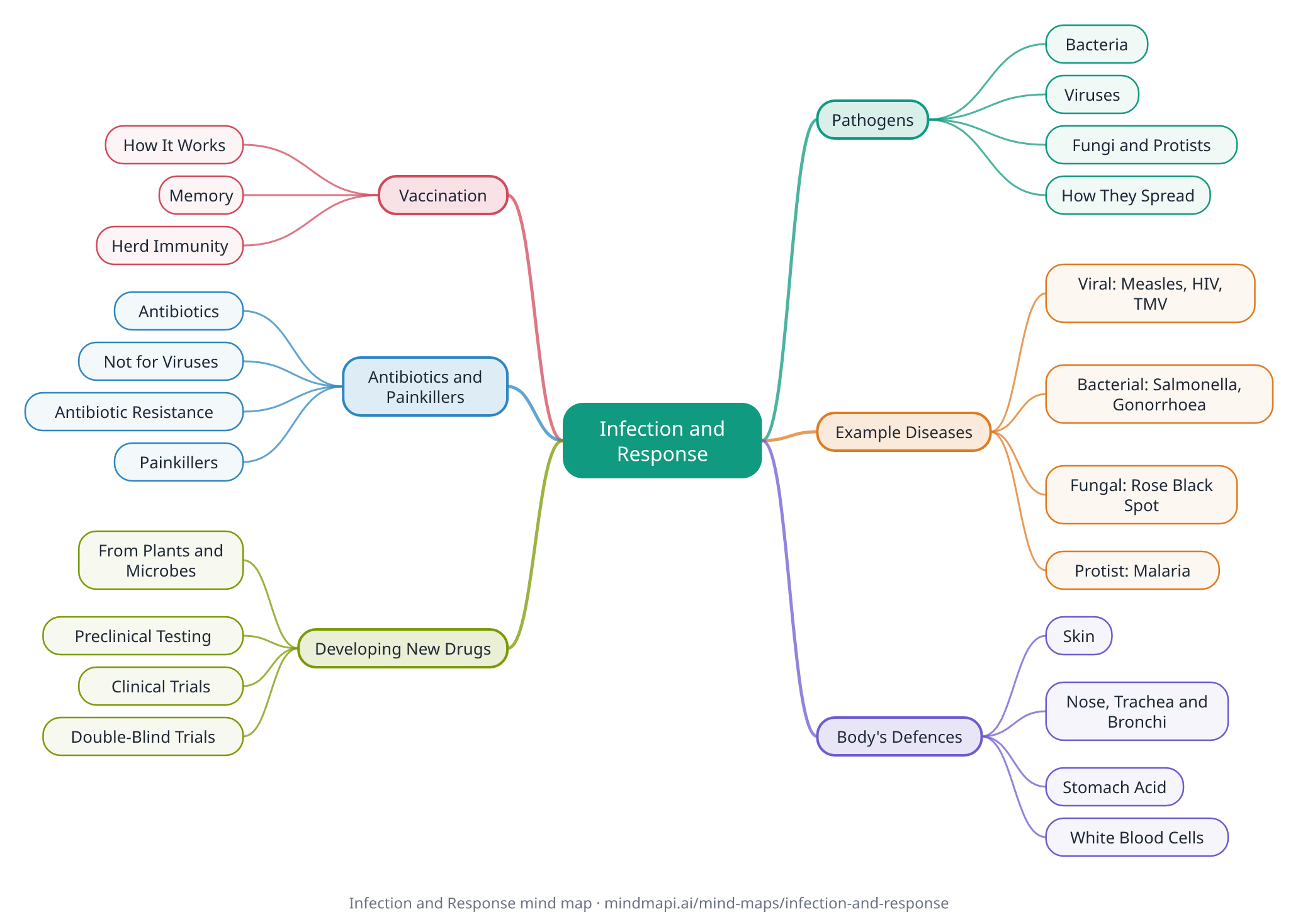
This infection and response mind map puts the whole topic on one page (AQA topic 3, and Edexcel topic 5, Health, disease and the development of medicines): the four types of pathogen, the diseases you need to know, how the body defends itself, vaccination, antibiotics and painkillers, and how new drugs are developed and tested. Every branch is explained in the notes below the map.
The example diseases follow AQA's list. Edexcel uses a different set of examples, which are named on the diseases branch so you can check yours.
Download this mind map
Print the map with all the notes as a PDF revision sheet, or save the map as an image. Free to use for revision and in class.
Infection and Response mind map explained
Pathogens
Pathogens are microorganisms that cause infectious disease. They can infect plants and animals.
Bacteria
Reproduce rapidly inside the body and may produce poisons, called toxins, that damage tissues and make us feel ill.
Viruses
Live and reproduce inside cells, causing cell damage.
Fungi and Protists
Fungi include rose black spot. Protists include the parasite that causes malaria.
How They Spread
- Through the air, in droplets from coughs and sneezes
- In water
- By direct contact
- By vectors, such as mosquitoes
Example Diseases
AQA's examples are below. Edexcel's examples are cholera, tuberculosis, Chalara ash dieback, malaria, HIV, stomach ulcers (Helicobacter) and Ebola.
Viral: Measles, HIV, TMV
- Measles: fever and a red skin rash, spread by droplets; prevented by vaccination
- HIV: flu-like illness at first, then attacks immune cells and can lead to AIDS; spread by sexual contact and body fluids; controlled by antiretroviral drugs
- Tobacco mosaic virus: a mosaic pattern on plant leaves, which reduces photosynthesis
Bacterial: Salmonella, Gonorrhoea
- Salmonella: food poisoning with fever, cramps, vomiting and diarrhoea; poultry in the UK is vaccinated against it
- Gonorrhoea: a sexually transmitted disease with a thick yellow or green discharge and pain when urinating; once treated with penicillin, but many strains are now resistant; condoms prevent spread
Fungal: Rose Black Spot
Purple or black spots on leaves, which turn yellow and drop early. Spread by water or wind; treated with fungicides and by removing affected leaves.
Protist: Malaria
Spread by mosquitoes, which are vectors. Causes repeated bouts of fever. Prevented by stopping mosquitoes breeding and using nets and insecticides.
Body's Defences
Non-specific defences stop pathogens getting in. The immune system destroys those that do.
Skin
A barrier to pathogens, which also produces antimicrobial secretions.
Nose, Trachea and Bronchi
Hairs and mucus trap particles. Cilia waft the mucus up to the throat to be swallowed.
Stomach Acid
Hydrochloric acid kills pathogens that are swallowed.
White Blood Cells
- Phagocytosis: engulfing and digesting pathogens
- Antibodies: made to target a specific pathogen
- Antitoxins: neutralise the toxins bacteria release
Vaccination
Vaccines make you immune to a disease before you ever catch it.
How It Works
A small amount of a dead or inactive form of the pathogen is put into the body. White blood cells produce antibodies against it.
Memory
If the real pathogen enters later, white blood cells quickly produce the right antibodies, so the infection is stopped before you become ill.
Herd Immunity
If a large proportion of a population is vaccinated, the disease is less likely to spread, which protects people who are not immune.
Antibiotics and Painkillers
Medicines either cure the disease or only relieve its symptoms.
Antibiotics
Kill bacteria inside the body, for example penicillin. Specific antibiotics are used for specific bacteria.
Not for Viruses
Antibiotics do not work on viruses, because viruses live inside cells. It is hard to make drugs that kill viruses without damaging body tissue.
Antibiotic Resistance
Strains of bacteria resistant to antibiotics are emerging, so doctors avoid prescribing antibiotics when they are not needed.
Painkillers
Painkillers such as paracetamol treat the symptoms but do not kill the pathogen.
Developing New Drugs
New drugs are tested for safety (toxicity), effectiveness (efficacy) and the right dose.
From Plants and Microbes
Digitalis, a heart drug, comes from foxgloves; aspirin from willow; penicillin was discovered by Alexander Fleming in Penicillium mould.
Preclinical Testing
Tested in the laboratory on cells, tissues and live animals.
Clinical Trials
Tested first on healthy volunteers at a very low dose, then on patients to find the best dose.
Double-Blind Trials
Some patients get a placebo. Neither the patients nor the doctors know who received the drug, so the results are not biased. Results are peer reviewed before publication.
How to revise with this mind map
- Learn each disease as a set of four facts: its type of pathogen, its symptoms, how it spreads and how it is treated or prevented. Exam questions ask for exactly these.
- Check your board's list. AQA and Edexcel use different example diseases, so make sure you know the ones in your specification.
- Explain vaccination step by step: what is injected, what the white blood cells do, and why you do not become ill when the real pathogen arrives.
- Be clear on antibiotics. They kill bacteria, not viruses, and overuse leads to resistant strains. This comes up almost every year.
- Make it yours. Build your own infection and response map in Mindmapi from your class notes, and ask the AI about any branch you are unsure of. The answer is saved into that branch's notes for next time.
Frequently asked questions
What are the four types of pathogen?
Bacteria, viruses, fungi and protists. Bacteria can release toxins; viruses live and reproduce inside cells and damage them.
How does vaccination work?
A small amount of a dead or inactive form of a pathogen is put into the body. White blood cells produce antibodies against it. If the real pathogen enters later, they quickly produce the right antibodies, so you do not become ill.
Why don't antibiotics work on viruses?
Viruses live and reproduce inside the body's cells, so antibiotics, which kill bacteria, cannot reach them. It is hard to make drugs that kill viruses without also damaging body tissue.
How do white blood cells defend the body?
By phagocytosis, engulfing and digesting pathogens; by producing antibodies that target specific pathogens; and by producing antitoxins that neutralise toxins.
How are new drugs tested?
First in preclinical testing on cells, tissues and live animals. Then in clinical trials: on healthy volunteers at a low dose, then on patients to find the best dose, often in double-blind trials with a placebo.
How do I make my own infection and response mind map?
Put infection and response in the centre and add branches for pathogens, diseases, defences, vaccination, medicines and drug testing. To save time, paste your class notes into Mindmapi and it will build a first draft of the map for you to edit.
Turn your own notes into a mind map
Upload your class notes, a PDF or a lecture recording and Mindmapi builds the map for you. Your first map is free.
Try It Free


