Homeostasis and Response Mind Map (GCSE)
GCSE · Biology · Checked against AQA and Edexcel · Updated 31 October 2026
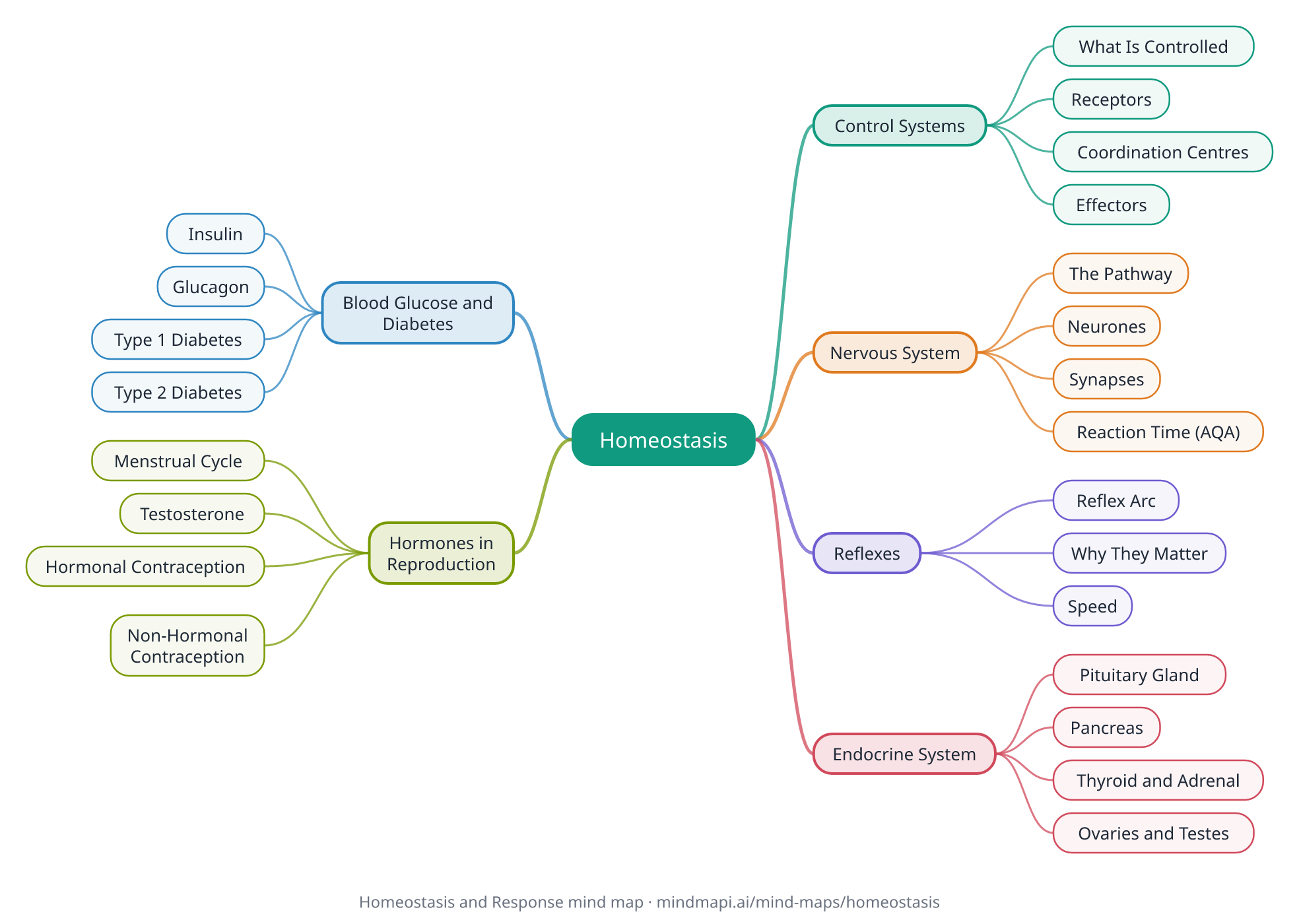
This homeostasis mind map puts the whole topic on one page (AQA topic 5, Homeostasis and response, and Edexcel topic 7): how the body keeps its internal conditions steady, the nervous system and reflex arcs, the endocrine system, blood glucose control and diabetes, and the hormones that control reproduction. Every branch is explained in the notes below the map.
Use it to check what you know before a test, or as a model when you build your own map from your class notes.
Download this mind map
Print the map with all the notes as a PDF revision sheet, or save the map as an image. Free to use for revision and in class.
Homeostasis and Response mind map explained
Control Systems
Homeostasis is the regulation of the internal conditions of a cell or organism to keep them at the best level for enzymes and cells to work.
What Is Controlled
Blood glucose concentration, body temperature and water levels.
Receptors
Cells that detect stimuli, which are changes in the environment.
Coordination Centres
The brain, spinal cord and pancreas receive and process information from receptors.
Effectors
Muscles or glands that bring about a response to restore the right level.
Nervous System
Lets the body react quickly to its surroundings and coordinate its behaviour.
The Pathway
stimulus → receptor → coordinator → effector → response
Neurones
Sensory neurones carry impulses from receptors to the central nervous system; relay neurones pass them on; motor neurones carry them to effectors.
Synapses
The gap between two neurones. A chemical is released and diffuses across the gap, starting an impulse in the next neurone.
Reaction Time (AQA)
AQA required practical: investigate how a factor, such as caffeine or practice, affects reaction time, for example with a ruler drop test.
Reflexes
Automatic and rapid responses that do not involve the conscious part of the brain.
Reflex Arc
receptor → sensory neurone → relay neurone (in the spinal cord) → motor neurone → effector
Why They Matter
They protect the body from harm, for example pulling your hand away from something hot.
Speed
Reflexes are fast because the impulse skips the conscious part of the brain.
Endocrine System
Glands secrete hormones directly into the blood, which carries them to a target organ. Effects are slower than nerves but last longer.
Pituitary Gland
The master gland in the brain. Its hormones act on other glands to make them release hormones.
Pancreas
Produces insulin, and glucagon, to control blood glucose.
Thyroid and Adrenal
The thyroid makes thyroxine, which controls metabolic rate. The adrenal glands make adrenaline, which prepares the body for fight or flight.
Ovaries and Testes
Ovaries make oestrogen; testes make testosterone.
Blood Glucose and Diabetes
The pancreas monitors and controls blood glucose concentration.
Insulin
When blood glucose is too high, the pancreas releases insulin. Glucose moves from the blood into cells, and in the liver and muscles excess glucose is stored as glycogen.
Glucagon
Higher tier. When blood glucose is too low, the pancreas releases glucagon, which converts glycogen back into glucose.
Type 1 Diabetes
The pancreas produces too little insulin, so blood glucose can rise uncontrollably. Treated with insulin injections.
Type 2 Diabetes
Body cells no longer respond to insulin. Treated with a carbohydrate-controlled diet and exercise. Obesity is a risk factor.
Hormones in Reproduction
Hormones control puberty, the menstrual cycle and many forms of contraception.
Menstrual Cycle
- FSH: makes eggs mature in the ovary
- LH: stimulates the release of an egg (ovulation)
- Oestrogen and progesterone: build up and maintain the lining of the uterus
Testosterone
The main male hormone, which stimulates sperm production.
Hormonal Contraception
The pill, implants, injections and patches use hormones to stop eggs maturing or being released.
Non-Hormonal Contraception
Condoms and diaphragms (barriers), intrauterine devices, spermicides, abstaining around ovulation, and surgery.
How to revise with this mind map
- Learn the reflex arc in order, from receptor to effector, and be able to label it on a diagram. It is one of the most common questions in this topic.
- Compare nervous and hormonal control: how the message travels, how fast it acts and how long the effect lasts.
- For blood glucose, practise the feedback loop both ways: what happens when glucose is too high, and what happens when it is too low.
- Know the two types of diabetes by cause and treatment. Type 1 means too little insulin; Type 2 means cells do not respond to it.
- Make it yours. Build your own homeostasis map in Mindmapi from your class notes, and ask the AI about any branch you are unsure of. The answer is saved into that branch's notes for next time.
Frequently asked questions
What is homeostasis?
The regulation of the internal conditions of a cell or organism, such as blood glucose, body temperature and water levels, to keep them at the best level for cells and enzymes to work.
What is a reflex arc?
The pathway of a reflex: receptor → sensory neurone → relay neurone in the spinal cord → motor neurone → effector. It is fast because it does not involve the conscious part of the brain.
How is blood glucose controlled?
By the pancreas. When blood glucose is too high it releases insulin, which moves glucose into cells and stores the excess as glycogen. When it is too low it releases glucagon, which converts glycogen back into glucose.
What is the difference between Type 1 and Type 2 diabetes?
In Type 1 the pancreas produces too little insulin, and it is treated with insulin injections. In Type 2 the body's cells no longer respond to insulin, and it is treated with a carbohydrate-controlled diet and exercise.
What is the difference between nervous and hormonal control?
Nerves send electrical impulses that act very quickly for a short time. Hormones travel in the blood, act more slowly and last longer.
How do I make my own homeostasis mind map?
Put homeostasis in the centre and add branches for control systems, the nervous system, reflexes, hormones, blood glucose and reproduction. To save time, paste your class notes into Mindmapi and it will build a first draft of the map for you to edit.
Turn your own notes into a mind map
Upload your class notes, a PDF or a lecture recording and Mindmapi builds the map for you. Your first map is free.
Try It Free


