Introduction to Organic Chemistry Mind Map (A Level)
A level · Chemistry · Checked against AQA and Edexcel and OCR · Updated 31 October 2026
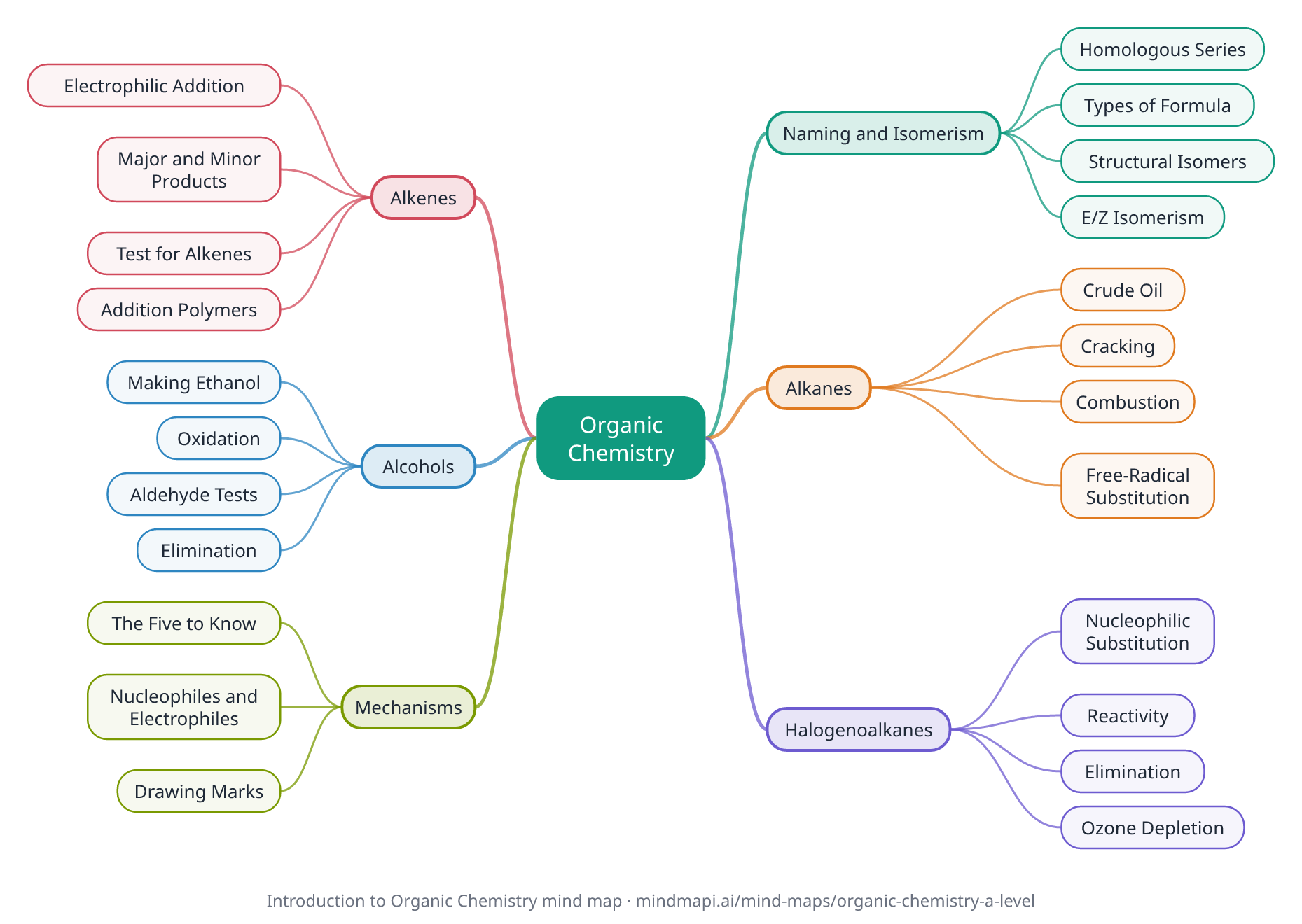
This organic chemistry mind map puts the first-year organic content on one page: naming and formulae, isomerism, alkanes, halogenoalkanes, alkenes and alcohols, with the key mechanisms and tests. Every branch is explained in the notes below the map.
It follows AQA's sections 3.3.1 to 3.3.5, and the same reactions appear in Edexcel's and OCR's first-year organic topics. Organic chemistry rewards a map more than most topics, because the reactions link one functional group to another.
Download this mind map
Print the map with all the notes as a PDF revision sheet, or save the map as an image. Free to use for revision and in class.
Introduction to Organic Chemistry mind map explained
Naming and Isomerism
The language of organic chemistry.
Homologous Series
A family of compounds with the same functional group and general formula, where each member differs by CH₂.
Types of Formula
Molecular, empirical, general, structural, displayed and skeletal formulae.
Structural Isomers
Same molecular formula, different structural formula: chain, position and functional group isomers.
E/Z Isomerism
A type of stereoisomerism caused by restricted rotation around a C=C double bond. Priorities are set by the Cahn-Ingold-Prelog rules: Z when the higher-priority groups are on the same side, E when opposite.
Alkanes
Saturated hydrocarbons with the general formula CnH2n+2.
Crude Oil
Separated into fractions by fractional distillation, based on boiling point.
Cracking
Breaks long alkanes into shorter, more useful ones and alkenes. Thermal cracking uses high temperature and pressure; catalytic cracking uses a zeolite catalyst and gives branched and aromatic hydrocarbons.
Combustion
Complete combustion gives carbon dioxide and water. Incomplete combustion also gives carbon monoxide and soot. Pollutants such as nitrogen oxides and sulfur dioxide are reduced by catalytic converters and flue gas desulfurisation.
Free-Radical Substitution
Alkane + chlorine in UV light. Initiation forms chlorine radicals; propagation steps keep the chain going; termination joins two radicals.
Halogenoalkanes
Alkanes with one or more halogen atoms. The C–X bond is polar.
Nucleophilic Substitution
Nucleophiles such as hydroxide ions, cyanide ions and ammonia attack the slightly positive carbon and replace the halogen.
Reactivity
Set by the C–X bond enthalpy: the C–I bond is the weakest, so iodoalkanes react fastest.
Elimination
With hydroxide ions in hot ethanol, the hydroxide acts as a base and an alkene forms.
Ozone Depletion
UV light breaks C–Cl bonds in CFCs, releasing chlorine radicals that catalyse the breakdown of ozone.
Alkenes
Unsaturated hydrocarbons, CnH2n, with a C=C double bond: an area of high electron density.
Electrophilic Addition
Electrophiles such as hydrogen bromide, bromine and sulfuric acid add across the double bond, through a carbocation intermediate.
Major and Minor Products
With an unsymmetrical alkene, the more stable carbocation (tertiary over secondary over primary) leads to the major product.
Test for Alkenes
Bromine water turns from orange to colourless.
Addition Polymers
Alkenes join to form polymers such as poly(ethene) and poly(chloroethene). They are unreactive, which makes disposal a problem.
Alcohols
Contain the –OH group. Classified as primary, secondary or tertiary by how many carbons are bonded to the carbon carrying the –OH.
Making Ethanol
Hydration of ethene with steam and a phosphoric acid catalyst (fast, continuous, uses a finite resource), or fermentation of glucose by yeast (renewable, slower, impure).
Oxidation
With acidified potassium dichromate, which turns from orange to green:
- Primary: aldehyde (distil it off), then carboxylic acid (heat under reflux)
- Secondary: ketone
- Tertiary: not oxidised
Aldehyde Tests
Aldehydes give a silver mirror with Tollens' reagent and a red precipitate with Fehling's solution; ketones do not.
Elimination
Heating an alcohol with a concentrated acid catalyst removes water, forming an alkene.
Mechanisms
Curly arrows show the movement of a pair of electrons, from a bond or lone pair to where it ends up.
The Five to Know
- Free-radical substitution (alkanes)
- Nucleophilic substitution (halogenoalkanes)
- Elimination (halogenoalkanes, alcohols)
- Electrophilic addition (alkenes)
- Addition polymerisation (alkenes)
Nucleophiles and Electrophiles
Nucleophiles donate an electron pair and are attracted to positive centres. Electrophiles accept an electron pair and are attracted to areas of high electron density.
Drawing Marks
Start each arrow at a lone pair or a bond, show the dipole on polar bonds, and draw the intermediate with its charge.
How to revise with this mind map
- Draw a reaction map. Put each functional group in a box and draw arrows between them, labelled with the reagent, conditions and mechanism. This is the fastest way to answer synthesis questions.
- Practise mechanisms by drawing them, not reading them. Marks depend on where every curly arrow starts and ends.
- Learn reagents and conditions precisely: acidified potassium dichromate, distil or reflux, hot ethanol or water, UV light. Vague conditions lose marks.
- Know the tests and their results: bromine water, Tollens', Fehling's and acidified dichromate.
- Make it yours. Build your own organic chemistry map in Mindmapi from your notes, and ask the AI about any reaction you are unsure of. The answer is saved into that branch's notes for next time.
Frequently asked questions
What is the mechanism for alkenes reacting with bromine?
Electrophilic addition. The C=C double bond induces a dipole in the bromine molecule, the double bond attacks it, and a carbocation intermediate forms, which is then attacked by the bromide ion.
How are primary, secondary and tertiary alcohols oxidised?
With acidified potassium dichromate, which turns from orange to green. Primary alcohols give an aldehyde if it is distilled off, or a carboxylic acid under reflux. Secondary alcohols give a ketone. Tertiary alcohols are not oxidised.
What is the difference between nucleophilic substitution and elimination?
Both happen to halogenoalkanes with hydroxide ions. In warm aqueous conditions the hydroxide acts as a nucleophile and an alcohol forms. In hot ethanolic conditions it acts as a base and an alkene forms.
What is E/Z isomerism?
A type of stereoisomerism in alkenes, caused by restricted rotation around the C=C double bond. Using the Cahn-Ingold-Prelog priority rules, it is the Z isomer if the higher-priority groups are on the same side and the E isomer if they are on opposite sides.
How do you tell an aldehyde from a ketone?
Aldehydes are oxidised by Tollens' reagent, forming a silver mirror, and by Fehling's solution, forming a red precipitate. Ketones give no change.
How do I make my own organic chemistry mind map?
Put organic chemistry in the centre and add branches for naming, alkanes, halogenoalkanes, alkenes, alcohols and mechanisms, then link the functional groups with reactions. To save time, paste your notes into Mindmapi and it will build a first draft of the map for you to edit.
Turn your own notes into a mind map
Upload your class notes, a PDF or a lecture recording and Mindmapi builds the map for you. Your first map is free.
Try It Free


