Biological Molecules Mind Map (A Level Biology)
A level · Biology · Checked against AQA and Edexcel and OCR · Updated 31 October 2026
This biological molecules mind map puts the whole topic on one page: carbohydrates, lipids, proteins, enzymes, DNA and RNA, ATP, water and inorganic ions, with the biochemical tests for each. Every branch is explained in the notes below the map.
It follows AQA's topic 1, Biological molecules, and the same molecules are central to Edexcel and OCR. Almost everything later in the course, from respiration to genetics, builds on these structures, so it is worth learning them well.
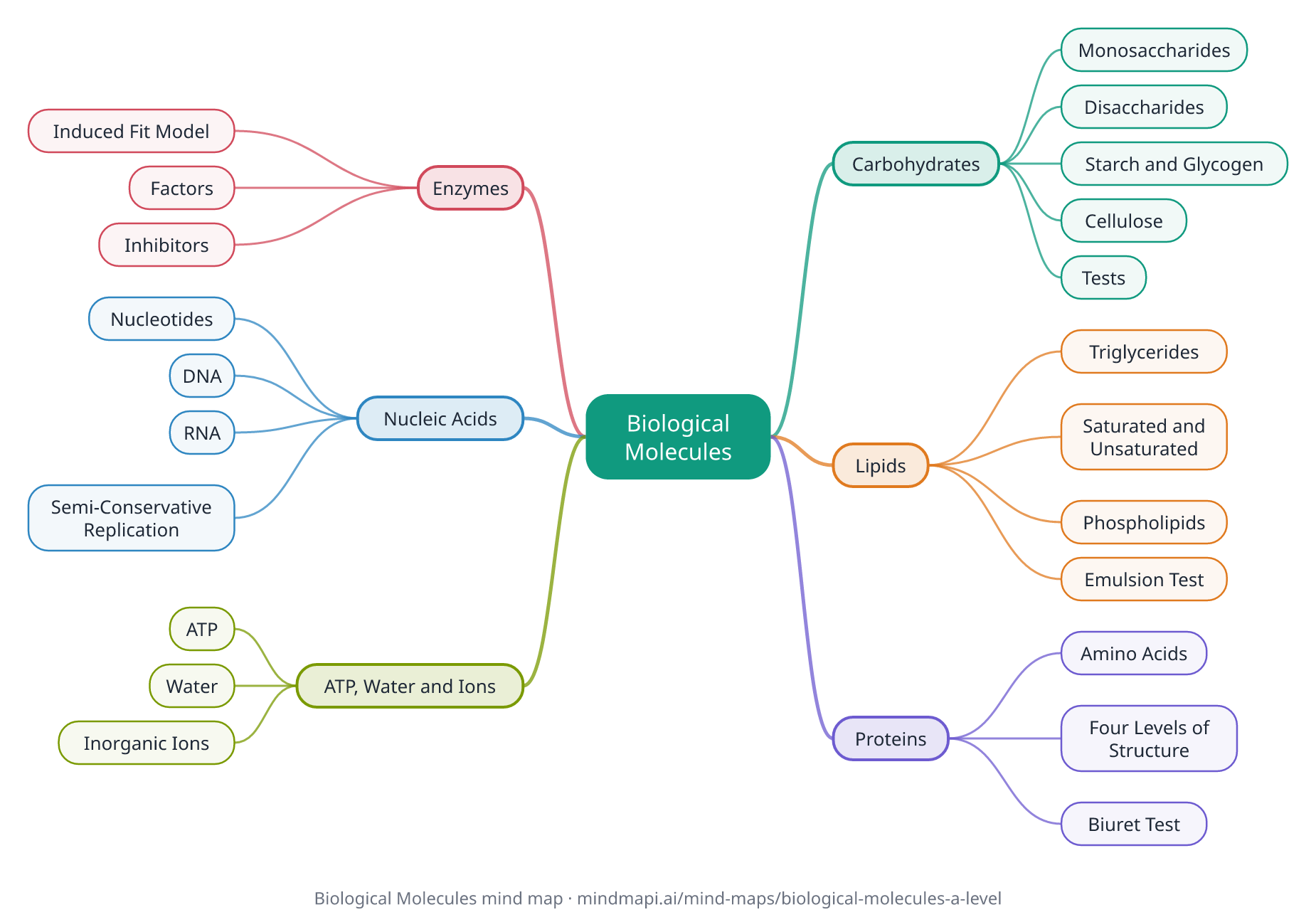
Download this mind map
Print the map with all the notes as a PDF revision sheet, or save the map as an image. Free to use for revision and in class.
Biological Molecules mind map explained
Carbohydrates
Made of carbon, hydrogen and oxygen. Monosaccharides join by condensation reactions to form glycosidic bonds; hydrolysis breaks them.
Monosaccharides
Single sugars: glucose (alpha and beta forms), galactose and fructose.
Disaccharides
- Maltose: glucose + glucose
- Sucrose: glucose + fructose
- Lactose: glucose + galactose
Starch and Glycogen
Energy stores made of alpha-glucose. Starch (plants) is amylose, a coiled unbranched chain, plus amylopectin, which is branched. Glycogen (animals) is more highly branched, so it is broken down quickly. Both are compact and insoluble.
Cellulose
Made of beta-glucose in straight, unbranched chains. Hydrogen bonds link parallel chains into microfibrils, giving plant cell walls their strength.
Tests
- Reducing sugars: heat with Benedict's reagent; blue turns green, yellow, orange or brick red
- Non-reducing sugars: boil with acid, neutralise, then test with Benedict's
- Starch: iodine turns blue-black
Lipids
Include triglycerides and phospholipids. Insoluble in water.
Triglycerides
One glycerol and three fatty acids joined by ester bonds in condensation reactions. A good energy store, insoluble, and a source of metabolic water.
Saturated and Unsaturated
Saturated fatty acids have no carbon-carbon double bonds; unsaturated ones have at least one, which puts a kink in the chain.
Phospholipids
One fatty acid is replaced by a phosphate group, giving a hydrophilic head and hydrophobic tails. They form the bilayer of cell membranes.
Emulsion Test
Shake the sample with ethanol, then add water: a milky white emulsion shows a lipid is present.
Proteins
Polymers of amino acids joined by peptide bonds in condensation reactions.
Amino Acids
Each has an amine group, a carboxyl group and a variable R group. There are 20 that are common to all organisms.
Four Levels of Structure
- Primary: the sequence of amino acids
- Secondary: alpha-helix and beta-pleated sheet, held by hydrogen bonds
- Tertiary: the 3D folding, held by hydrogen, ionic and disulfide bonds
- Quaternary: more than one polypeptide chain
Biuret Test
Add biuret reagent: blue turns purple if protein is present.
Enzymes
Proteins that act as biological catalysts by lowering the activation energy of reactions.
Induced Fit Model
The active site changes shape slightly as the substrate binds, putting strain on bonds and lowering the activation energy.
Factors
Temperature, pH, substrate concentration and enzyme concentration all affect the rate. High temperatures and extreme pH denature the enzyme by changing the shape of the active site.
Inhibitors
Competitive inhibitors have a similar shape to the substrate and block the active site. Non-competitive inhibitors bind elsewhere and change the active site's shape.
Nucleic Acids
DNA and RNA are polymers of nucleotides, joined by phosphodiester bonds.
Nucleotides
Each has a pentose sugar, a phosphate group and a nitrogen-containing base.
DNA
Deoxyribose sugar; bases adenine, thymine, cytosine and guanine. Two antiparallel strands in a double helix, with complementary base pairs (A with T, C with G) held by hydrogen bonds.
RNA
Ribose sugar, uracil instead of thymine, and usually a single, shorter strand.
Semi-Conservative Replication
DNA helicase unzips the strands; free nucleotides pair with each template; DNA polymerase joins them. Each new molecule keeps one original strand. Meselson and Stahl's experiment provided the evidence.
ATP, Water and Ions
Small molecules with vital roles.
ATP
Adenine, ribose and three phosphate groups. ATP hydrolase breaks it into ADP and phosphate, releasing energy in small, manageable amounts. ATP synthase makes it again during respiration and photosynthesis.
Water
A polar molecule that forms hydrogen bonds. It is a good solvent and a metabolite, has a high specific heat capacity and a high latent heat of vaporisation, and shows strong cohesion.
Inorganic Ions
Hydrogen ions set pH, iron ions are part of haemoglobin, sodium ions are needed for co-transport, and phosphate ions are part of DNA and ATP.
How to revise with this mind map
- Draw the structures. Sketch alpha and beta-glucose, a triglyceride, a phospholipid, an amino acid and a nucleotide from memory, then check them. Questions often give a diagram to interpret.
- Link structure to function every time: why glycogen's branches help animals, why cellulose's straight chains make strong cell walls, why phospholipids form a bilayer.
- Know condensation and hydrolysis for every polymer, and the bond each one forms: glycosidic, ester, peptide or phosphodiester.
- Learn the tests as methods, with the positive result for each: Benedict's, the non-reducing sugar test, iodine, the emulsion test and biuret.
- Make it yours. Build your own biological molecules map in Mindmapi from your notes, and ask the AI about any branch you are unsure of. The answer is saved into that branch's notes for next time.
Frequently asked questions
What is the difference between starch, glycogen and cellulose?
Starch and glycogen are energy stores made of alpha-glucose; glycogen is more highly branched, so it can be broken down quickly. Cellulose is made of beta-glucose in straight chains that form microfibrils, giving plant cell walls strength.
What are the four levels of protein structure?
Primary is the sequence of amino acids. Secondary is folding into alpha-helices and beta-pleated sheets, held by hydrogen bonds. Tertiary is the overall 3D shape, held by hydrogen, ionic and disulfide bonds. Quaternary is two or more polypeptide chains together.
How does the induced fit model work?
When the substrate binds, the enzyme's active site changes shape slightly to fit it more closely. This puts strain on the substrate's bonds and lowers the activation energy.
What is the difference between DNA and RNA?
DNA has deoxyribose sugar and the base thymine, and is a double-stranded helix. RNA has ribose sugar and uracil instead of thymine, and is usually single-stranded and shorter.
How do you test for a non-reducing sugar?
First do a Benedict's test to show there is no reducing sugar. Then boil a new sample with dilute hydrochloric acid, neutralise it with sodium hydrogencarbonate and repeat the Benedict's test. A colour change shows a non-reducing sugar was present.
How do I make my own biological molecules mind map?
Put biological molecules in the centre and add branches for carbohydrates, lipids, proteins, enzymes, nucleic acids, and ATP, water and ions. To save time, paste your notes into Mindmapi and it will build a first draft of the map for you to edit.
Turn your own notes into a mind map
Upload your class notes, a PDF or a lecture recording and Mindmapi builds the map for you. Your first map is free.
Try It Free


