Bonding and Structure Mind Map (GCSE)
GCSE · Chemistry · Checked against AQA and Edexcel · Updated 31 October 2026
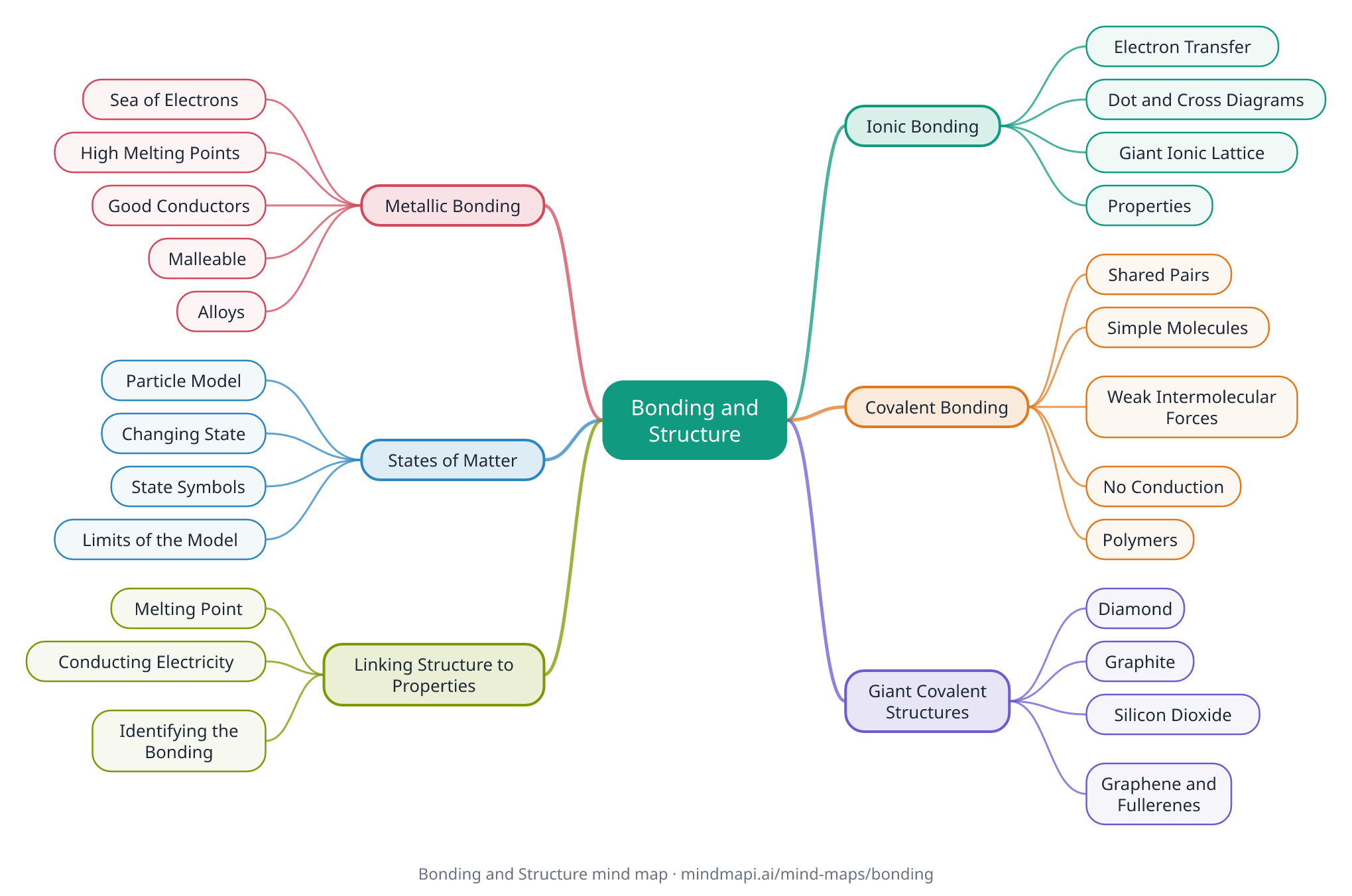
This bonding mind map puts the whole topic on one page (AQA topic 2, Bonding, structure, and the properties of matter, and the matching parts of Edexcel topic 1): ionic, covalent and metallic bonding, simple molecules and giant structures, diamond, graphite and other forms of carbon, and the states of matter. Every branch is explained in the notes below the map.
The key to this topic is linking structure to properties, so each branch explains why a substance melts, conducts or bends the way it does.
Download this mind map
Print the map with all the notes as a PDF revision sheet, or save the map as an image. Free to use for revision and in class.
Bonding and Structure mind map explained
Ionic Bonding
Happens between a metal and a non-metal.
Electron Transfer
Metal atoms lose electrons to form positive ions; non-metal atoms gain them to form negative ions. Both end up with the electronic structure of a noble gas.
Dot and Cross Diagrams
Show the electrons moving, for example sodium chloride: Na⁺ and Cl⁻. Groups 1 and 2 form 1+ and 2+ ions; groups 6 and 7 form 2− and 1− ions.
Giant Ionic Lattice
Oppositely charged ions held together by strong electrostatic forces acting in all directions.
Properties
- High melting and boiling points: lots of energy breaks the strong bonds
- Conduct electricity when melted or dissolved, because the ions can move
- Do not conduct when solid
Covalent Bonding
Happens between non-metal atoms, which share pairs of electrons.
Shared Pairs
Each covalent bond is a shared pair of electrons. Covalent bonds are strong.
Simple Molecules
Small molecules such as H₂, Cl₂, O₂, N₂, HCl, H₂O, NH₃ and CH₄. Learn to draw their dot and cross diagrams.
Weak Intermolecular Forces
Simple molecules have low melting and boiling points because only the weak forces between molecules break, not the covalent bonds. Larger molecules have stronger forces.
No Conduction
Simple molecular substances do not conduct electricity, because the molecules have no overall charge.
Polymers
Very long chains of atoms joined by covalent bonds. Their intermolecular forces are stronger, so they are usually solid at room temperature.
Giant Covalent Structures
Huge networks of atoms joined by covalent bonds, so they have very high melting points.
Diamond
Each carbon atom forms four covalent bonds. Very hard, a very high melting point and does not conduct electricity.
Graphite
Each carbon atom forms three bonds, in layers of hexagons. The layers slide, so graphite is soft and slippery. One electron per atom is delocalised, so it conducts electricity.
Silicon Dioxide
Silica, the main compound in sand. Another giant covalent structure with a high melting point.
Graphene and Fullerenes
Graphene is a single layer of graphite: strong and a good conductor. Fullerenes are hollow carbon molecules, such as buckminsterfullerene (C₆₀) and nanotubes.
Metallic Bonding
Metals form giant structures of positive ions in a sea of delocalised electrons.
Sea of Electrons
The strong attraction between the positive ions and the delocalised electrons holds the metal together.
High Melting Points
Most metals have high melting and boiling points because the metallic bonds are strong.
Good Conductors
The delocalised electrons carry electrical charge and thermal energy through the metal.
Malleable
Layers of atoms can slide over each other, so metals can be bent and shaped.
Alloys
Mixtures of metals. Different sized atoms distort the layers so they cannot slide easily, which makes alloys harder than pure metals.
States of Matter
Solid, liquid and gas, explained with the particle model.
Particle Model
Solids: particles vibrate in fixed positions. Liquids: particles move around each other. Gases: particles move quickly and randomly, far apart.
Changing State
Melting and boiling need energy to overcome the forces between particles. The stronger the forces, the higher the melting and boiling points.
State Symbols
(s) solid, (l) liquid, (g) gas, (aq) dissolved in water.
Limits of the Model
Higher tier, AQA. It treats particles as solid spheres with no forces between them, which they are not.
Linking Structure to Properties
Most marks in this topic come from explaining a property using the structure.
Melting Point
Ask which forces or bonds must break. Strong bonds in giant structures mean high melting points; weak intermolecular forces mean low ones.
Conducting Electricity
Ask whether there are charged particles free to move: ions in molten or dissolved ionic compounds, or delocalised electrons in metals and graphite.
Identifying the Bonding
- Metal and non-metal: ionic
- Non-metals only: covalent
- Metal only: metallic
How to revise with this mind map
- Start by identifying the bonding. Metal and non-metal is ionic, non-metals only is covalent, and a metal on its own is metallic.
- Practise dot and cross diagrams for ionic compounds and the common simple molecules until you can draw them from memory.
- Explain properties with structure. For every melting point or conductivity question, say which particles there are, which forces hold them, and whether anything charged can move.
- Watch the commonest slip: boiling a simple molecule breaks the weak forces between molecules, not the covalent bonds inside them.
- Make it yours. Build your own bonding map in Mindmapi from your class notes, and ask the AI about any branch you are unsure of. The answer is saved into that branch's notes for next time.
Frequently asked questions
What is the difference between ionic and covalent bonding?
Ionic bonding happens between a metal and a non-metal: electrons are transferred, forming oppositely charged ions held together by electrostatic forces. Covalent bonding happens between non-metals, which share pairs of electrons.
Why do simple molecular substances have low boiling points?
Because only the weak intermolecular forces between the molecules need to be overcome, which takes little energy. The strong covalent bonds inside the molecules do not break.
Why does graphite conduct electricity but diamond does not?
In graphite each carbon atom forms three covalent bonds, leaving one electron per atom delocalised and free to move. In diamond each carbon atom forms four bonds, so there are no free electrons.
Why do ionic compounds conduct electricity only when melted or dissolved?
Electricity needs charged particles that can move. In a solid the ions are held in fixed positions; when the compound is melted or dissolved, the ions are free to move and carry the charge.
Why are alloys harder than pure metals?
The different sized atoms in an alloy distort the regular layers, so the layers cannot slide over each other as easily.
How do I make my own bonding mind map?
Put bonding in the centre and add branches for ionic, covalent and metallic bonding, giant covalent structures and states of matter. To save time, paste your class notes into Mindmapi and it will build a first draft of the map for you to edit.
Turn your own notes into a mind map
Upload your class notes, a PDF or a lecture recording and Mindmapi builds the map for you. Your first map is free.
Try It Free


