Rates of Reaction Mind Map (GCSE)
GCSE · Chemistry · Checked against AQA and Edexcel · Updated 31 October 2026
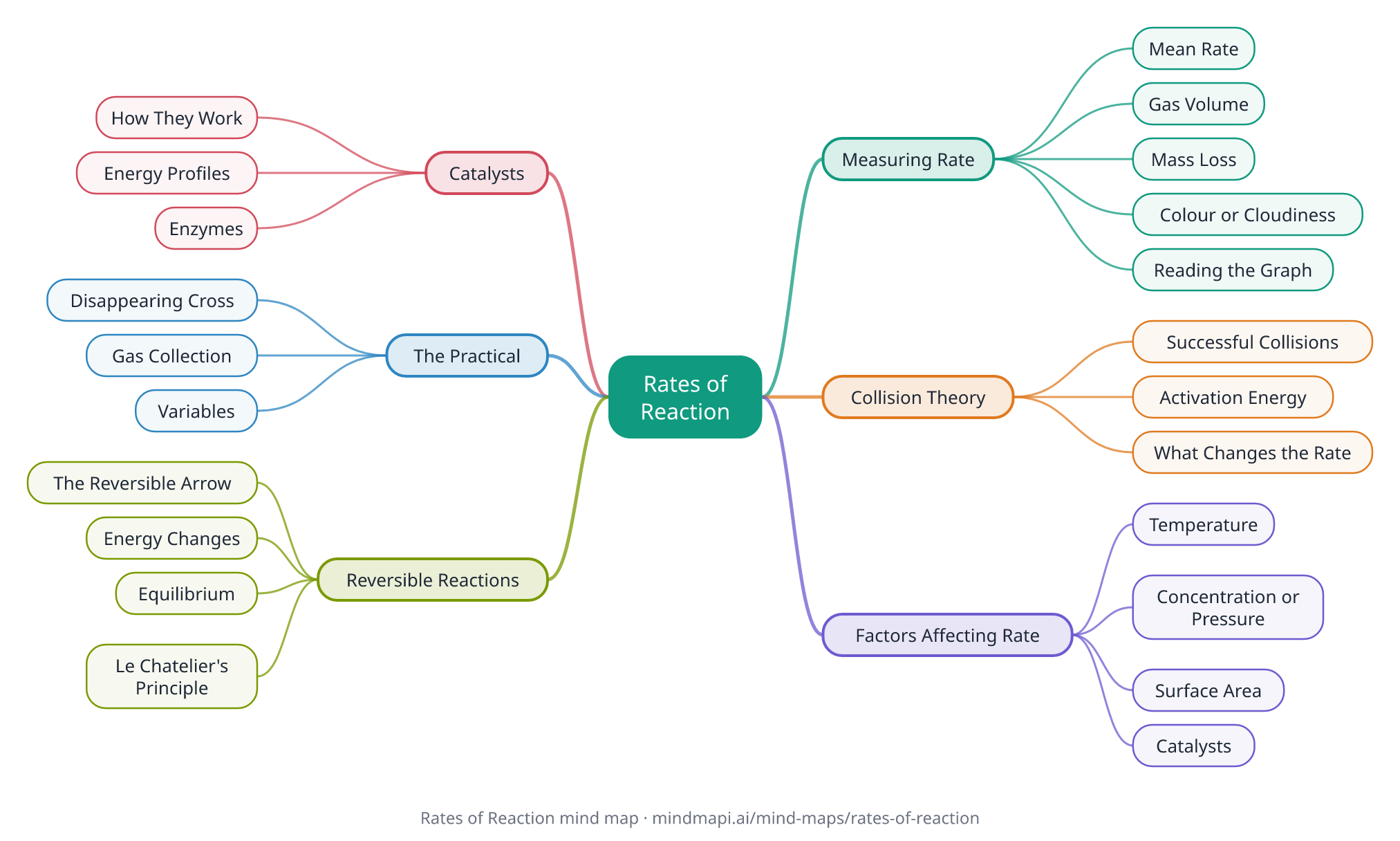
This rates of reaction mind map puts the whole topic on one page (AQA topic 6, The rate and extent of chemical change, and Edexcel topic 7): how to measure the rate, collision theory, the factors that change the rate, catalysts, the practical, and reversible reactions and equilibrium. Every branch is explained in the notes below the map.
Almost every question in this topic can be answered with collision theory, so the map explains each factor in terms of how often particles collide and with how much energy.
Download this mind map
Print the map with all the notes as a PDF revision sheet, or save the map as an image. Free to use for revision and in class.
Rates of Reaction mind map explained
Measuring Rate
The rate is how quickly reactants are used up or products are formed.
Mean Rate
mean rate = quantity of reactant used ÷ time, or quantity of product formed ÷ time. Units such as g/s or cm³/s, and mol/s at higher tier.
Gas Volume
Collect the gas in a gas syringe or upturned measuring cylinder and record the volume over time.
Mass Loss
Put the flask on a balance and record the mass as the gas escapes.
Colour or Cloudiness
Time how long a cross under the flask takes to disappear as a precipitate forms.
Reading the Graph
A steeper line means a faster reaction. The line levels off when a reactant is used up. Higher tier: find the rate at a point from the gradient of a tangent.
Collision Theory
Chemical reactions happen only when particles collide.
Successful Collisions
Particles must collide with enough energy to react.
Activation Energy
The minimum amount of energy particles need to react.
What Changes the Rate
The rate increases if collisions happen more often, or if more of them have at least the activation energy.
Factors Affecting Rate
Explain each one in terms of collisions.
Temperature
Particles move faster, so they collide more often, and more collisions have at least the activation energy. Both increase the rate.
Concentration or Pressure
More particles in the same volume, so collisions happen more often.
Surface Area
Smaller pieces have a larger surface area to volume ratio, so more particles are exposed and collisions happen more often.
Catalysts
Speed up a reaction without being used up. Covered in the next branch.
Catalysts
Substances that increase the rate of a reaction but are not used up, so they are not in the equation.
How They Work
They provide a different pathway for the reaction with a lower activation energy, so more collisions are successful.
Energy Profiles
On a reaction profile, a catalyst lowers the peak (the activation energy) but not the energy of the reactants or products.
Enzymes
Biological catalysts, used in living things and in industry.
The Practical
AQA required practical and Edexcel core practical: how concentration (or another condition) affects the rate.
Disappearing Cross
Sodium thiosulfate reacts with hydrochloric acid to form a sulfur precipitate. Time how long it takes for a cross under the flask to disappear, at different concentrations.
Gas Collection
Magnesium, or marble chips, with hydrochloric acid. Measure the volume of gas produced over time.
Variables
- Independent: concentration of the acid or thiosulfate
- Dependent: time taken, or volume of gas
- Control: temperature, volumes, and the same person judging the cross
Reversible Reactions
Mainly AQA topic 6. Reactions where the products can react to form the reactants again.
The Reversible Arrow
Written with the ⇌ symbol. For example, ammonium chloride ⇌ ammonia + hydrogen chloride.
Energy Changes
If the reaction is exothermic one way, it is endothermic the other way, transferring the same amount of energy. Example: blue hydrated copper sulfate ⇌ white anhydrous copper sulfate + water.
Equilibrium
In a closed system, the forward and reverse reactions eventually happen at exactly the same rate.
Le Chatelier's Principle
Higher tier. If conditions change, the position of equilibrium shifts to counteract the change.
How to revise with this mind map
- Use collision theory every time. For each factor, say whether collisions become more frequent, more energetic, or both. Saying the reaction is just faster gets no marks.
- For temperature, give both reasons: particles collide more often and more of the collisions have enough energy.
- Learn the practical method, the variables and how to make it a fair test. It is examined in detail on both boards.
- Practise reading rate graphs: which line is fastest, when the reaction stops, and why two lines finish at the same height when the same amount of limiting reactant is used.
- Make it yours. Build your own rates of reaction map in Mindmapi from your class notes, and ask the AI about any branch you are unsure of. The answer is saved into that branch's notes for next time.
Frequently asked questions
What is collision theory?
Chemical reactions happen only when particles collide with enough energy, called the activation energy. The rate increases if collisions happen more often or if more collisions have enough energy.
What factors affect the rate of reaction?
Temperature, the concentration of solutions or pressure of gases, the surface area of solids, and the presence of a catalyst.
Why does increasing the temperature increase the rate?
Particles move faster, so they collide more often, and a higher proportion of collisions have at least the activation energy, so more collisions are successful.
How does a catalyst work?
It provides a different pathway for the reaction with a lower activation energy, so more collisions are successful. It is not used up in the reaction.
What is the rates of reaction required practical?
Investigating how concentration affects the rate, usually by timing how long sodium thiosulfate and hydrochloric acid take to make a cross disappear, or by measuring the volume of gas a reaction gives off over time.
How do I make my own rates of reaction mind map?
Put rates of reaction in the centre and add branches for measuring rate, collision theory, the factors, catalysts, the practical and reversible reactions. To save time, paste your class notes into Mindmapi and it will build a first draft of the map for you to edit.
Turn your own notes into a mind map
Upload your class notes, a PDF or a lecture recording and Mindmapi builds the map for you. Your first map is free.
Try It Free


