Atomic Structure Mind Map (GCSE)
GCSE · Chemistry · Checked against AQA and Edexcel · Updated 28 October 2026
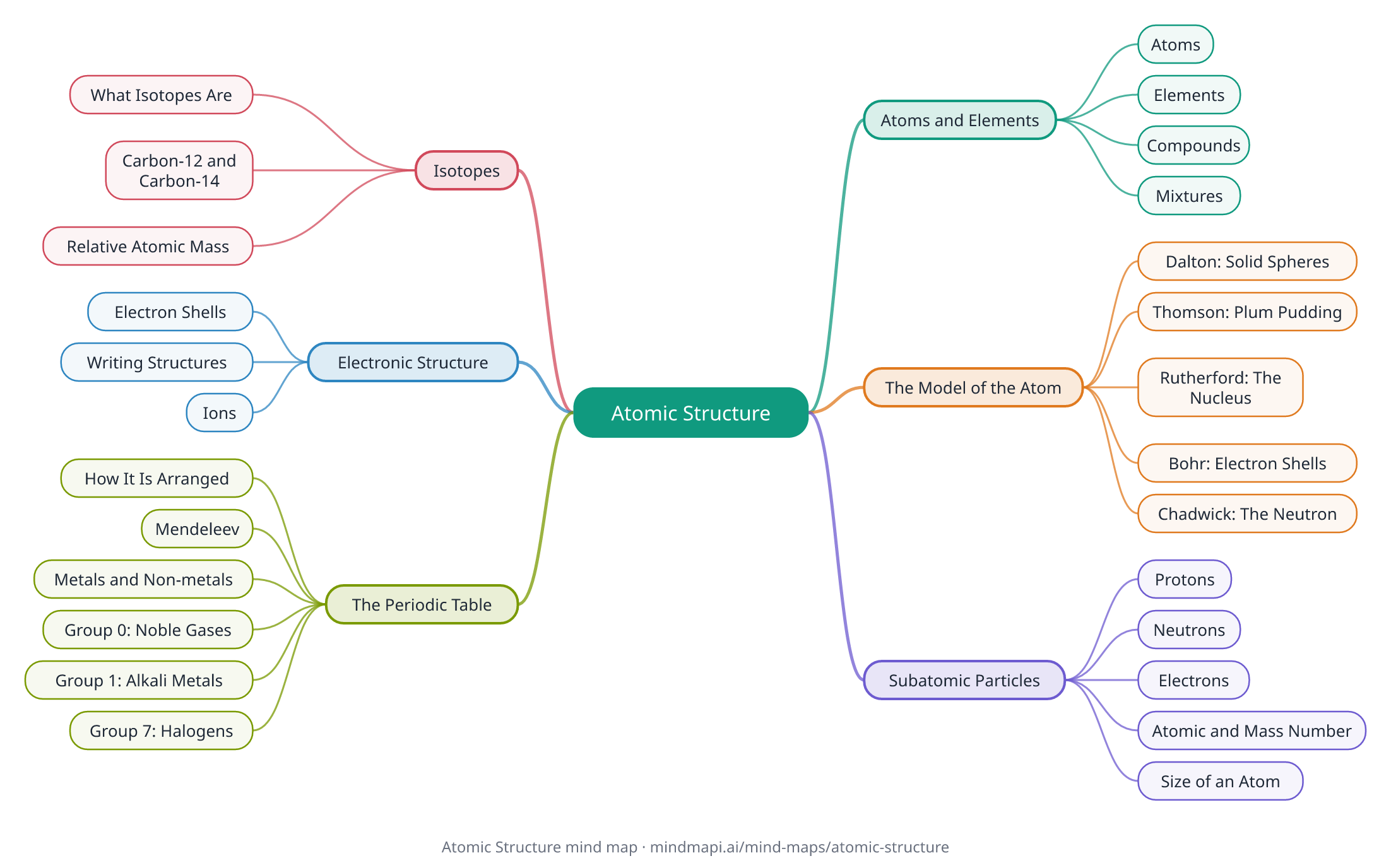
This atomic structure mind map puts GCSE atomic structure and the periodic table on one page (AQA topic 1, or C1, and Edexcel topics 1, 2 and 6): what atoms are, how the model of the atom developed, the particles inside an atom, isotopes, electron shells and the groups of the periodic table. Every branch is explained in the notes below the map.
Use it to check what you know before a test, or as a model when you build your own map from your class notes.
Download this mind map
Print the map with all the notes as a PDF revision sheet, or save the map as an image. Free to use for revision and in class.
Atomic Structure mind map explained
Atoms and Elements
The basic building blocks, and the difference between substances that are chemically combined and those that are only mixed.
Atoms
The smallest part of an element that can exist. Atoms have no overall charge, because they contain equal numbers of protons and electrons.
Elements
A substance made of only one type of atom. There are about 100 elements, shown in the periodic table, and every atom of an element has the same number of protons.
Compounds
Two or more elements chemically combined in fixed proportions. Compounds can only be separated into their elements by chemical reactions.
Mixtures
Two or more substances not chemically combined. Mixtures can be separated by physical processes:
- Filtration
- Crystallisation
- Simple distillation
- Fractional distillation
- Chromatography
The Model of the Atom
The model changed whenever a new experiment produced evidence the old model could not explain. Exam questions often ask what evidence led to each change.
Dalton: Solid Spheres
In the early 1800s, John Dalton described atoms as tiny solid spheres that could not be divided.
Thomson: Plum Pudding
In 1897, J.J. Thomson discovered the electron. His plum pudding model pictured the atom as a ball of positive charge with negative electrons embedded in it.
Rutherford: The Nucleus
In the alpha particle scattering experiment (1909), alpha particles were fired at thin gold foil. Most passed straight through, but a few were deflected. This showed that an atom's mass is concentrated in a tiny, positively charged nucleus and that most of the atom is empty space. Rutherford proposed this nuclear model in 1911.
Bohr: Electron Shells
In 1913, Niels Bohr suggested that electrons orbit the nucleus in shells at fixed distances. His calculations agreed with experimental observations.
Chadwick: The Neutron
In 1932, James Chadwick showed that the nucleus also contains neutrons, which have no charge.
Subatomic Particles
Learn the charge, mass and position of each particle. They often come up as a table to complete.
Protons
Relative charge +1, relative mass 1, found in the nucleus. The number of protons is the atomic number, and it defines the element.
Neutrons
Relative charge 0, relative mass 1, found in the nucleus. Neutrons add to the mass but not the charge, and their number varies between isotopes.
Electrons
Relative charge -1, very small mass (Edexcel gives it as 1/1836), found in shells around the nucleus. Electrons decide how an atom reacts.
Atomic and Mass Number
- Atomic number: the number of protons
- Mass number: the number of protons plus neutrons
So the number of neutrons = mass number - atomic number.
Size of an Atom
Atoms have a radius of about 0.1 nanometres (1 x 10^-10 m). The radius of the nucleus is less than 1/10,000 of the radius of the atom.
Isotopes
Isotopes explain why relative atomic masses in the periodic table are not always whole numbers.
What Isotopes Are
Atoms of the same element with the same number of protons but a different number of neutrons, so a different mass number.
Carbon-12 and Carbon-14
Both have 6 protons. Carbon-12 has 6 neutrons and carbon-14 has 8.
Relative Atomic Mass
The average mass of an element's atoms, taking account of how common each isotope is:
relative atomic mass = (mass of isotope 1 x % abundance + mass of isotope 2 x % abundance) / 100
For example, chlorine is 75% chlorine-35 and 25% chlorine-37: (35 x 75 + 37 x 25) / 100 = 35.5.
Electronic Structure
Electrons are arranged in shells, and the outer shell controls how an element reacts.
Electron Shells
Electrons occupy shells, also called energy levels, filling the shell closest to the nucleus first. For the first 20 elements, the first shell holds up to 2 electrons, the second up to 8, and the third up to 8.
Writing Structures
Write the number of electrons in each shell, separated by commas:
- Sodium (11 electrons): 2,8,1
- Chlorine (17 electrons): 2,8,7
Ions
Atoms gain or lose electrons to get a full outer shell. Metals lose electrons to form positive ions; non-metals gain electrons to form negative ions.
The Periodic Table
The table's layout follows from electronic structure, which is why elements in the same group behave alike.
How It Is Arranged
Elements are in order of atomic number. Elements in the same group have the same number of outer electrons, so they have similar chemical properties. The period number is the number of electron shells.
Mendeleev
In 1869, Dmitri Mendeleev ordered the elements mainly by atomic weight, but swapped some to fit their properties and left gaps for elements not yet discovered, correctly predicting their properties.
Metals and Non-metals
Most elements are metals, found on the left and in the middle of the table. Metals form positive ions; non-metals are on the right.
Group 0: Noble Gases
Full outer shells, so they are unreactive. Boiling points increase down the group.
Group 1: Alkali Metals
One outer electron. They react with water to form a metal hydroxide and hydrogen. Reactivity increases down the group, because the outer electron is further from the nucleus and is lost more easily.
Group 7: Halogens
Seven outer electrons, and they exist as molecules made of pairs of atoms. Reactivity decreases down the group, because it is harder to gain an electron further from the nucleus, while melting and boiling points increase. A more reactive halogen displaces a less reactive one from a solution of its salt.
How to revise with this mind map
- Learn the particle table. Be able to fill in the relative charge, relative mass and position of protons, neutrons and electrons from memory.
- Tell the story of the atom with evidence. For each model, from Dalton to Chadwick, know what the scientist proposed and what evidence made the old model change. The alpha particle scattering experiment comes up often.
- Practise the calculations. Work out numbers of protons, neutrons and electrons from atomic and mass numbers, write electronic structures for the first 20 elements, and calculate relative atomic mass from isotope abundances.
- Explain the group trends. Don't just state that Group 1 gets more reactive down the group: explain it using how far the outer electron is from the nucleus. Higher marks need the reason.
- Make it yours. Build your own atomic structure map in Mindmapi from your class notes, and ask the AI about any branch you are unsure of. The answer is saved into that branch's notes for next time.
Frequently asked questions
What is the difference between atomic number and mass number?
The atomic number is the number of protons in an atom. The mass number is the number of protons plus neutrons. Subtract the atomic number from the mass number to find the number of neutrons.
What are isotopes?
Isotopes are atoms of the same element with the same number of protons but a different number of neutrons, so they have different mass numbers. Carbon-12 and carbon-14 are isotopes of carbon.
How did the model of the atom change?
Dalton's solid spheres were replaced by Thomson's plum pudding model after the electron was discovered. Rutherford's alpha particle scattering experiment then showed a tiny positive nucleus, Bohr placed electrons in shells, and Chadwick discovered the neutron.
How do you work out electronic structure?
Fill the shells from the nucleus outwards: up to 2 electrons in the first shell, then up to 8 in the second and 8 in the third, for the first 20 elements. Sodium, with 11 electrons, is 2,8,1.
How do you calculate relative atomic mass?
Multiply each isotope's mass by its percentage abundance, add the results, and divide by 100. For chlorine: (35 x 75 + 37 x 25) / 100 = 35.5.
How do I make my own atomic structure mind map?
Put atomic structure in the centre and add branches for atoms and elements, the model of the atom, subatomic particles, isotopes, electronic structure and the periodic table. To save time, paste your class notes into Mindmapi and it will build a first draft of the map for you to edit.
Turn your own notes into a mind map
Upload your class notes, a PDF or a lecture recording and Mindmapi builds the map for you. Your first map is free.
Try It Free


