Chemical Changes Mind Map (GCSE)
GCSE · Chemistry · Checked against AQA and Edexcel · Updated 31 October 2026
This chemical changes mind map puts the whole topic on one page (AQA topic 4, and Edexcel topics 3 and 4): the reactivity of metals, how metals are extracted, the reactions of acids and how to make salts, pH and neutralisation, and electrolysis. Every branch is explained in the notes below the map.
The topic has two practicals that are examined on both boards, making a salt and electrolysis, so the map spells out their methods too.
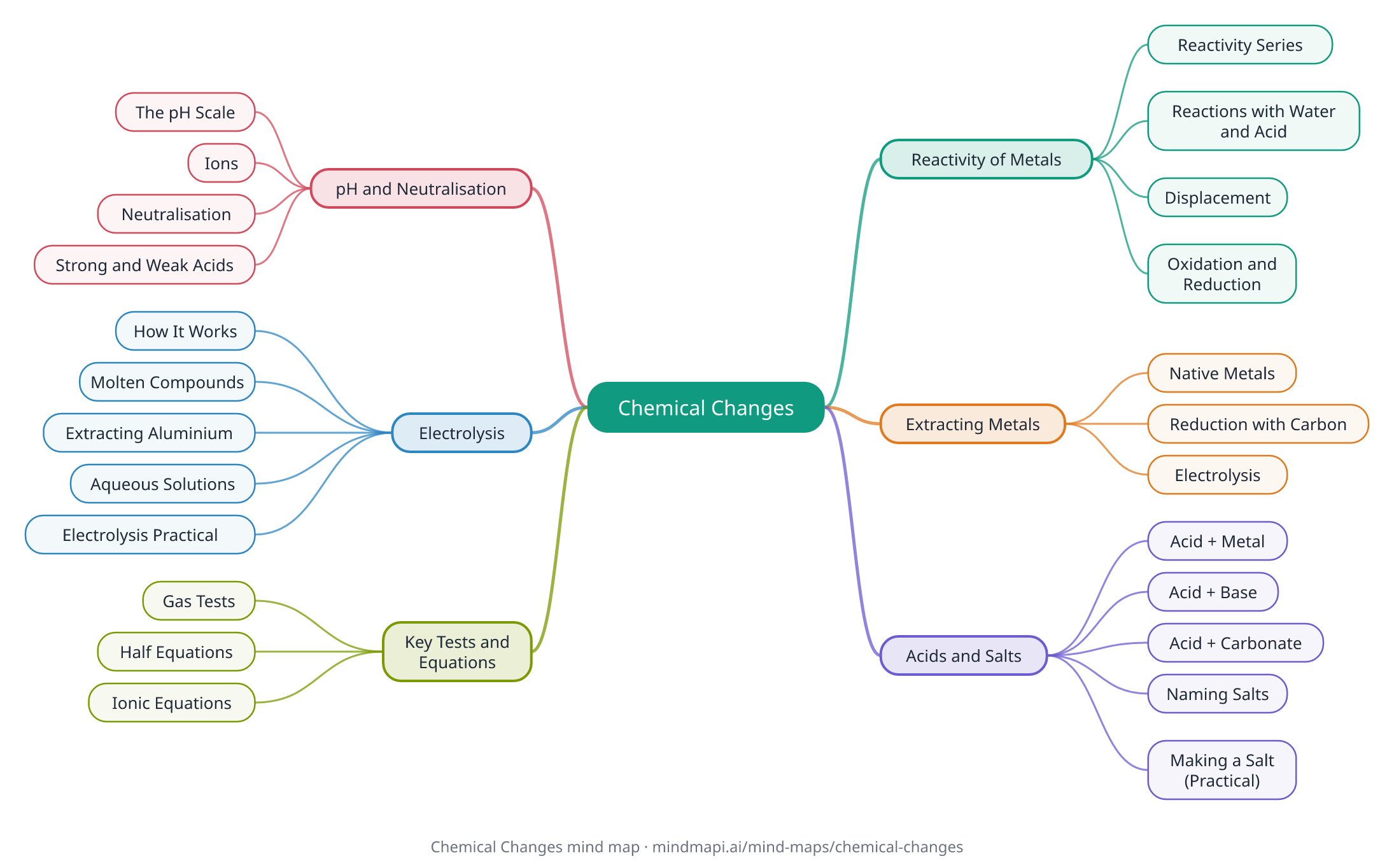
Download this mind map
Print the map with all the notes as a PDF revision sheet, or save the map as an image. Free to use for revision and in class.
Chemical Changes mind map explained
Reactivity of Metals
Metals react with other substances by losing electrons to form positive ions. The more easily they do, the more reactive they are.
Reactivity Series
From most to least reactive: potassium, sodium, lithium, calcium, magnesium, (carbon), zinc, iron, (hydrogen), copper. Carbon and hydrogen are included for comparison.
Reactions with Water and Acid
The more reactive the metal, the more vigorously it reacts with water and acids. Metals above hydrogen react with acids to release hydrogen gas.
Displacement
A more reactive metal displaces a less reactive metal from its compound. For example, iron displaces copper from copper sulfate solution.
Oxidation and Reduction
Metals reacting with oxygen form metal oxides: this is oxidation. Removing oxygen is reduction. Higher tier: oxidation is loss of electrons, reduction is gain (OIL RIG).
Extracting Metals
How a metal is extracted depends on where it sits in the reactivity series.
Native Metals
Unreactive metals such as gold are found in the Earth as the metal itself.
Reduction with Carbon
Metals less reactive than carbon are extracted by heating their oxides with carbon. For example, iron oxide + carbon → iron + carbon dioxide.
Electrolysis
Metals more reactive than carbon, such as aluminium, are extracted by electrolysis, which uses large amounts of energy and is expensive.
Acids and Salts
Acids react with metals and bases to make salts.
Acid + Metal
acid + metal → salt + hydrogen. Test for hydrogen: a lighted splint gives a squeaky pop.
Acid + Base
acid + metal oxide or metal hydroxide → salt + water. Bases neutralise acids; soluble bases are called alkalis.
Acid + Carbonate
acid + metal carbonate → salt + water + carbon dioxide. Test for carbon dioxide: it turns limewater milky.
Naming Salts
- Hydrochloric acid makes chlorides
- Sulfuric acid makes sulfates
- Nitric acid makes nitrates
Making a Salt (Practical)
Required practical (AQA) and core practical (Edexcel). Warm dilute sulfuric acid, add copper oxide until no more dissolves (it is in excess), filter out the excess, then gently evaporate and leave the solution to crystallise into copper sulfate crystals.
pH and Neutralisation
The pH scale measures how acidic or alkaline a solution is.
The pH Scale
From 0 to 14. Below 7 is acidic, 7 is neutral and above 7 is alkaline. Measure it with universal indicator or a pH probe.
Ions
Acids produce hydrogen ions (H⁺) in water; alkalis produce hydroxide ions (OH⁻).
Neutralisation
Hydrogen ions and hydroxide ions react to form water: H⁺ + OH⁻ → H₂O.
Strong and Weak Acids
Higher tier. Strong acids, such as hydrochloric, nitric and sulfuric, are completely ionised in water. Weak acids, such as ethanoic, citric and carbonic, are only partially ionised. Strong is not the same as concentrated.
Electrolysis
Using electricity to break down an ionic compound that is melted or dissolved, so its ions can move.
How It Works
Positive ions move to the negative electrode (cathode); negative ions move to the positive electrode (anode). The ions are discharged there as elements.
Molten Compounds
The metal forms at the cathode and the non-metal at the anode. Molten lead bromide gives lead and bromine.
Extracting Aluminium
Aluminium oxide is dissolved in cryolite to lower its melting point and save energy. Aluminium forms at the cathode; oxygen at the anode reacts with the carbon anodes, so they must be replaced.
Aqueous Solutions
- At the cathode: hydrogen forms if the metal is more reactive than hydrogen; otherwise the metal forms
- At the anode: oxygen forms, unless the solution contains halide ions, when the halogen forms
Brine gives hydrogen, chlorine and sodium hydroxide solution.
Electrolysis Practical
Required practical (AQA) and core practical (Edexcel): electrolyse aqueous solutions with inert electrodes and identify the products, for example copper sulfate solution, where copper forms at the cathode.
Key Tests and Equations
Quick checks that come up across the topic.
Gas Tests
- Hydrogen: squeaky pop with a lighted splint
- Oxygen: relights a glowing splint
- Carbon dioxide: turns limewater milky
- Chlorine: bleaches damp litmus paper
Half Equations
Higher tier. Show what happens at each electrode, for example Cu²⁺ + 2e⁻ → Cu at the cathode.
Ionic Equations
Higher tier. Show only the ions that react, for example in displacement and neutralisation.
How to revise with this mind map
- Learn the reactivity series with a mnemonic, including where carbon and hydrogen sit. It explains displacement, extraction and which metals react with acids.
- Write the general acid equations from memory: with a metal, a base and a carbonate. Then practise naming the salt each acid makes.
- Know both practicals step by step: making copper sulfate crystals, and electrolysing aqueous solutions. Be ready to explain why the base is added in excess and why the excess is filtered off.
- For electrolysis, practise predicting the products at each electrode, for molten compounds and for solutions. This is where most marks are lost.
- Make it yours. Build your own chemical changes map in Mindmapi from your class notes, and ask the AI about any branch you are unsure of. The answer is saved into that branch's notes for next time.
Frequently asked questions
What is the reactivity series?
A list of metals in order of reactivity: potassium, sodium, lithium, calcium, magnesium, carbon, zinc, iron, hydrogen, copper. Carbon and hydrogen are included for comparison. A more reactive metal displaces a less reactive one from its compounds.
What do acids produce when they react?
With a metal: a salt and hydrogen. With a metal oxide or hydroxide: a salt and water. With a metal carbonate: a salt, water and carbon dioxide.
How do you make copper sulfate crystals?
Warm dilute sulfuric acid and add copper oxide until no more dissolves, so it is in excess. Filter out the excess copper oxide, then gently evaporate the solution and leave it to crystallise.
Why is aluminium oxide dissolved in cryolite for electrolysis?
To lower its melting point, which saves energy and money. Aluminium forms at the cathode and oxygen at the anode, where it reacts with the carbon anodes, so these have to be replaced regularly.
What is the difference between a strong and a weak acid?
A strong acid is completely ionised in water; a weak acid is only partially ionised. This is different from concentration, which is how much acid is dissolved in a given volume.
How do I make my own chemical changes mind map?
Put chemical changes in the centre and add branches for reactivity, extracting metals, acids and salts, pH and electrolysis. To save time, paste your class notes into Mindmapi and it will build a first draft of the map for you to edit.
Turn your own notes into a mind map
Upload your class notes, a PDF or a lecture recording and Mindmapi builds the map for you. Your first map is free.
Try It Free


