Weimar and Nazi Germany Mind Map (GCSE)
GCSE · History · Checked against AQA and Edexcel · Updated 31 October 2026
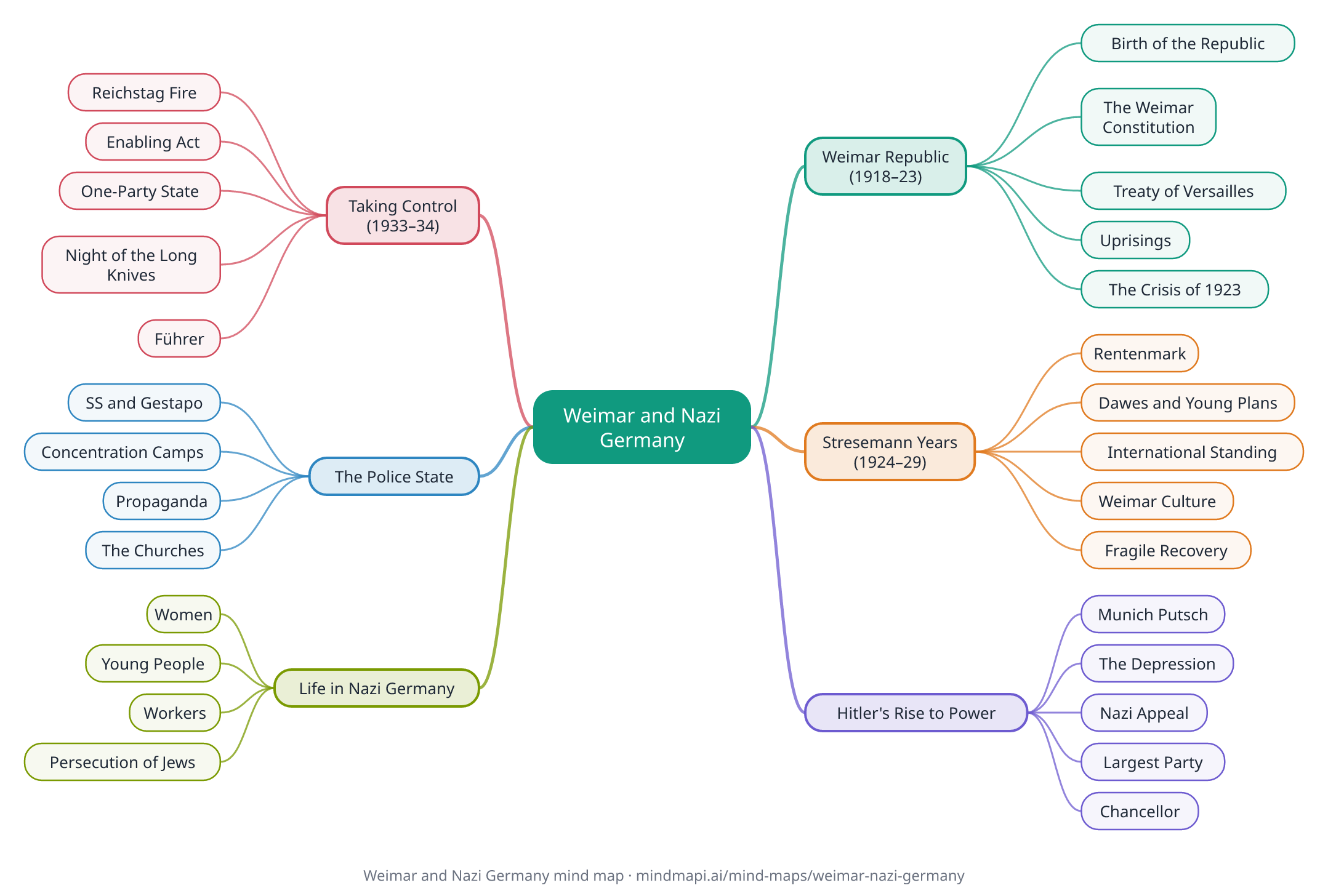
This Weimar and Nazi Germany mind map puts the whole period from 1918 to 1939 on one page: the troubled birth of the Weimar Republic, the crisis of 1923, recovery under Stresemann, Hitler's rise to power, how the Nazis took and kept control, and life for Germans under the Nazis. Every branch is explained in the notes below the map.
It covers both main GCSE courses. Edexcel's Weimar and Nazi Germany runs from 1918 to 1939. AQA's Germany, 1890 to 1945 covers the same core, but also starts with Kaiser Wilhelm II's Germany and ends with the Second World War, so AQA students need those two periods as well.
Download this mind map
Print the map with all the notes as a PDF revision sheet, or save the map as an image. Free to use for revision and in class.
Weimar and Nazi Germany mind map explained
Weimar Republic (1918–23)
Germany became a democracy at the end of the First World War, but the new republic faced crisis after crisis. AQA also covers the Kaiser's Germany from 1890.
Birth of the Republic
Kaiser Wilhelm II abdicated in November 1918, and the new government signed the armistice on 11 November. Many Germans blamed these "November Criminals" for defeat, and some believed the army had been "stabbed in the back".
The Weimar Constitution
A democratic system with proportional representation, which led to many small parties and weak coalition governments. Article 48 let the President rule by decree in an emergency.
Treaty of Versailles
Signed in June 1919. Germany accepted blame for the war (Article 231, the war guilt clause), lost land and all its colonies, had its army cut to 100,000 men with no air force, and had to pay reparations, set in 1921 at £6.6 billion.
Uprisings
The communist Spartacist Revolt (January 1919) and the right-wing Kapp Putsch (March 1920) both tried to overthrow the government.
The Crisis of 1923
When Germany fell behind with reparations, France and Belgium occupied the Ruhr industrial area in January 1923. The government printed money to pay striking workers, causing hyperinflation: by November 1923 a loaf of bread cost about 200 billion marks.
Stresemann Years (1924–29)
Gustav Stresemann, as Chancellor in 1923 and then Foreign Minister until his death in October 1929, led a recovery often called the Golden Age.
Rentenmark
A new currency introduced in November 1923, later replaced by the Reichsmark, which ended hyperinflation.
Dawes and Young Plans
The Dawes Plan (1924) gave Germany American loans and spread out reparation payments. The Young Plan (1929) cut the total reparations bill.
International Standing
The Locarno Pact (1925), joining the League of Nations (1926) and the Kellogg–Briand Pact (1928) brought Germany back into the international community.
Weimar Culture
Art, architecture such as the Bauhaus, cinema and cabaret flourished, though conservatives saw it as immoral.
Fragile Recovery
The economy depended on American loans, which would be called in after the Wall Street Crash.
Hitler's Rise to Power
From a failed putsch in 1923 to Chancellor in 1933.
Munich Putsch
In November 1923, Hitler tried to seize power in Munich and failed. In prison he wrote Mein Kampf and decided to win power through elections instead.
The Depression
After the Wall Street Crash (October 1929), American loans were recalled and unemployment rose to about 6 million by 1932. Desperate voters turned to extremist parties.
Nazi Appeal
Propaganda, rallies and the SA, promises of work and bread, blaming Versailles, communists and Jews, and Hitler's speeches won support.
Largest Party
In July 1932, the Nazis won 230 seats, about 37% of the vote, making them the largest party in the Reichstag.
Chancellor
On 30 January 1933, President Hindenburg appointed Hitler Chancellor in a deal with von Papen, who believed he could control him.
Taking Control (1933–34)
Hitler turned the chancellorship into a dictatorship in eighteen months.
Reichstag Fire
The Reichstag building burned on 27 February 1933. Hitler blamed the communists and used emergency powers to arrest them.
Enabling Act
Passed in March 1933, it let Hitler make laws without the Reichstag.
One-Party State
Trade unions were banned in May 1933 and all other political parties by July 1933.
Night of the Long Knives
On 30 June 1934, Hitler had Ernst Röhm and other SA leaders killed, removing a rival and winning the army's support.
Führer
When Hindenburg died in August 1934, Hitler combined the roles of Chancellor and President as Führer, and the army swore an oath of loyalty to him personally.
The Police State
The Nazis kept control through terror, propaganda and control of every part of life.
SS and Gestapo
The SS, led by Himmler, and the Gestapo secret police arrested opponents, often on tip-offs from informers.
Concentration Camps
The first, Dachau, opened in 1933 for political opponents and later held other groups the Nazis persecuted.
Propaganda
Goebbels controlled newspapers, radio and film. Cheap radios (the People's Receiver), the Nuremberg rallies and the 1936 Berlin Olympics spread the Nazi message.
The Churches
The Concordat with the Pope (1933) promised not to interfere with Catholics, but was broken. Protestant opponents such as Pastor Niemöller formed the Confessing Church; he was sent to a concentration camp.
Life in Nazi Germany
How Nazi policies affected different groups between 1933 and 1939. AQA also covers the war years to 1945.
Women
Expected to focus on "Kinder, Küche, Kirche" (children, kitchen, church). Marriage loans and the Mother's Cross encouraged large families.
Young People
The Hitler Youth and the League of German Maidens trained boys for the army and girls for motherhood. A 1936 law made the Hitler Youth the only youth organisation, and membership became compulsory in 1939. School subjects were rewritten with Nazi ideas.
Workers
Unemployment fell through public works, rearmament and conscription. Trade unions were replaced by the German Labour Front, with schemes such as Strength Through Joy.
Persecution of Jews
- 1933: boycott of Jewish shops
- 1935: Nuremberg Laws removed Jews' citizenship and banned marriage between Jews and non-Jews
- November 1938: Kristallnacht, when synagogues, homes and shops were attacked
How to revise with this mind map
- Know your course's dates. Edexcel covers 1918 to 1939. AQA covers 1890 to 1945, so it adds the Kaiser's Germany before the war and the Nazi war years after 1939.
- Build a timeline. Most marks come from putting events in order and explaining how one led to another, for example how the Depression helped the Nazis win votes.
- Learn specific evidence: precise dates, numbers and names. 230 seats in July 1932, or bread at about 200 billion marks in 1923, makes an answer far stronger than vague statements.
- Practise the question types: explaining consequences, explaining why something happened, and judging how far you agree with a statement using evidence on both sides.
- Make it yours. Build your own Germany map in Mindmapi from your class notes, and ask the AI about any branch you are unsure of. The answer is saved into that branch's notes for next time.
Frequently asked questions
Why was the Treaty of Versailles hated in Germany?
Germans saw it as a dictated peace. Germany had to accept blame for the war, lose land and all its colonies, cut its army to 100,000 men and pay £6.6 billion in reparations. Many blamed the Weimar politicians who signed it.
What caused hyperinflation in 1923?
When Germany fell behind with reparations, France and Belgium occupied the Ruhr in January 1923. The government printed money to pay workers who went on strike there, and the currency lost its value: by November a loaf of bread cost about 200 billion marks.
How did Hitler become Chancellor?
The Depression after 1929 caused mass unemployment, and the Nazis won votes with propaganda and promises of work. They became the largest party in July 1932, and on 30 January 1933 President Hindenburg appointed Hitler Chancellor in a deal with von Papen.
How did Hitler become a dictator?
He used the Reichstag Fire to arrest communists, passed the Enabling Act (March 1933) to make laws without the Reichstag, banned trade unions and other parties, removed rivals in the Night of the Long Knives (June 1934), and became Führer when Hindenburg died in August 1934.
Do AQA and Edexcel cover the same Germany content?
The core from 1918 to 1939 appears in both. Edexcel's Weimar and Nazi Germany stops in 1939. AQA's Germany, 1890 to 1945 also covers Kaiser Wilhelm II's Germany and the Nazi years during the Second World War.
How do I make my own Weimar and Nazi Germany mind map?
Put Germany in the centre and add branches for the Weimar Republic, the Stresemann years, Hitler's rise, taking control, the police state and life in Nazi Germany. To save time, paste your class notes into Mindmapi and it will build a first draft of the map for you to edit.
Turn your own notes into a mind map
Upload your class notes, a PDF or a lecture recording and Mindmapi builds the map for you. Your first map is free.
Try It Free


