Medicine Through Time Mind Map (GCSE)
GCSE · History · Checked against AQA and Edexcel · Updated 31 October 2026
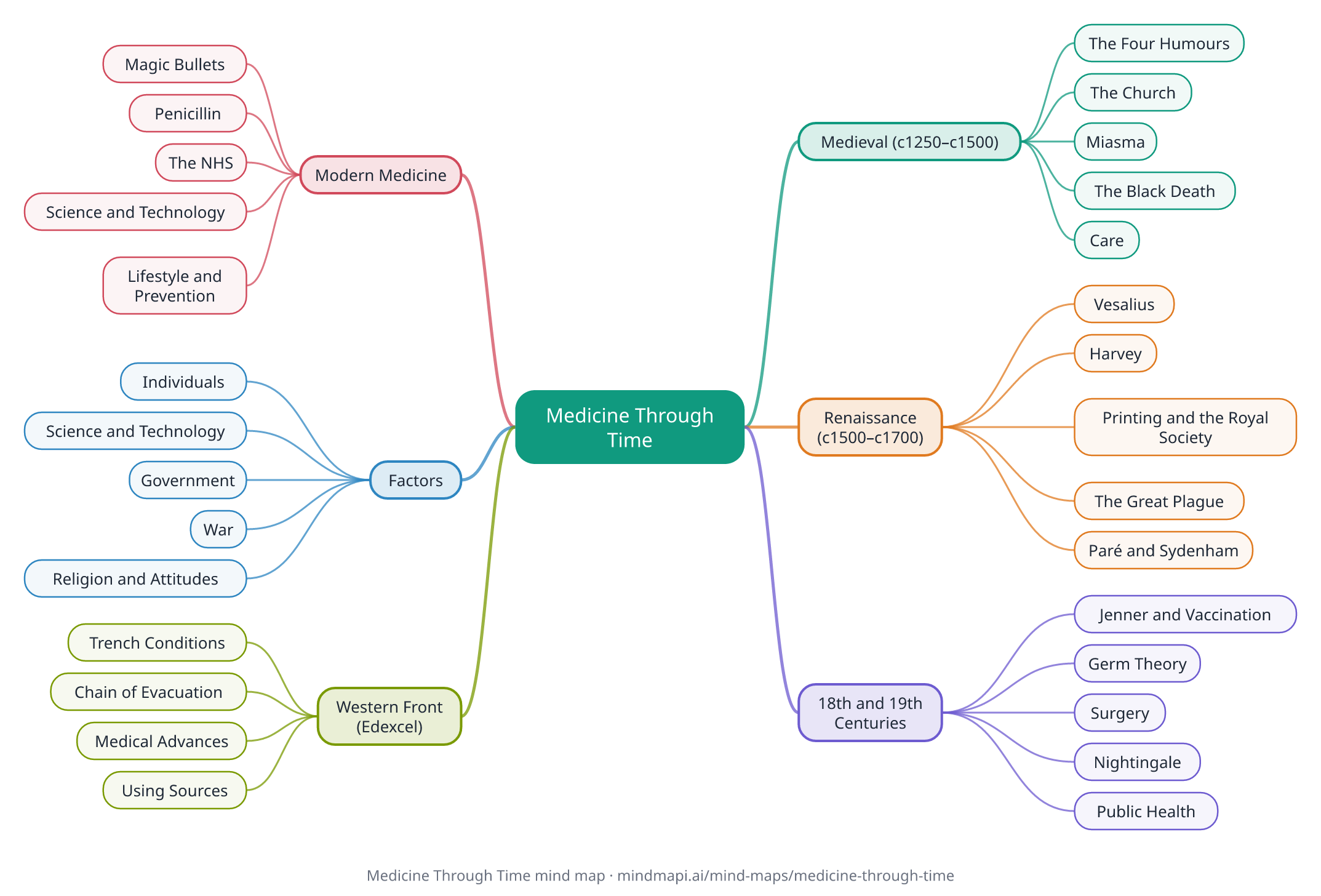
This Medicine Through Time mind map puts nearly a thousand years of medicine in Britain on one page: medieval ideas about disease, the Renaissance, the breakthroughs of the 18th and 19th centuries, modern medicine and the NHS, and the factors that drove change. Every branch is explained in the notes below the map.
It covers both main GCSE courses. AQA's Health and the people starts around 1000. Edexcel's Medicine in Britain starts around 1250 and is examined with the British sector of the Western Front, 1914 to 1918, which has its own branch here.
Download this mind map
Print the map with all the notes as a PDF revision sheet, or save the map as an image. Free to use for revision and in class.
Medicine Through Time mind map explained
Medieval (c1250–c1500)
Ideas about disease were based on ancient writers and the Church.
The Four Humours
Hippocrates' theory, developed by Galen: illness came from an imbalance of blood, phlegm, yellow bile and black bile. Treatments included bloodletting, purging and Galen's theory of opposites.
The Church
Many believed illness was a punishment from God, so people prayed and went on pilgrimages. The Church controlled medical training and promoted Galen's ideas, which discouraged new thinking.
Miasma
The belief that disease was spread by bad air from rotting matter, so people carried sweet-smelling herbs.
The Black Death
Arrived in 1348 and killed between a third and a half of England's population. People blamed God, miasma and the planets; treatments included prayer, flagellants whipping themselves, and bloodletting.
Care
Physicians, apothecaries and barber-surgeons treated the sick. Monasteries and hospitals, run by the Church, cared for people rather than cured them.
Renaissance (c1500–c1700)
New ideas challenged Galen, but most treatments stayed the same.
Vesalius
His book The Fabric of the Human Body (1543) used dissection to correct Galen's mistakes about anatomy.
Harvey
Showed in 1628 that the heart pumps blood around the body in a circulation, disproving Galen's idea that blood was constantly made and used up.
Printing and the Royal Society
The printing press spread new ideas quickly. The Royal Society, founded in 1660, encouraged scientific experiments.
The Great Plague
In 1665, the government and London authorities took more action than in 1348: searchers found the dead, infected houses were shut up for 40 days, and cats and dogs were killed. Treatments had changed little.
Paré and Sydenham
Ambroise Paré (AQA) used ligatures and a soothing ointment on wounds instead of hot oil. Thomas Sydenham (Edexcel) diagnosed by observing symptoms carefully.
18th and 19th Centuries
The biggest breakthroughs: vaccination, germ theory, safer surgery and public health.
Jenner and Vaccination
In 1796, Edward Jenner used cowpox to protect against smallpox, the first vaccination. It was made compulsory in 1853.
Germ Theory
Louis Pasteur published germ theory in 1861, showing microbes cause decay. Robert Koch identified the bacteria behind specific diseases, such as tuberculosis (1882) and cholera (1883).
Surgery
Pain: James Simpson used chloroform as an anaesthetic (1847). Infection: Joseph Lister used carbolic acid as an antiseptic (1867). Later came aseptic surgery.
Nightingale
Improved hygiene in army hospitals during the Crimean War and opened a nursing school at St Thomas' Hospital in 1860, making nursing a trained profession.
Public Health
John Snow linked cholera to a water pump on Broad Street (1854). After the Great Stink of 1858, Bazalgette built London's sewers. The 1875 Public Health Act made councils provide clean water and sewers.
Modern Medicine
From magic bullets to the NHS and DNA.
Magic Bullets
Paul Ehrlich's team found Salvarsan 606 (1909), a chemical cure for syphilis, the first magic bullet.
Penicillin
Alexander Fleming discovered penicillin in 1928. Howard Florey and Ernst Chain developed it into a medicine, and the Second World War drove mass production in the 1940s.
The NHS
After the Beveridge Report (1942), the NHS launched in 1948, led by Aneurin Bevan: healthcare free at the point of use for everyone.
Science and Technology
X-rays, blood transfusions, transplants and the discovery of the structure of DNA (Crick and Watson, 1953, using Rosalind Franklin's work) transformed diagnosis and treatment.
Lifestyle and Prevention
Research in 1950 linked smoking to lung cancer. Governments now campaign against smoking, poor diet and lack of exercise.
Factors
Exam questions ask how far each factor caused change, or blocked it.
Individuals
People such as Vesalius, Jenner, Pasteur and Fleming made key breakthroughs, but usually needed other factors to succeed.
Science and Technology
Microscopes, printing, X-rays and laboratories made new discoveries possible.
Government
From plague orders to the Public Health Act and the NHS, government action spread improvements to everyone.
War
War sped up surgery, blood transfusions and the production of penicillin.
Religion and Attitudes
The Church held back new ideas in medieval times, and public resistance slowed some changes, such as vaccination.
Western Front (Edexcel)
Edexcel's historic environment: the British sector of the Western Front, 1914 to 1918.
Trench Conditions
Wet, cold and crowded trenches caused trench foot, trench fever and shell shock. Wounds came from shrapnel, bullets and gas attacks.
Chain of Evacuation
Stretcher bearers took the wounded to a Regimental Aid Post, then a Dressing Station, a Casualty Clearing Station and base hospitals, staffed by the RAMC and nurses.
Medical Advances
Mobile X-ray units, the Thomas splint for broken legs, which cut deaths from leg fractures, and stored blood: a blood bank was used at the Battle of Cambrai in 1917.
Using Sources
Be ready to judge how useful sources such as army records, photographs and diaries are, and how to follow up a question with a further source.
How to revise with this mind map
- Know your course. AQA's Health and the people runs from about 1000; Edexcel's Medicine in Britain runs from about 1250 and adds the Western Front, which is examined with source questions.
- Learn it by period, then by theme. For each period, know the ideas about causes, the treatments, prevention and care, so you can compare any two periods.
- Learn the individuals with their dates and what changed because of them. Vague answers about Pasteur or Fleming lose marks; precise ones gain them.
- Practise factor essays. Pick a factor, such as war or government, and explain how it caused change in at least two different periods, then judge how important it was compared with others.
- Make it yours. Build your own medicine map in Mindmapi from your class notes, and ask the AI about any branch you are unsure of. The answer is saved into that branch's notes for next time.
Frequently asked questions
What was the theory of the four humours?
An idea from Hippocrates, developed by Galen, that the body contained four humours: blood, phlegm, yellow bile and black bile. Illness was thought to come from an imbalance, so treatments such as bloodletting and purging tried to restore the balance.
Why was germ theory important?
Pasteur's germ theory (1861) showed that microbes cause disease, replacing ideas such as miasma. It led to Koch identifying specific bacteria, to Lister's antiseptic surgery and to new vaccines, and gave public health reform a scientific basis.
Who discovered penicillin?
Alexander Fleming discovered it in 1928. Howard Florey and Ernst Chain turned it into a usable medicine, and mass production during the Second World War, helped by American funding, made it widely available.
What factors affected medicine through time?
The main factors are individuals, science and technology, government, war, and religion and attitudes. Most breakthroughs came when several worked together, such as war and government funding speeding up penicillin.
What do I need to know about the Western Front?
For Edexcel: conditions in the trenches and the illnesses and wounds they caused, the chain of evacuation, medical advances such as mobile X-rays, the Thomas splint and blood banks, and how to use and evaluate sources.
How do I make my own Medicine Through Time mind map?
Put medicine in the centre and add a branch for each period, plus one for factors. To save time, paste your class notes into Mindmapi and it will build a first draft of the map for you to edit.
Turn your own notes into a mind map
Upload your class notes, a PDF or a lecture recording and Mindmapi builds the map for you. Your first map is free.
Try It Free


