The Cold War Mind Map (GCSE)
GCSE · History · Checked against AQA and Edexcel · Updated 28 October 2026
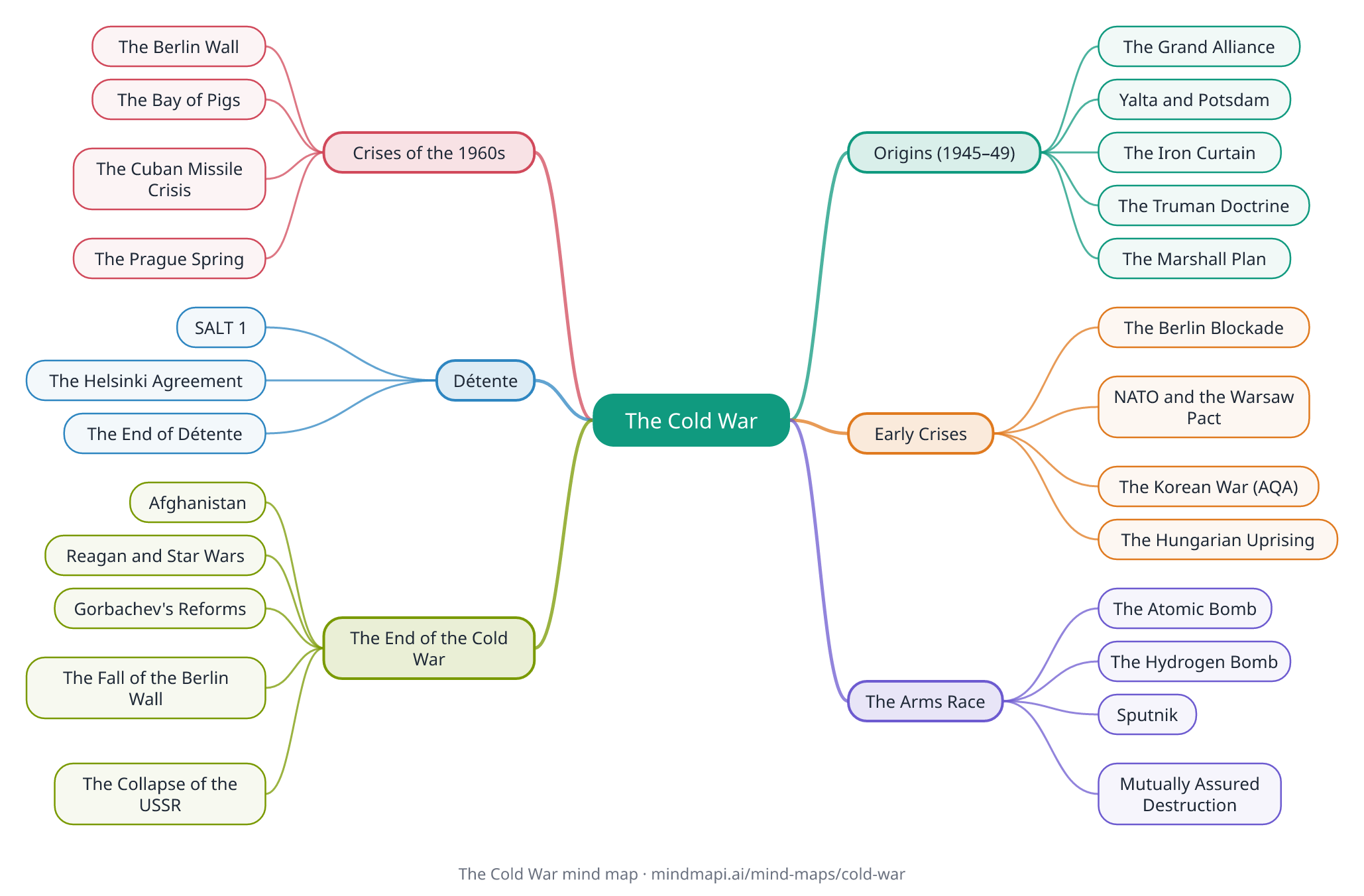
This Cold War mind map puts the whole conflict on one page, from the breakdown of the wartime alliance to the collapse of the USSR: the origins, the early crises, the arms race, the crises of the 1960s, détente and the end of the Cold War. Every branch is explained in the notes below the map.
It covers both main GCSE courses. AQA's Conflict and tension between East and West runs from 1945 to 1972 and includes the Korean War. Edexcel's Superpower relations and the Cold War runs from 1941 to 1991, so it also includes the end of the Cold War. The parts only one board covers are labelled.
Download this mind map
Print the map with all the notes as a PDF revision sheet, or save the map as an image. Free to use for revision and in class.
The Cold War mind map explained
Origins (1945–49)
Edexcel students also need the Long Telegram (Kennan, 1946) and the Novikov Telegram (1946): each side's secret report warning about the other's aims.
The Grand Alliance
The USA, Britain and the USSR fought together in the Second World War but distrusted each other. Capitalism and communism were opposing ideologies, and the leaders had different aims for post-war Europe.
Yalta and Potsdam
At Yalta (February 1945) and Potsdam (July to August 1945), the Allies agreed to divide Germany and Berlin into four zones. By Potsdam, Truman had replaced Roosevelt and was tougher on Stalin, and disputes over Poland and reparations grew. The USA's use of the atomic bomb on Japan in August 1945 deepened Soviet suspicion.
The Iron Curtain
In March 1946, Churchill warned that an "iron curtain" had descended across Europe as the USSR set up communist governments in Eastern Europe, its satellite states.
The Truman Doctrine
In March 1947, the USA promised to support countries resisting communism. This was the policy of containment.
The Marshall Plan
From 1947, billions of dollars of American aid to rebuild Europe and stop the spread of communism. The USSR saw it as dollar imperialism and responded with Cominform (1947) and Comecon (1949).
Early Crises
The first direct confrontations, in which each side tested how far the other would go.
The Berlin Blockade
From June 1948 to May 1949, Stalin cut off road, rail and canal routes into West Berlin. The West supplied the city by air in the Berlin Airlift for almost a year until Stalin gave up. Germany was then formally split into West Germany and East Germany (1949).
NATO and the Warsaw Pact
The West formed the military alliance NATO in 1949, committing its members to defend each other. The USSR and its satellite states formed the Warsaw Pact in 1955.
The Korean War (AQA)
AQA only. From 1950 to 1953, communist North Korea invaded South Korea. UN forces led by the USA pushed back, and China joined on the North's side. The war ended in a stalemate near the 38th parallel.
The Hungarian Uprising
In 1956, Imre Nagy's government tried to leave the Warsaw Pact. Soviet tanks crushed the uprising, killing thousands, and the West did not intervene.
The Arms Race
Each side raced to build more powerful weapons and the means to deliver them.
The Atomic Bomb
The USA used it in 1945. Its monopoly ended when the USSR tested its own atomic bomb in 1949.
The Hydrogen Bomb
Tested by the USA in 1952 and by the USSR in 1953, and far more powerful than the atomic bomb.
Sputnik
In 1957, the USSR launched the first satellite, showing it had rockets that could reach the USA. This started the space race.
Mutually Assured Destruction
Both sides had enough nuclear weapons to destroy each other (MAD), so all-out nuclear war became unthinkable and direct war less likely.
Crises of the 1960s
The most dangerous decade of the Cold War, when the superpowers came closest to nuclear war.
The Berlin Wall
In August 1961, East Germany built a wall to stop people fleeing to the West through Berlin. It divided families and became the symbol of a divided Europe. Kennedy visited in 1963 and declared "Ich bin ein Berliner".
The Bay of Pigs
In April 1961, a US-backed invasion of communist Cuba failed, pushing Castro closer to the USSR.
The Cuban Missile Crisis
In October 1962, the USA discovered Soviet nuclear missiles in Cuba and placed a naval blockade, or quarantine, around the island. After thirteen days the USSR removed the missiles, the USA promised not to invade Cuba, and it secretly agreed to remove its missiles from Turkey. Afterwards came a hotline between Washington and Moscow and the Limited Test Ban Treaty (both 1963).
The Prague Spring
In 1968, Alexander Dubček introduced reforms in Czechoslovakia. Warsaw Pact troops invaded in August 1968. The Brezhnev Doctrine said the USSR would intervene to stop any satellite state leaving communism.
Détente
An easing of tension between the superpowers in the late 1960s and 1970s, managed through negotiation and limited cooperation.
SALT 1
Signed in 1972, the first agreement to limit nuclear weapons.
The Helsinki Agreement
Signed in 1975, it recognised post-war borders and covered cooperation and human rights.
The End of Détente
Détente ended with the Soviet invasion of Afghanistan in December 1979.
The End of the Cold War
Edexcel only. From renewed confrontation after 1979 to the collapse of the USSR in 1991.
Afghanistan
After the Soviet invasion in 1979, the USA issued the Carter Doctrine and boycotted the 1980 Moscow Olympics, and the SALT 2 treaty was never ratified.
Reagan and Star Wars
Ronald Reagan called the USSR an "evil empire" and in 1983 announced the Strategic Defence Initiative, known as Star Wars. This period is often called the Second Cold War.
Gorbachev's Reforms
From 1985, Mikhail Gorbachev introduced glasnost (openness) and perestroika (restructuring), and loosened Soviet control over Eastern Europe. In 1987 he and Reagan signed the INF Treaty, which removed a whole class of nuclear missiles.
The Fall of the Berlin Wall
In November 1989, the Berlin Wall came down as communist governments across Eastern Europe collapsed. Germany reunified in 1990.
The Collapse of the USSR
In 1991 the Warsaw Pact was dissolved, and in December the USSR broke up into independent states, ending the Cold War.
How to revise with this mind map
- Know which parts your course covers. AQA runs from 1945 to 1972 and includes the Korean War. Edexcel runs from 1941 to 1991 and includes the end of the Cold War. Focus your time on the branches your exam actually tests.
- Build a timeline from the map. The Cold War is a chain of action and reaction. Put the events in order and, for each one, note what caused it and what it led to.
- Learn specific evidence. Strong answers use precise dates, names and details: the Berlin Airlift lasted almost a year, the Cuban Missile Crisis thirteen days. Vague answers lose marks.
- Explain, don't describe. Most questions ask why something happened, what its consequences were, or how important it was. Use the map to link each event to its causes and results.
- Make it yours. Build your own Cold War map in Mindmapi from your class notes, and ask the AI about any branch you are unsure of. The answer is saved into that branch's notes for next time.
Frequently asked questions
What caused the Cold War?
The USA and the USSR had opposing ideologies, capitalism and communism, and distrusted each other even as wartime allies. Disagreements over Germany and Eastern Europe at Yalta and Potsdam, Soviet control of Eastern Europe, the atomic bomb, the Truman Doctrine and the Marshall Plan all deepened the divide.
What happened in the Cuban Missile Crisis?
In October 1962 the USA discovered Soviet nuclear missiles in Cuba and placed a naval blockade around the island. After thirteen days the USSR agreed to remove them, in return for a US promise not to invade Cuba and a secret deal to remove US missiles from Turkey.
What was détente?
Détente was the easing of tension between the superpowers in the late 1960s and 1970s. It produced arms control agreements such as SALT 1 (1972) and the Helsinki Agreement (1975), and ended with the Soviet invasion of Afghanistan in 1979.
How did the Cold War end?
After renewed tension under Reagan, Gorbachev's reforms from 1985 loosened Soviet control. Communist governments in Eastern Europe collapsed in 1989, the Berlin Wall fell, Germany reunified in 1990 and the USSR broke up in December 1991.
Do AQA and Edexcel cover the same Cold War content?
Not quite. AQA's Conflict and tension between East and West covers 1945 to 1972 and includes the Korean War. Edexcel's Superpower relations and the Cold War covers 1941 to 1991, so it includes détente's collapse and the end of the Cold War. The core events from 1945 to the 1960s appear in both.
How do I make my own Cold War mind map?
Put the Cold War in the centre and add branches for each phase: origins, early crises, the arms race, the 1960s, détente and the end. To save time, paste your class notes into Mindmapi and it will build a first draft of the map for you to edit.
Turn your own notes into a mind map
Upload your class notes, a PDF or a lecture recording and Mindmapi builds the map for you. Your first map is free.
Try It Free


