The Tudors Mind Map (A Level History)
A level · History · Checked against AQA · Updated 31 October 2026
This Tudors mind map puts the whole dynasty on one page, from Henry VII's victory at Bosworth in 1485 to Elizabeth I's death in 1603: each monarch's government, religious changes, rebellions and foreign policy, and the themes that run through the period. Every branch is explained in the notes below the map.
It follows AQA's breadth study 1C, The Tudors: England, 1485 to 1603. Breadth essays ask about change and continuity across the whole period, so the final branch draws out the themes that connect the reigns.
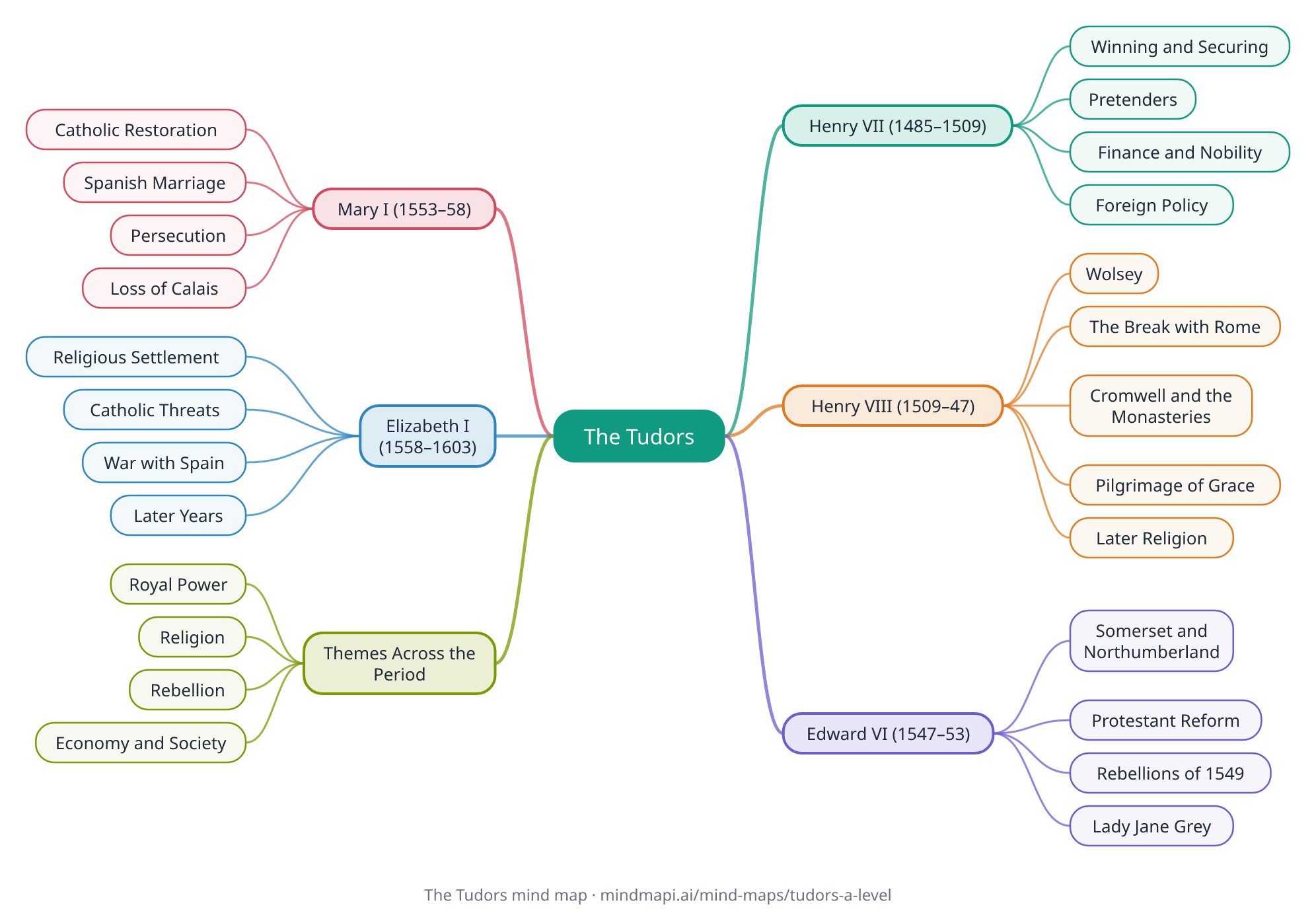
Download this mind map
Print the map with all the notes as a PDF revision sheet, or save the map as an image. Free to use for revision and in class.
The Tudors mind map explained
Henry VII (1485–1509)
Seized the throne and made the new dynasty secure.
Winning and Securing
Defeated Richard III at Bosworth in 1485 and married Elizabeth of York in 1486, uniting the houses of Lancaster and York.
Pretenders
Lambert Simnel's rising was defeated at Stoke in 1487. Perkin Warbeck threatened Henry through the 1490s and was executed in 1499.
Finance and Nobility
Henry raised income from crown lands and used bonds and recognisances, enforced by Empson and Dudley, to control the nobility. He left a healthy treasury.
Foreign Policy
The Treaty of Medina del Campo (1489) arranged Prince Arthur's marriage to Catherine of Aragon; the Treaty of Étaples (1492) secured French payments; the Magnus Intercursus (1496) restored trade with Burgundy.
Henry VIII (1509–47)
Glory abroad, the break with Rome and a revolution in the Church.
Wolsey
Cardinal Wolsey, Lord Chancellor from 1515, dominated government and foreign policy, including the Field of the Cloth of Gold (1520). The failed Amicable Grant tax (1525) and the annulment crisis led to his fall in 1529.
The Break with Rome
To annul his marriage to Catherine of Aragon, Henry broke with the Pope: the Act in Restraint of Appeals (1533) and the Act of Supremacy (1534) made him Supreme Head of the Church of England.
Cromwell and the Monasteries
Thomas Cromwell organised the Dissolution of the Monasteries (1536–40), transferring their wealth to the Crown.
Pilgrimage of Grace
The largest Tudor rebellion (1536), in the north, against religious change and the dissolution. Henry crushed it and executed its leaders.
Later Religion
The Act of Six Articles (1539) reaffirmed Catholic doctrine: Henry rejected the Pope but not Catholic beliefs.
Edward VI (1547–53)
A boy king whose government made England Protestant.
Somerset and Northumberland
England was ruled first by the Duke of Somerset as Lord Protector, then by the Duke of Northumberland.
Protestant Reform
The Book of Common Prayer (1549), revised in a more Protestant direction in 1552.
Rebellions of 1549
The Western (Prayer Book) Rebellion opposed the new services; Kett's Rebellion in Norfolk protested about enclosure and social grievances.
Lady Jane Grey
Northumberland tried to put his Protestant daughter-in-law on the throne in 1553, but support rallied to Mary.
Mary I (1553–58)
Restored Catholicism and the link with Rome.
Catholic Restoration
Reversed the Protestant reforms and restored papal authority.
Spanish Marriage
Married Philip of Spain in 1554. Fear of Spanish influence sparked Wyatt's Rebellion the same year.
Persecution
Around 280 Protestants were burned as heretics, which shaped her later reputation as "Bloody Mary".
Loss of Calais
England's last possession in France was lost in 1558, during war with France alongside Spain.
Elizabeth I (1558–1603)
Settled religion and survived plots and war, but left the succession unresolved until her death.
Religious Settlement
The 1559 Acts of Supremacy and Uniformity created a moderate Protestant Church, with Elizabeth as Supreme Governor.
Catholic Threats
The Revolt of the Northern Earls (1569), plots around Mary Queen of Scots, and her execution in 1587.
War with Spain
Open war from 1585, the defeat of the Spanish Armada in 1588, and later war in Ireland.
Later Years
Economic problems and the Poor Laws, faction at court, and the Earl of Essex's failed rebellion (1601). James VI of Scotland succeeded her in 1603.
Themes Across the Period
Breadth essays ask how far things changed between 1485 and 1603.
Royal Power
How monarchs used the Privy Council, Parliament, patronage and ministers such as Wolsey, Cromwell and Cecil to rule.
Religion
From Catholic England, through the break with Rome, Edward's Protestantism and Mary's restoration, to Elizabeth's settlement.
Rebellion
From dynastic threats under Henry VII to religious and social risings. Ask what caused them and why none overthrew a monarch.
Economy and Society
Population growth, inflation, enclosure and poverty, and the government's response, culminating in the Poor Laws.
How to revise with this mind map
- Learn the chronology first. Know the order of reigns and the key dates in each, so you can place any event in context.
- Then revise by theme across the whole period: royal power, religion, rebellion, foreign policy, and economy and society. Breadth essays reward comparisons between reigns.
- Collect precise evidence for each theme, such as named acts, rebellions and ministers with dates, so your judgements are backed by specifics.
- For the source question, practise evaluating value: provenance, tone and emphasis, and how the content fits your own knowledge of the period.
- Make it yours. Build your own Tudors map in Mindmapi from your notes, and ask the AI about any event you are unsure of. The answer is saved into that branch's notes for next time.
Frequently asked questions
Why did Henry VIII break with Rome?
Mainly to annul his marriage to Catherine of Aragon, who had not given him a surviving son, so he could marry Anne Boleyn. Other factors included the chance to take Church wealth and Henry's view of his own authority. The Act in Restraint of Appeals (1533) and Act of Supremacy (1534) completed the break.
How did Henry VII secure his throne?
By marrying Elizabeth of York to unite the rival houses, defeating the pretenders Lambert Simnel and Perkin Warbeck, controlling the nobility with bonds and recognisances, building up royal finances, and making treaties that won foreign recognition.
What were the main Tudor rebellions?
Simnel (1487) and Warbeck (1490s) under Henry VII; the Pilgrimage of Grace (1536) under Henry VIII; the Western and Kett's rebellions (1549) under Edward VI; Wyatt's Rebellion (1554) under Mary I; and the Revolt of the Northern Earls (1569) and Essex's Rebellion (1601) under Elizabeth I.
How did religion change under the Tudors?
England was Catholic under Henry VII. Henry VIII broke with Rome but kept Catholic doctrine. Edward VI made the Church Protestant, Mary I restored Catholicism, and Elizabeth I's 1559 settlement created a moderate Protestant Church of England.
What does a breadth study on the Tudors involve?
AQA's 1C covers the whole period from 1485 to 1603. Essays ask about change and continuity across several reigns, and there is a source question on interpretations of the period.
How do I make my own Tudors mind map?
Put the Tudors in the centre and add a branch for each monarch, plus one for the themes that run across the period. To save time, paste your notes into Mindmapi and it will build a first draft of the map for you to edit.
Turn your own notes into a mind map
Upload your class notes, a PDF or a lecture recording and Mindmapi builds the map for you. Your first map is free.
Try It Free


