Elizabethan England Mind Map (GCSE)
GCSE · History · Checked against AQA and Edexcel · Updated 31 October 2026
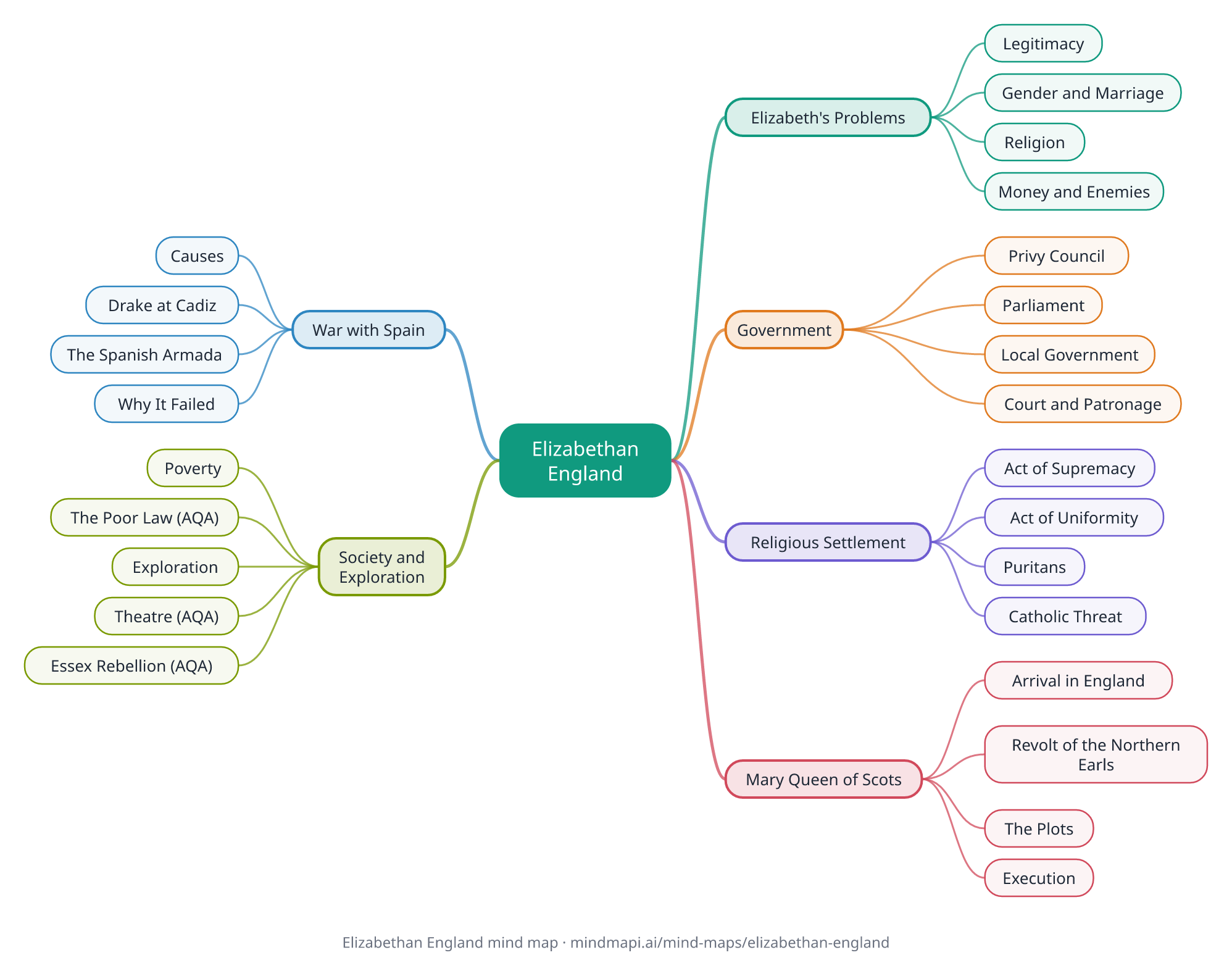
This Elizabethan England mind map puts Elizabeth I's reign on one page: the problems she faced in 1558, how she governed, the religious settlement and its challengers, Mary Queen of Scots and the plots, war with Spain and the Armada, and life in Elizabethan society. Every branch is explained in the notes below the map.
It covers both main GCSE courses. Edexcel's Early Elizabethan England runs from 1558 to 1588. AQA's Elizabethan England runs from about 1568 to 1603, so it adds the later reign: the theatre, the Poor Law and the Essex Rebellion. The parts only one board covers are labelled.
Download this mind map
Print the map with all the notes as a PDF revision sheet, or save the map as an image. Free to use for revision and in class.
Elizabethan England mind map explained
Elizabeth's Problems
Elizabeth became queen in November 1558, aged 25, and faced problems on every side.
Legitimacy
Catholics did not recognise Henry VIII's marriage to her mother, Anne Boleyn, so they saw Elizabeth as illegitimate.
Gender and Marriage
Many believed a woman could not rule alone. She was expected to marry and produce an heir, and the question of succession hung over her reign.
Religion
England had switched between Protestant and Catholic under her father, brother and sister, and the country was deeply divided.
Money and Enemies
The Crown was in debt, around £300,000, and France, Scotland and Spain were Catholic powers that threatened England.
Government
Elizabeth ruled through her Court, the Privy Council, Parliament and local officials.
Privy Council
Her closest advisers, including William Cecil (her chief minister), Robert Dudley and Sir Francis Walsingham (her spymaster).
Parliament
Called to pass laws and grant taxes. It clashed with Elizabeth over her marriage and the succession, which she saw as her business alone.
Local Government
Justices of the Peace kept order and enforced laws in each county.
Court and Patronage
Elizabeth controlled her nobles by giving and withholding favours, titles and jobs. Royal progresses, journeys around the country, showed her to her people.
Religious Settlement
Elizabeth's 1559 settlement aimed at a middle way that most people could accept.
Act of Supremacy
Made Elizabeth Supreme Governor of the Church of England, a title designed to be less offensive to Catholics than Supreme Head.
Act of Uniformity
Set out how services should be held, using the Book of Common Prayer. People who did not attend church, called recusants, were fined 12 pence (one shilling).
Puritans
Strict Protestants who wanted to remove remaining Catholic features, such as vestments, from the Church.
Catholic Threat
The Pope excommunicated Elizabeth in 1570. Missionary priests, including Jesuits such as Edmund Campion (executed 1581), came to keep Catholicism alive in England.
Mary Queen of Scots
Elizabeth's Catholic cousin and heir, and the focus of plots against her.
Arrival in England
Mary fled Scotland in 1568 and was held captive in England for almost nineteen years.
Revolt of the Northern Earls
In 1569, Catholic nobles in the north rebelled, planning to free Mary and restore Catholicism. The revolt was crushed.
The Plots
- Ridolfi Plot (1571)
- Throckmorton Plot (1583)
- Babington Plot (1586)
Each planned to put Mary on the throne, with Spanish or French help. Walsingham's spies uncovered them.
Execution
The Babington Plot proved Mary had approved Elizabeth's murder. She was executed in February 1587, removing the Catholic heir.
War with Spain
Rivalry with Philip II of Spain grew into open war in 1585.
Causes
Religion, trade, Drake's raids on Spanish ships and colonies, and English help for the Protestant Dutch rebels against Spain, made official by the Treaty of Nonsuch (1585).
Drake at Cadiz
In 1587, Drake attacked the Spanish fleet at Cadiz, "singeing the King of Spain's beard" and delaying the Armada by a year.
The Spanish Armada
In 1588 Philip sent a fleet, led by the Duke of Medina Sidonia, to escort an invasion army from the Netherlands. English fireships at Calais broke its formation, and it was beaten at the Battle of Gravelines.
Why It Failed
Spanish planning problems, English ships and tactics, the fireships, and storms as the fleet sailed home around Scotland and Ireland, where many ships were wrecked.
Society and Exploration
Often called a Golden Age, but life was hard for the poor.
Poverty
A rising population, rising prices, enclosure and bad harvests increased poverty. Vagabonds were feared and punished, for example under the Vagabonds Act of 1572.
The Poor Law (AQA)
AQA only. The 1601 Poor Law made each parish responsible for its poor, paid for by a local tax, the poor rate.
Exploration
Francis Drake sailed around the world in 1577 to 1580. Walter Raleigh sponsored the attempt to found a colony in Virginia, at Roanoke, in 1585.
Theatre (AQA)
AQA only. Theatres such as The Theatre (1576) and the Globe (1599) drew huge crowds to plays by writers like Shakespeare, though Puritans opposed them.
Essex Rebellion (AQA)
AQA only. In 1601 the Earl of Essex, a former favourite, led a failed rebellion in London and was executed.
How to revise with this mind map
- Know your dates. Edexcel covers 1558 to 1588; AQA covers about 1568 to 1603. Focus on the branches your exam actually tests.
- Link causes and consequences. The plots, Mary's execution and the Armada are a chain of events: be able to explain how each led to the next.
- Learn precise evidence: the names of the plots and their dates, the 1559 settlement's two Acts, and the reasons the Armada failed.
- Practise judging importance. Questions ask, for example, whether religion was the main cause of war with Spain. Weigh at least two causes and reach a clear judgement.
- Make it yours. Build your own Elizabethan England map in Mindmapi from your class notes, and ask the AI about any branch you are unsure of. The answer is saved into that branch's notes for next time.
Frequently asked questions
What problems did Elizabeth I face in 1558?
Catholics saw her as illegitimate, many doubted a woman could rule alone, she was expected to marry and produce an heir, the country was divided over religion, the Crown was in debt, and Catholic powers such as France and Spain threatened England.
What was the Elizabethan religious settlement?
Elizabeth's 1559 settlement. The Act of Supremacy made her Supreme Governor of the Church of England, and the Act of Uniformity set out services using the Book of Common Prayer, with fines for not attending church. It aimed at a middle way between Protestants and Catholics.
Why was Mary Queen of Scots executed?
Mary was Elizabeth's Catholic heir and the focus of several plots to put her on the throne. The Babington Plot of 1586 proved she had approved Elizabeth's murder, and she was executed in February 1587.
Why did the Spanish Armada fail?
Spanish planning problems, better English ships and tactics, the fireships at Calais that broke the Armada's formation, defeat at the Battle of Gravelines, and storms that wrecked many ships as they sailed home around Scotland and Ireland.
Do AQA and Edexcel cover the same Elizabethan content?
They overlap but are not the same. Edexcel's Early Elizabethan England covers 1558 to 1588. AQA's Elizabethan England covers about 1568 to 1603, so it adds the later reign, including the theatre, the 1601 Poor Law and the Essex Rebellion.
How do I make my own Elizabethan England mind map?
Put Elizabeth in the centre and add branches for her problems, government, religion, Mary Queen of Scots, war with Spain and society. To save time, paste your class notes into Mindmapi and it will build a first draft of the map for you to edit.
Turn your own notes into a mind map
Upload your class notes, a PDF or a lecture recording and Mindmapi builds the map for you. Your first map is free.
Try It Free


