The Nursing Process and Care Plans Mind Map
University · Nursing · Updated 31 October 2026
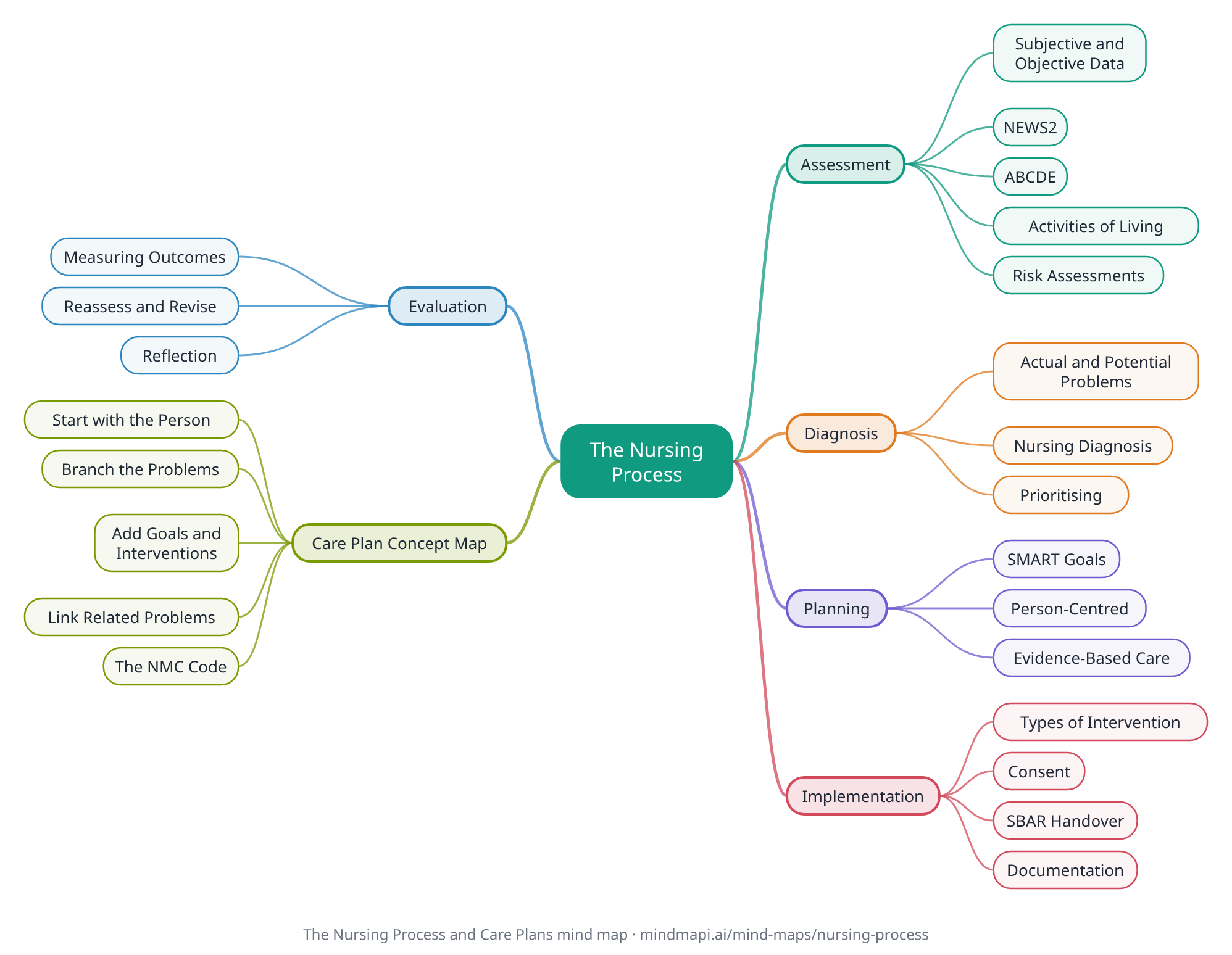
This nursing process mind map puts the stages of planning patient care on one page: assessment, identifying problems (nursing diagnosis), planning, implementation and evaluation, with the UK frameworks that sit behind each stage. Every branch is explained in the notes below the map.
Nursing has more research on mind maps and concept maps than any other degree: several meta-analyses find concept mapping improves nursing students' critical thinking and clinical performance, and many courses use concept maps for care plans. This page is for study and placement preparation, not clinical guidance: always follow your trust's policies and your practice supervisor.
Download this mind map
Print the map with all the notes as a PDF revision sheet, or save the map as an image. Free to use for revision and in class.
The Nursing Process and Care Plans mind map explained
Assessment
Collecting information about the person to understand their needs. It is holistic: physical, psychological, social and spiritual.
Subjective and Objective Data
Subjective data is what the person tells you, such as pain or worries. Objective data is what you observe and measure, such as vital signs.
NEWS2
The National Early Warning Score 2 scores respiration rate, oxygen saturation, systolic blood pressure, pulse, level of consciousness (ACVPU) and temperature, plus whether the person needs oxygen. A rising score triggers escalation.
ABCDE
A structured assessment of the deteriorating patient: Airway, Breathing, Circulation, Disability, Exposure.
Activities of Living
Roper, Logan and Tierney's model assesses twelve activities of living, such as breathing, eating and drinking, mobilising and sleeping.
Risk Assessments
Standard tools such as Waterlow (pressure ulcer risk), MUST (malnutrition risk) and falls risk assessments.
Diagnosis
Turning the assessment into a clear list of the person's problems or needs.
Actual and Potential Problems
Actual problems are present now, such as pain. Potential problems are risks, such as a risk of pressure ulcers.
Nursing Diagnosis
A statement of the person's response to a health problem, which nurses can act on. Some countries use the NANDA-I list; many UK courses call this step identifying needs.
Prioritising
Deal with life-threatening problems first, using ABCDE, then other needs. Maslow's hierarchy of needs is often used to rank them.
Planning
Agreeing goals with the person and choosing the care to reach them.
SMART Goals
Specific, Measurable, Achievable, Realistic and Time-bound. For example, the person will walk to the bathroom with one person assisting within three days.
Person-Centred
The person, and their family where appropriate, are involved in setting goals and making decisions.
Evidence-Based Care
Interventions should be based on the best evidence, such as NICE guidance and local policies, with a rationale for each.
Implementation
Carrying out the plan safely and recording it.
Types of Intervention
Independent (nurse-led, such as repositioning), interdependent (with other professionals, such as physiotherapy) and dependent (on a prescriber's order, such as giving medication).
Consent
Valid consent must be informed and voluntary, from a person who has capacity to give it.
SBAR Handover
Situation, Background, Assessment, Recommendation: a structure for clear communication and escalation.
Documentation
Records should be accurate, clear and made as soon as possible: if it was not written down, it was not done.
Evaluation
Checking whether the goals were met, and changing the plan if not. The process is a cycle.
Measuring Outcomes
Compare the person's progress with each SMART goal: met, partly met or not met.
Reassess and Revise
If a goal is not met, reassess to find out why, then change the goal or the interventions.
Reflection
Reflective models such as Gibbs' reflective cycle help you learn from practice: description, feelings, evaluation, analysis, conclusion and action plan.
Care Plan Concept Map
How to turn the nursing process into a concept map for a placement or assignment.
Start with the Person
Put the person, with their main diagnosis and background, in the centre.
Branch the Problems
Give each nursing problem its own branch, with the assessment data that supports it.
Add Goals and Interventions
Under each problem, add its SMART goal, the interventions and the rationale for each.
Link Related Problems
Draw connections between problems that affect each other, such as pain reducing mobility, which raises the risk of pressure ulcers.
The NMC Code
Keep the four themes in mind: prioritise people, practise effectively, preserve safety, and promote professionalism and trust.
How to revise with this mind map
- Learn the stages in order, and what happens at each: assessment, diagnosis (or identifying needs), planning, implementation and evaluation. Check whether your course uses ADPIE or APIE.
- Practise writing SMART goals for real problems you have seen on placement, and check each one against all five letters.
- Know the assessment tools your trust uses, especially NEWS2 and ABCDE, and what each score or finding should trigger.
- Build care plans as concept maps. Linking related problems shows the critical thinking that markers and practice supervisors look for.
- Make it yours. Build your own care plan maps in Mindmapi from your notes, and ask the AI about any branch you are unsure of. The answer is saved into that branch's notes for next time.
Frequently asked questions
What are the stages of the nursing process?
Assessment, diagnosis, planning, implementation and evaluation, often shortened to ADPIE. Many UK courses use APIE (assess, plan, implement, evaluate), where identifying needs is part of assessment. The process is a cycle: evaluation leads back to reassessment.
What is a nursing care plan?
A written plan of a person's care, based on the nursing process. It lists their problems or needs, a goal for each, the interventions to reach it and the rationale, and is updated as the person's condition changes.
What is a care plan concept map?
A diagram that puts the person at the centre, with their nursing problems as branches and the supporting data, goals and interventions under each. Lines between problems show how they affect each other, which develops clinical reasoning.
What are SMART goals in nursing?
Goals that are Specific, Measurable, Achievable, Realistic and Time-bound, so that you can clearly evaluate whether they have been met.
What does NEWS2 measure?
Respiration rate, oxygen saturation, systolic blood pressure, pulse rate, level of consciousness (ACVPU) and temperature, plus whether the person is on supplemental oxygen. The total score shows how urgently they need a clinical response.
How do I make my own nursing care plan mind map?
Put the person in the centre and add a branch for each problem, then add the assessment data, goal, interventions and rationale under each. To save time, paste your notes into Mindmapi and it will build a first draft of the map for you to edit.
Turn your own notes into a mind map
Upload your class notes, a PDF or a lecture recording and Mindmapi builds the map for you. Your first map is free.
Try It Free


