Autonomic Nervous System Mind Map
University · Physiology · Updated 31 October 2026
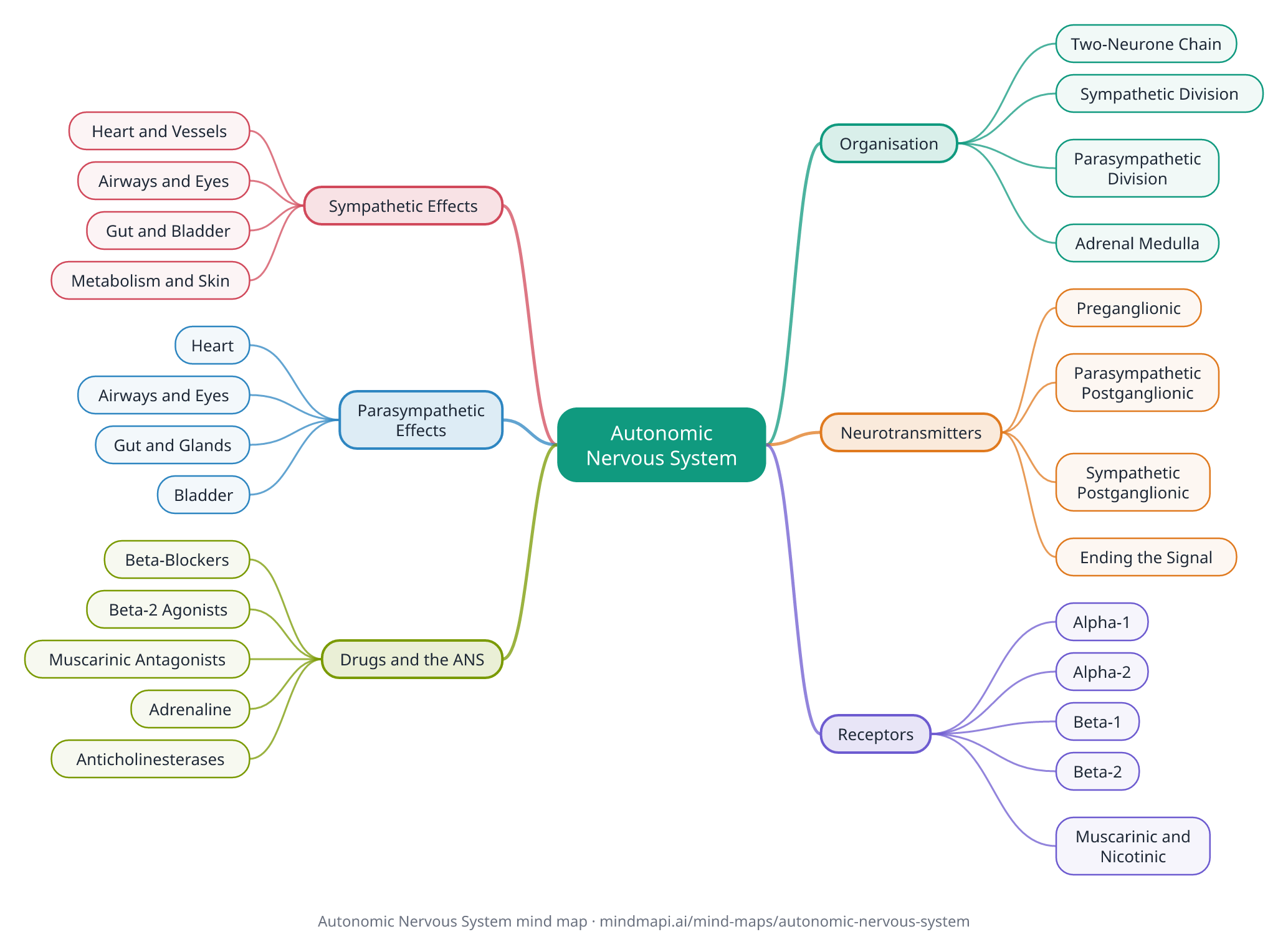
This autonomic nervous system mind map puts the topic on one page: how the system is organised, its neurotransmitters and receptors, the effects of the sympathetic and parasympathetic divisions on each organ, and the drugs that act on it. Every branch is explained in the notes below the map.
It is pitched at medicine, nursing, pharmacy and biomedical science courses, where the autonomic nervous system links physiology to pharmacology. The drug examples are there to help you learn the receptors; they are not clinical guidance.
Download this mind map
Print the map with all the notes as a PDF revision sheet, or save the map as an image. Free to use for revision and in class.
Autonomic Nervous System mind map explained
Organisation
The involuntary part of the peripheral nervous system. It controls smooth muscle, cardiac muscle and glands.
Two-Neurone Chain
A preganglionic neurone runs from the central nervous system to a ganglion, where it synapses with a postganglionic neurone that runs to the target organ.
Sympathetic Division
Thoracolumbar outflow (spinal segments T1 to L2). Short preganglionic fibres to the sympathetic chain near the spine, then long postganglionic fibres.
Parasympathetic Division
Craniosacral outflow: cranial nerves III, VII, IX and X (the vagus) and sacral segments S2 to S4. Long preganglionic fibres to ganglia in or near the target organ, then short postganglionic fibres.
Adrenal Medulla
Works like a sympathetic ganglion: preganglionic fibres stimulate it to release adrenaline, and some noradrenaline, straight into the blood.
Neurotransmitters
Which chemical is released depends on the division and the neurone.
Preganglionic
All preganglionic neurones, in both divisions, release acetylcholine onto nicotinic receptors.
Parasympathetic Postganglionic
Release acetylcholine onto muscarinic receptors on the target organ.
Sympathetic Postganglionic
Mostly release noradrenaline onto adrenergic receptors. The main exception is sweat glands, where they release acetylcholine onto muscarinic receptors.
Ending the Signal
Acetylcholinesterase breaks down acetylcholine. Noradrenaline is mainly taken back up into the nerve ending.
Receptors
Knowing the receptor tells you the effect, and which drugs will act there.
Alpha-1
Smooth muscle contraction: constricts blood vessels and dilates the pupil.
Alpha-2
On nerve endings, where it reduces further noradrenaline release (negative feedback).
Beta-1
Mainly in the heart: increases heart rate and force of contraction. Also triggers renin release from the kidney.
Beta-2
Relaxes smooth muscle: dilates the airways and blood vessels in skeletal muscle.
Muscarinic and Nicotinic
Cholinergic receptors. Nicotinic receptors are at the ganglia; muscarinic receptors are on target organs, for example M2 in the heart (slows it) and M3 in smooth muscle and glands.
Sympathetic Effects
Fight or flight: preparing the body for action.
Heart and Vessels
Heart rate and force of contraction rise. Vessels to the skin and gut constrict, while those to skeletal muscle dilate.
Airways and Eyes
The airways dilate (bronchodilation) and the pupils dilate (mydriasis).
Gut and Bladder
Gut movement and secretions slow. The bladder wall relaxes and its sphincter contracts, holding urine in.
Metabolism and Skin
The liver releases glucose and fat is broken down for energy. Sweating increases.
Parasympathetic Effects
Rest and digest: conserving energy and supporting digestion.
Heart
The vagus nerve slows the heart rate.
Airways and Eyes
The airways narrow (bronchoconstriction) and the pupils constrict (miosis).
Gut and Glands
Gut movement and digestive secretions increase, and salivation increases.
Bladder
The bladder wall contracts and the sphincter relaxes, emptying the bladder.
Drugs and the ANS
Examples for learning receptor pharmacology, not clinical guidance.
Beta-Blockers
Block beta-1 receptors in the heart, slowing it and lowering blood pressure, for example atenolol.
Beta-2 Agonists
Stimulate beta-2 receptors in the airways, causing bronchodilation, for example salbutamol in asthma.
Muscarinic Antagonists
Block muscarinic receptors, for example atropine, which speeds up a slow heart and dilates the pupils.
Adrenaline
Acts on alpha and beta receptors. Used in anaphylaxis to constrict blood vessels and open the airways.
Anticholinesterases
Stop acetylcholinesterase breaking down acetylcholine, so more acts at the receptors, for example neostigmine.
How to revise with this mind map
- Learn the wiring first. Draw both divisions side by side: where the outflow leaves the spinal cord, where the ganglia sit, and how long the preganglionic and postganglionic fibres are.
- Then learn the chemistry: which neurotransmitter each neurone releases and which receptor it acts on. Most exam questions build on this.
- Make an organ-by-organ table with a sympathetic column and a parasympathetic column: heart, airways, pupils, gut, bladder and glands.
- Link drugs to receptors. For each drug, say which receptor it acts on, whether it activates or blocks it, and so what effect it has. Predicting a drug's effects from its receptor is a classic exam question.
- Make it yours. Build your own autonomic nervous system map in Mindmapi from your lecture notes, and ask the AI about any branch you are unsure of. The answer is saved into that branch's notes for next time.
Frequently asked questions
What is the difference between the sympathetic and parasympathetic nervous systems?
The sympathetic division prepares the body for action (fight or flight): faster heart rate, dilated airways and pupils, and slower digestion. The parasympathetic division supports rest and digestion: slower heart rate, constricted pupils and more digestive activity.
Which neurotransmitters does the autonomic nervous system use?
All preganglionic neurones release acetylcholine. Parasympathetic postganglionic neurones also release acetylcholine, onto muscarinic receptors. Most sympathetic postganglionic neurones release noradrenaline, onto adrenergic receptors; sweat glands are the main exception.
What do beta-1 and beta-2 receptors do?
Beta-1 receptors, mainly in the heart, increase heart rate and force of contraction. Beta-2 receptors relax smooth muscle, dilating the airways and the blood vessels in skeletal muscle.
Where do the sympathetic and parasympathetic nerves leave the spinal cord?
Sympathetic nerves leave from the thoracic and lumbar segments (T1 to L2). Parasympathetic nerves leave in cranial nerves III, VII, IX and X and from sacral segments S2 to S4.
How does a beta-blocker work?
It blocks beta-1 receptors in the heart, so noradrenaline and adrenaline have less effect. The heart beats more slowly and less forcefully, which lowers blood pressure.
How do I make my own autonomic nervous system mind map?
Put the autonomic nervous system in the centre and add branches for organisation, neurotransmitters, receptors, sympathetic effects, parasympathetic effects and drugs. To save time, paste your lecture notes into Mindmapi and it will build a first draft of the map for you to edit.
Turn your own notes into a mind map
Upload your class notes, a PDF or a lecture recording and Mindmapi builds the map for you. Your first map is free.
Try It Free


