Mechanics Mind Map (A Level Physics)
A level · Physics · Checked against AQA and Edexcel and OCR · Updated 31 October 2026
This mechanics mind map puts the topic on one page: describing motion and the SUVAT equations, projectile motion, Newton's laws, momentum and impulse, work, energy and power, and moments and equilibrium. Every branch is explained in the notes below the map.
It follows AQA's Force, energy and momentum section, and the same content appears on Edexcel and OCR. Mechanics problems reward clear steps, so each branch gives the equations and when to use them.
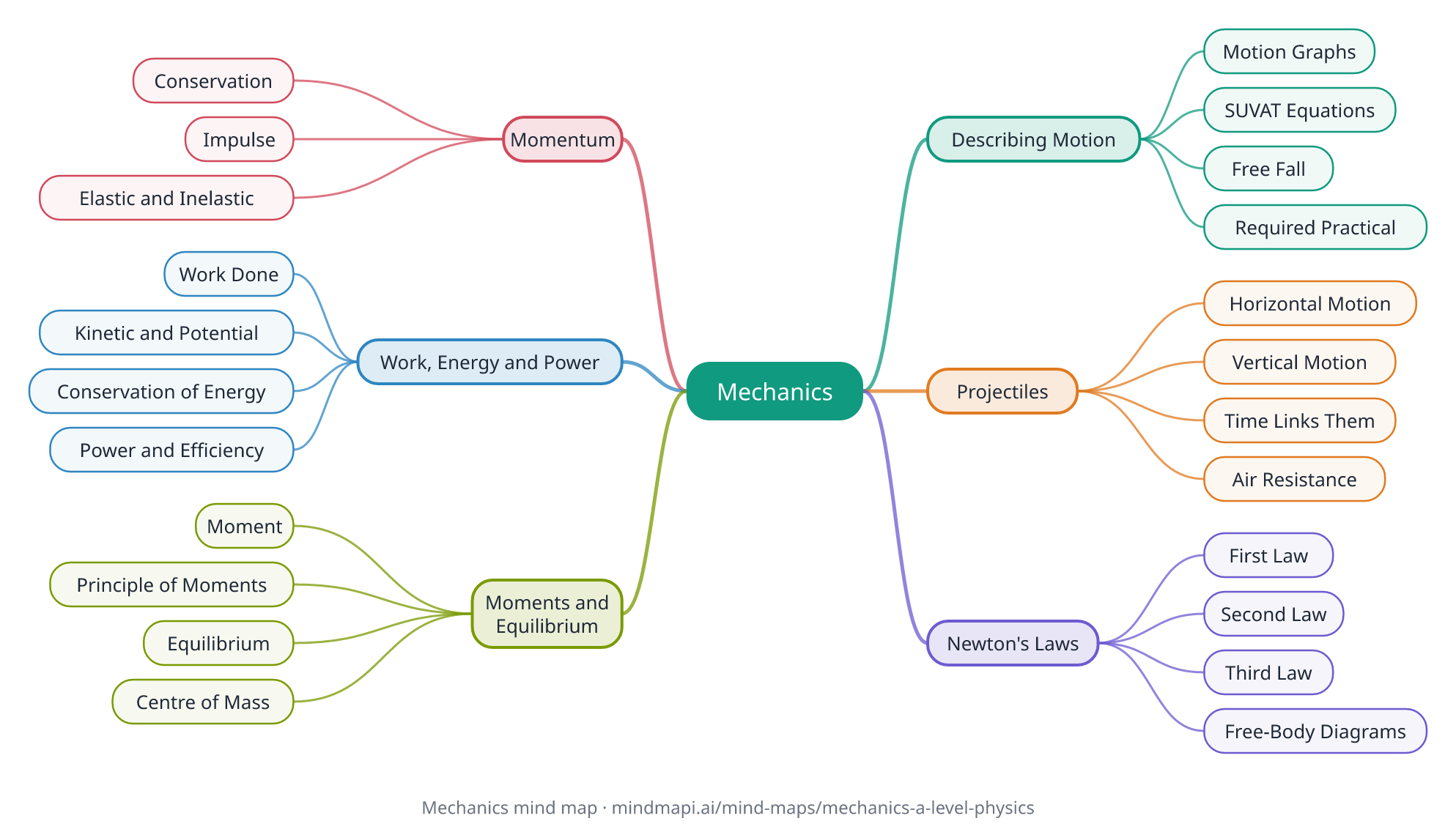
Download this mind map
Print the map with all the notes as a PDF revision sheet, or save the map as an image. Free to use for revision and in class.
Mechanics mind map explained
Describing Motion
Displacement, velocity and acceleration are vectors; distance and speed are scalars.
Motion Graphs
The gradient of a displacement-time graph is velocity. The gradient of a velocity-time graph is acceleration, and the area under it is displacement.
SUVAT Equations
For constant acceleration:
- v = u + at
- s = ut + ½at²
- v² = u² + 2as
- s = ½(u + v)t
Free Fall
With no air resistance, every object accelerates at g, 9.81 m s^-2 near the Earth's surface.
Required Practical
AQA required practical: measure g by timing a falling object over different heights, for example with light gates. The gradient of a suitable graph gives g.
Projectiles
Treat the horizontal and vertical motion separately.
Horizontal Motion
With no air resistance, the horizontal velocity is constant.
Vertical Motion
The vertical motion has a constant acceleration of g downwards. Use SUVAT on it.
Time Links Them
The time of flight is the same for both directions, so find it from one and use it in the other.
Air Resistance
Drag increases with speed. When drag equals weight, the object falls at its terminal velocity.
Newton's Laws
The rules connecting forces and motion.
First Law
An object stays at rest or moves at constant velocity unless a resultant force acts on it.
Second Law
F = ma for constant mass. More generally, the resultant force equals the rate of change of momentum.
Third Law
If A exerts a force on B, B exerts an equal and opposite force of the same type on A.
Free-Body Diagrams
Draw every force acting on one object, then find the resultant.
Momentum
Momentum p = mv, a vector measured in kg m s^-1.
Conservation
In a closed system, total momentum before a collision or explosion equals total momentum after.
Impulse
Impulse = FΔt = change in momentum, equal to the area under a force-time graph. Crumple zones and airbags increase the time, reducing the force.
Elastic and Inelastic
Kinetic energy is conserved in an elastic collision but not in an inelastic one. Momentum is conserved in both.
Work, Energy and Power
Energy is transferred when a force does work.
Work Done
W = Fs cos θ, where θ is the angle between the force and the direction of motion.
Kinetic and Potential
Kinetic energy = ½mv². Change in gravitational potential energy = mgΔh.
Conservation of Energy
Energy cannot be created or destroyed, only transferred. For a falling object with no air resistance, the loss in potential energy equals the gain in kinetic energy.
Power and Efficiency
Power = work done ÷ time = Fv. Efficiency = useful output ÷ total input, as a fraction or percentage.
Moments and Equilibrium
The turning effect of forces.
Moment
Moment = force × perpendicular distance from the pivot.
Principle of Moments
For an object in equilibrium, the sum of clockwise moments equals the sum of anticlockwise moments about any point.
Equilibrium
The resultant force is zero and the resultant moment is zero. Resolve forces into perpendicular components to check.
Centre of Mass
The point where the whole weight of an object can be taken to act. An object topples when its centre of mass moves beyond its base.
How to revise with this mind map
- Learn the SUVAT equations and practise choosing the right one: list the three values you know and the one you want, then pick the equation that links them.
- Split projectiles into horizontal and vertical motion every time, and use time to connect them.
- Draw a free-body diagram before every force question. Most errors come from a missing force or a wrong direction.
- For momentum and energy, state the conservation law you are using, and remember momentum is a vector: choose a positive direction.
- Make it yours. Build your own mechanics map in Mindmapi from your notes, and ask the AI to talk you through any problem type. The answer is saved into that branch's notes for next time.
Frequently asked questions
What are the SUVAT equations?
For constant acceleration: v = u + at, s = ut + ½at², v² = u² + 2as and s = ½(u + v)t, where s is displacement, u initial velocity, v final velocity, a acceleration and t time.
How do you solve projectile problems?
Treat the horizontal and vertical motions separately. Horizontal velocity is constant; vertical motion has acceleration g. Find the time from one direction and use it in the other.
What is Newton's second law?
The resultant force on an object equals the rate of change of its momentum. For constant mass, this becomes F = ma.
What is the difference between elastic and inelastic collisions?
In both, momentum is conserved. In an elastic collision kinetic energy is also conserved; in an inelastic one some kinetic energy is transferred to other forms, such as heat and sound.
What is the principle of moments?
For an object in equilibrium, the total clockwise moment about any point equals the total anticlockwise moment about that point.
How do I make my own mechanics mind map?
Put mechanics in the centre and add branches for motion, projectiles, Newton's laws, momentum, energy and moments, with the key equations on each. To save time, paste your notes into Mindmapi and it will build a first draft of the map for you to edit.
Turn your own notes into a mind map
Upload your class notes, a PDF or a lecture recording and Mindmapi builds the map for you. Your first map is free.
Try It Free


