Integration Mind Map (A Level Maths)
A level · Mathematics · Checked against AQA and Edexcel and OCR · Updated 31 October 2026
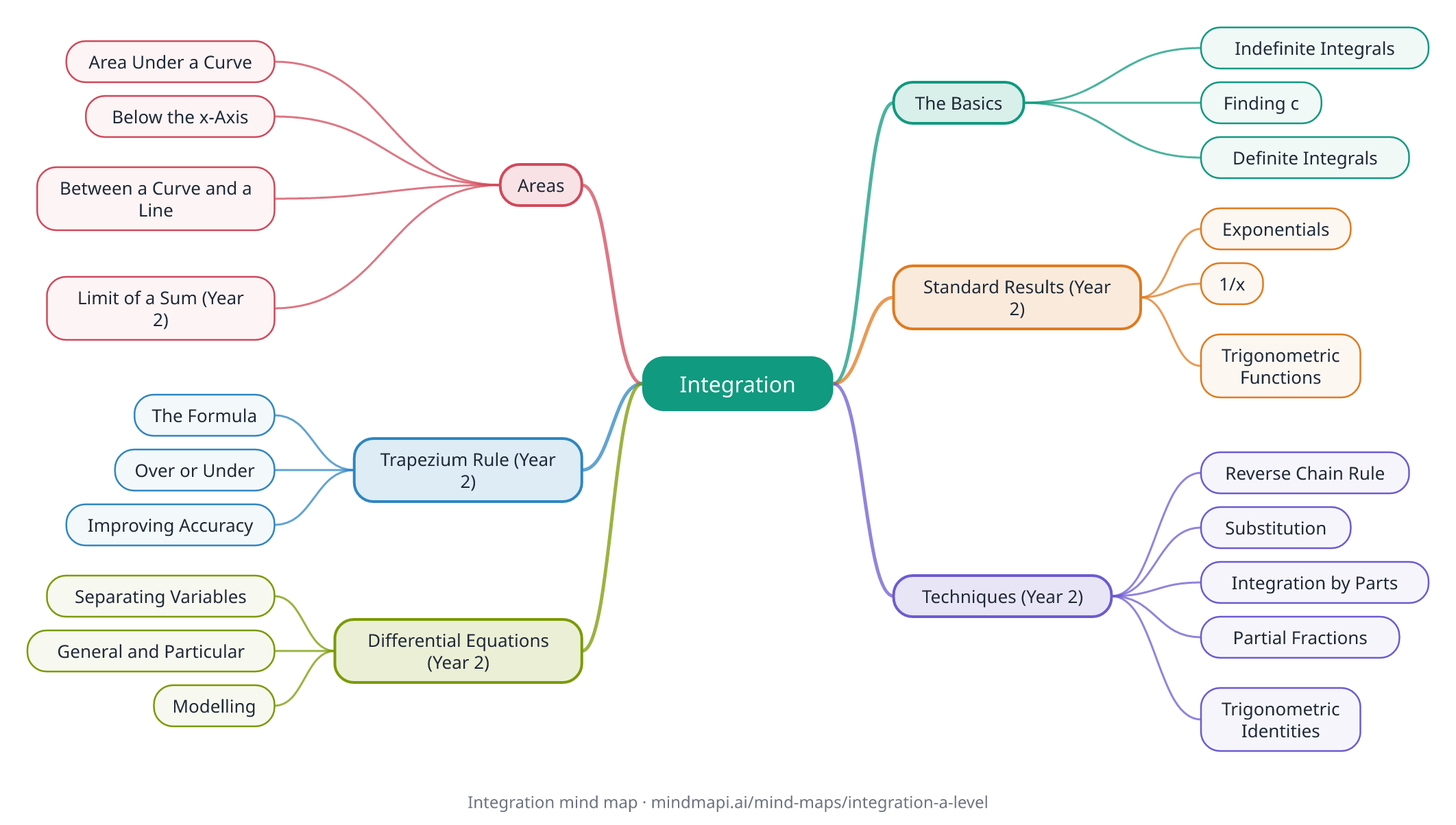
This integration mind map puts the whole topic on one page: indefinite and definite integrals, the standard results, substitution, integration by parts and partial fractions, finding areas, the trapezium rule, and differential equations. Every branch is explained in the notes below the map.
The pure maths content is the same on AQA, Edexcel and OCR. Year 1 covers integrating powers of x and finding areas; Year 2 adds the other standard results, the techniques and differential equations. Year 2 parts are labelled.
Download this mind map
Print the map with all the notes as a PDF revision sheet, or save the map as an image. Free to use for revision and in class.
Integration mind map explained
The Basics
Integration is the reverse of differentiation.
Indefinite Integrals
The integral of x^n is x^(n+1) / (n + 1) + c, for any n except −1. Always add the constant of integration, c.
Finding c
If you know a point on the curve, substitute it after integrating to find the value of c.
Definite Integrals
Integrate, then substitute the upper limit and subtract the value at the lower limit. No constant is needed.
Standard Results (Year 2)
Learn these alongside the derivatives they reverse.
Exponentials
The integral of e^(kx) is (1/k)e^(kx) + c.
1/x
The integral of 1/x is ln|x| + c. More generally, f'(x)/f(x) integrates to ln|f(x)| + c.
Trigonometric Functions
- sin kx integrates to −(1/k) cos kx + c
- cos kx integrates to (1/k) sin kx + c
- sec²kx integrates to (1/k) tan kx + c
Angles in radians.
Techniques (Year 2)
For integrals that are not standard results.
Reverse Chain Rule
Spot an integral in the form f'(x) × g(f(x)), adjust for the constant, and integrate directly.
Substitution
Replace part of the integrand with u, rewrite dx in terms of du, integrate, then substitute back. For definite integrals, change the limits too.
Integration by Parts
For a product: the integral of u dv/dx dx = uv − the integral of v du/dx dx. Choose u to be the part that gets simpler when differentiated, such as x (but ln x is usually u).
Partial Fractions
Split a rational function into simpler fractions, then integrate each one, usually to a ln term.
Trigonometric Identities
Use identities to rewrite integrals such as sin²x or cos²x in a form you can integrate.
Areas
A definite integral gives the area between a curve and the x-axis.
Area Under a Curve
Integrate between the two x-values. Sketch the curve first.
Below the x-Axis
Areas below the x-axis give negative integrals. Find each region separately and add their sizes.
Between a Curve and a Line
Integrate the upper function minus the lower function, between the points where they meet.
Limit of a Sum (Year 2)
The area is the limit of the sum of the areas of thin rectangles as their width tends to zero.
Trapezium Rule (Year 2)
A numerical method for estimating an area when you cannot integrate exactly.
The Formula
Area is approximately (h/2)[y0 + 2(y1 + y2 + ... + y(n−1)) + yn], where h is the strip width and y0 to yn are the heights at each step.
Over or Under
It overestimates the area if the curve is convex (bending upwards) and underestimates if it is concave.
Improving Accuracy
Use more, narrower strips.
Differential Equations (Year 2)
Equations involving a derivative, used to model change.
Separating Variables
Rearrange so all the y terms are with dy and all the x terms with dx, then integrate both sides.
General and Particular
The general solution includes the constant c. A particular solution uses given conditions to find c.
Modelling
For example, dP/dt = kP models growth proportional to size, giving exponential growth or decay. Comment on whether the model is realistic.
How to revise with this mind map
- Learn the standard results in pairs with their derivatives, so you can check any answer by differentiating it.
- Practise choosing the method. Ask in order: is it a standard result, a reverse chain rule, a product (by parts), a substitution, or a fraction (partial fractions)?
- Sketch before finding areas. A quick sketch shows where the curve crosses the x-axis and which regions are below it.
- Show every step in differential equations: separating, integrating both sides, adding the constant, then using the conditions. Marks follow the working.
- Make it yours. Build your own integration map in Mindmapi from your notes, and ask the AI about any technique you are unsure of. The answer is saved into that branch's notes for next time.
Frequently asked questions
How do you integrate x^n?
Add one to the power and divide by the new power: x^n integrates to x^(n+1) / (n + 1) + c. This works for every n except −1, where 1/x integrates to ln|x| + c.
When do you use integration by parts?
When integrating a product of two functions that substitution cannot simplify, such as x e^x or x sin x. Choose u to be the part that becomes simpler when differentiated.
How do you find the area between two curves?
Find where the curves meet, then integrate the upper function minus the lower function between those x-values.
Why do areas below the x-axis give negative answers?
Because the y-values there are negative. Integrate each region separately, then add their sizes rather than the signed values.
Does the trapezium rule overestimate or underestimate?
It overestimates when the curve is convex (bending upwards) and underestimates when it is concave. Using more strips makes the estimate more accurate.
How do I make my own integration mind map?
Put integration in the centre and add branches for the basics, standard results, techniques, areas, the trapezium rule and differential equations. To save time, paste your notes into Mindmapi and it will build a first draft of the map for you to edit.
Turn your own notes into a mind map
Upload your class notes, a PDF or a lecture recording and Mindmapi builds the map for you. Your first map is free.
Try It Free


