Differentiation Mind Map (A Level Maths)
A level · Mathematics · Checked against AQA and Edexcel and OCR · Updated 31 October 2026
This differentiation mind map puts the whole topic on one page: differentiation from first principles, the standard derivatives, the chain, product and quotient rules, implicit and parametric differentiation, tangents and normals, stationary points, and optimisation problems. Every branch is explained in the notes below the map.
The pure maths content is the same on AQA, Edexcel and OCR. Year 1 covers polynomials, tangents and stationary points; Year 2 adds the chain, product and quotient rules, trigonometric, exponential and log functions, and implicit and parametric differentiation. Year 2 parts are labelled.
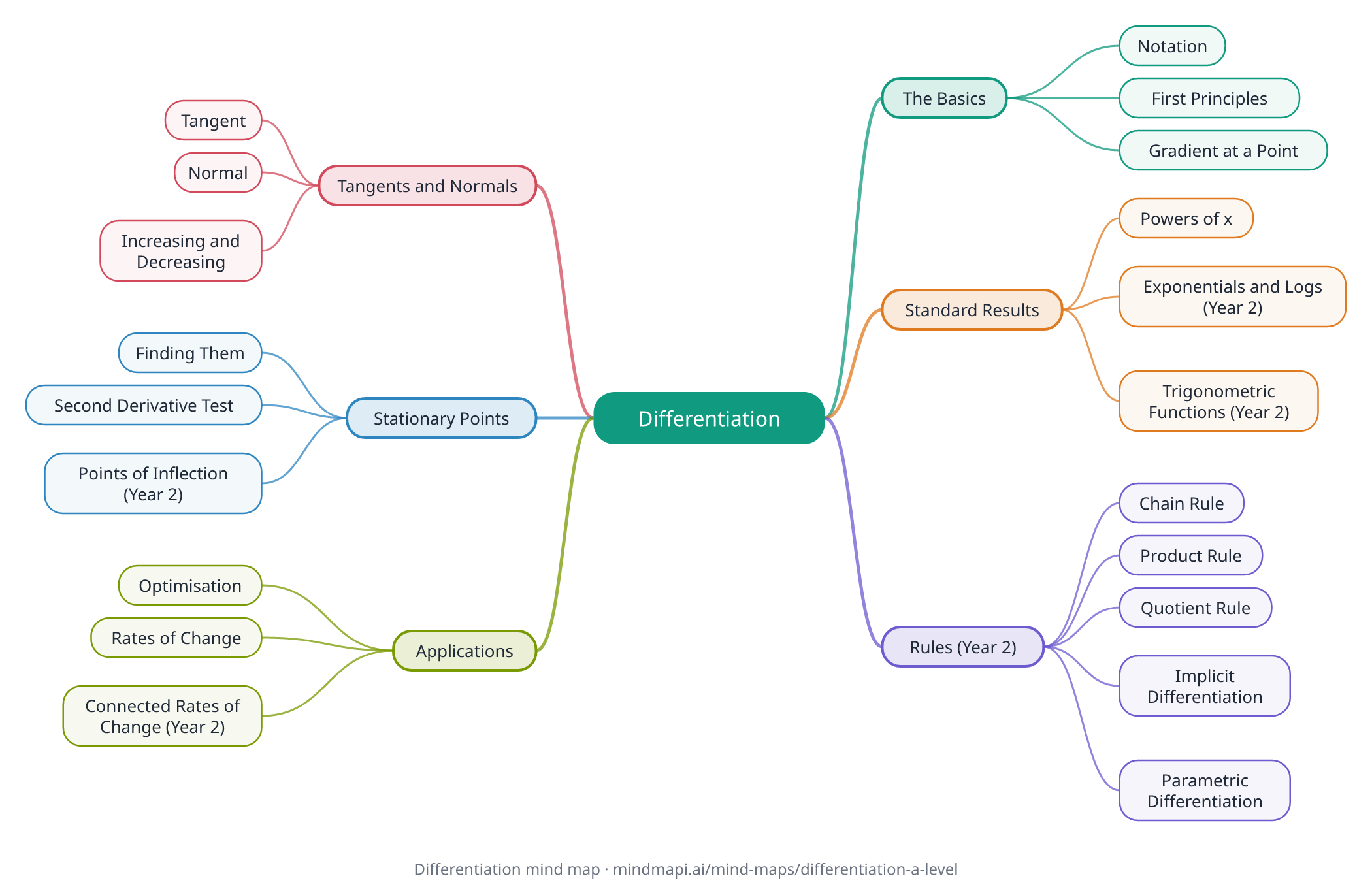
Download this mind map
Print the map with all the notes as a PDF revision sheet, or save the map as an image. Free to use for revision and in class.
Differentiation mind map explained
The Basics
Differentiation finds the gradient of a curve, which is the rate of change of y with respect to x.
Notation
dy/dx or f'(x) is the first derivative; d²y/dx² or f''(x) is the second derivative.
First Principles
f'(x) is the limit, as h tends to 0, of (f(x + h) − f(x)) / h: the gradient of a chord as it shrinks to a tangent. You may be asked to prove simple results this way, such as the derivative of x^2.
Gradient at a Point
Substitute the x-coordinate into dy/dx to find the gradient of the curve there.
Standard Results
Learn these so you can apply them without thinking.
Powers of x
If y = ax^n, then dy/dx = anx^(n−1). Rewrite roots and fractions as powers first, for example 1/x = x^(−1).
Exponentials and Logs (Year 2)
e^(kx) differentiates to ke^(kx). ln x differentiates to 1/x. a^x differentiates to a^x ln a.
Trigonometric Functions (Year 2)
sin kx → k cos kx; cos kx → −k sin kx; tan kx → k sec²kx. Angles must be in radians.
Rules (Year 2)
For functions combined in different ways.
Chain Rule
For a function of a function: dy/dx = dy/du × du/dx. For example, (3x + 1)^5 differentiates to 15(3x + 1)^4.
Product Rule
For y = uv: dy/dx = u dv/dx + v du/dx.
Quotient Rule
For y = u/v: dy/dx = (v du/dx − u dv/dx) / v².
Implicit Differentiation
Differentiate every term with respect to x. A y term picks up a factor of dy/dx, for example y² becomes 2y dy/dx. Then rearrange for dy/dx.
Parametric Differentiation
If x and y are both given in terms of t: dy/dx = (dy/dt) / (dx/dt).
Tangents and Normals
Straight lines that touch or cross the curve at a point.
Tangent
Find the gradient m at the point (x₁, y₁), then use y − y₁ = m(x − x₁).
Normal
Perpendicular to the tangent, so its gradient is −1/m.
Increasing and Decreasing
A function is increasing where dy/dx > 0 and decreasing where dy/dx < 0.
Stationary Points
Points where the gradient is zero.
Finding Them
Solve dy/dx = 0 to find the x-coordinates, then substitute into y to find the points.
Second Derivative Test
If d²y/dx² > 0 it is a minimum; if d²y/dx² < 0 it is a maximum. If it equals 0 the test fails: check the gradient on either side instead.
Points of Inflection (Year 2)
Where the second derivative changes sign. A curve is convex where f''(x) > 0 and concave where f''(x) < 0.
Applications
Using derivatives to solve problems.
Optimisation
Write the quantity to maximise or minimise, such as an area or volume, in terms of one variable, differentiate, set to zero and solve. Check whether it is a maximum or minimum.
Rates of Change
dy/dx measures how fast y changes as x changes, for example velocity as the derivative of displacement with respect to time.
Connected Rates of Change (Year 2)
Link rates with the chain rule, for example dV/dt = dV/dr × dr/dt for a growing sphere.
How to revise with this mind map
- Learn the standard results until they are instant. Most differentiation questions lose marks on a slipped power or sign, not on the method.
- Recognise which rule to use: a function of a function needs the chain rule, a product needs the product rule, a fraction needs the quotient rule (or the product rule with a negative power).
- Always rewrite first. Turn roots into fractional powers and 1/x terms into negative powers before differentiating.
- For stationary points, show every step: dy/dx = 0, solve, find y, then justify the nature with the second derivative. Method marks depend on the working.
- Make it yours. Build your own differentiation map in Mindmapi from your notes, and ask the AI about any rule you are unsure of. The answer is saved into that branch's notes for next time.
Frequently asked questions
How do you differentiate x^n?
Multiply by the power and reduce the power by one: the derivative of x^n is nx^(n−1). For ax^n it is anx^(n−1).
When do I use the chain rule?
When one function is inside another, such as (3x + 1)^5 or sin(x²). Differentiate the outer function, keep the inside the same, then multiply by the derivative of the inside.
How do you find and classify stationary points?
Solve dy/dx = 0 to find them. Then find d²y/dx²: if it is positive the point is a minimum, if negative a maximum. If it is zero, check the gradient on either side.
What is the difference between a tangent and a normal?
A tangent touches the curve with the same gradient as the curve at that point. A normal is perpendicular to the tangent, so its gradient is −1 divided by the tangent's gradient.
What is differentiation from first principles?
Finding the derivative as the limit of the gradient of a chord: f'(x) is the limit as h tends to 0 of (f(x + h) − f(x)) / h.
How do I make my own differentiation mind map?
Put differentiation in the centre and add branches for the basics, standard results, the rules, tangents and normals, stationary points and applications. To save time, paste your notes into Mindmapi and it will build a first draft of the map for you to edit.
Turn your own notes into a mind map
Upload your class notes, a PDF or a lecture recording and Mindmapi builds the map for you. Your first map is free.
Try It Free


