Electricity Mind Map (A Level Physics)
A level · Physics · Checked against AQA and Edexcel and OCR · Updated 31 October 2026
This electricity mind map puts the whole topic on one page: charge, current and potential difference, I-V characteristics, resistivity and superconductors, series and parallel circuits, potential dividers, and EMF and internal resistance, with the two required practicals. Every branch is explained in the notes below the map.
It follows AQA's section 3.5, Electricity, and the same content appears on Edexcel and OCR. Most marks come from using the equations correctly, so each branch gives the equation you need.
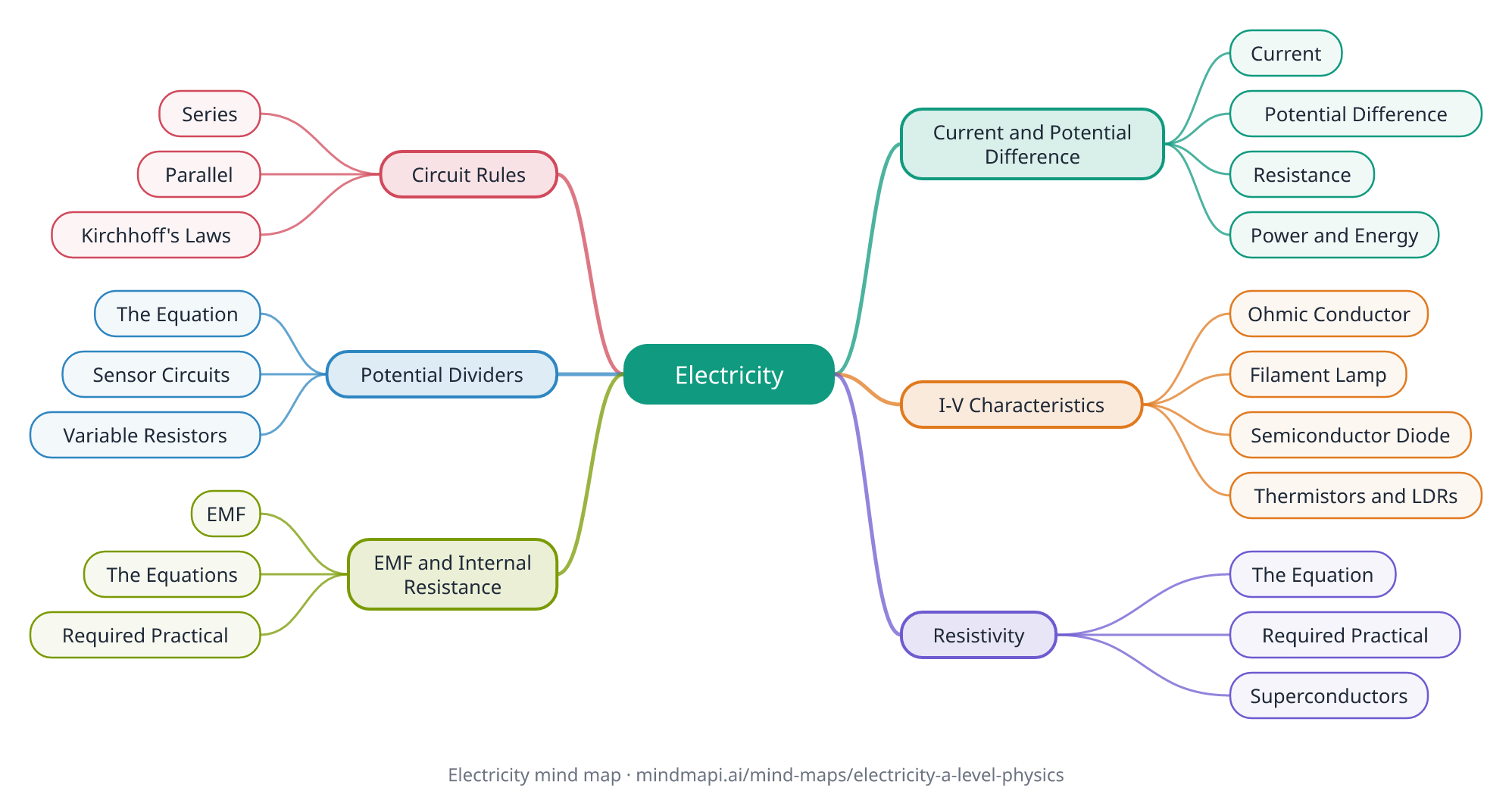
Download this mind map
Print the map with all the notes as a PDF revision sheet, or save the map as an image. Free to use for revision and in class.
Electricity mind map explained
Current and Potential Difference
The basic quantities and their definitions.
Current
The rate of flow of charge: I = ΔQ / Δt, measured in amperes. In metals the charge carriers are electrons, each carrying 1.6 × 10^-19 C.
Potential Difference
The work done per unit charge: V = W / Q, measured in volts.
Resistance
R = V / I, measured in ohms.
Power and Energy
P = VI = I²R = V²/R, and energy transferred E = VIt.
I-V Characteristics
How current varies with potential difference for different components.
Ohmic Conductor
A straight line through the origin: current is directly proportional to potential difference, at constant temperature (Ohm's law).
Filament Lamp
A curve that flattens: as the filament heats up, its resistance increases.
Semiconductor Diode
Conducts in the forward direction once the potential difference passes a threshold, and has a very high resistance in reverse.
Thermistors and LDRs
The resistance of a negative temperature coefficient thermistor falls as temperature rises. The resistance of a light-dependent resistor falls as light intensity rises.
Resistivity
A property of the material, not the shape of the conductor.
The Equation
ρ = RA / L, where A is the cross-sectional area and L the length. Measured in ohm metres.
Required Practical
AQA required practical: measure the resistance of a wire at different lengths, and the diameter with a micrometer at several points. The gradient of R against L equals ρ / A.
Superconductors
Materials with zero resistivity below their critical temperature. Uses include strong magnets for MRI scanners and power cables with no energy loss.
Circuit Rules
Based on conservation of charge and conservation of energy (Kirchhoff's laws).
Series
The same current flows through every component; the potential differences add up to the supply; R = R₁ + R₂ + ...
Parallel
Each branch has the same potential difference; the currents add up; 1/R = 1/R₁ + 1/R₂ + ...
Kirchhoff's Laws
The total current into a junction equals the total out. Around any closed loop, the sum of the EMFs equals the sum of the potential differences.
Potential Dividers
Two resistors in series that split the supply voltage.
The Equation
V_out = V_in × R₂ / (R₁ + R₂). The bigger share of resistance takes the bigger share of the potential difference.
Sensor Circuits
Replacing a resistor with a thermistor or LDR makes the output voltage change with temperature or light, for example to switch on a heater or a street light.
Variable Resistors
A potentiometer gives a continuously variable output voltage.
EMF and Internal Resistance
Real power supplies have resistance of their own.
EMF
The energy transferred to each coulomb of charge by the source: ε = E / Q.
The Equations
ε = I(R + r), so the terminal potential difference V = ε − Ir. The Ir term is the lost volts.
Required Practical
AQA required practical: vary the external resistance and record V and I. On a graph of V against I, the y-intercept is ε and the gradient is −r.
How to revise with this mind map
- Learn every equation with its units, and practise rearranging them. Most electricity marks come from substitution and rearrangement.
- Sketch the I-V graphs from memory for each component and explain the shape, especially why the filament lamp's resistance rises.
- For circuit problems, write down what is shared: current in series, potential difference in parallel. Then apply the rules step by step.
- Know both required practicals: the method, how to reduce uncertainty, and how to get the answer from the graph's gradient or intercept.
- Make it yours. Build your own electricity map in Mindmapi from your notes, and ask the AI about anything you are unsure of. The answer is saved into that branch's notes for next time.
Frequently asked questions
What is the equation for resistivity?
ρ = RA / L, where R is resistance, A is cross-sectional area and L is length. Resistivity is measured in ohm metres and depends on the material, not its shape.
What is internal resistance?
The resistance inside a power source. It causes lost volts, so the terminal potential difference is less than the EMF when a current flows: V = ε − Ir.
How does a potential divider work?
Two resistors in series share the supply voltage in proportion to their resistances: V_out = V_in × R₂ / (R₁ + R₂). Using a thermistor or LDR makes the output change with temperature or light.
Why does the I-V graph for a filament lamp curve?
As the current increases, the filament gets hotter. The metal ions vibrate more, so electrons collide with them more often, and the resistance increases.
How do you find EMF and internal resistance from a graph?
Plot terminal potential difference against current. The y-intercept gives the EMF, and the gradient is minus the internal resistance.
How do I make my own electricity mind map?
Put electricity in the centre and add branches for current and potential difference, I-V characteristics, resistivity, circuit rules, potential dividers and EMF. To save time, paste your notes into Mindmapi and it will build a first draft of the map for you to edit.
Turn your own notes into a mind map
Upload your class notes, a PDF or a lecture recording and Mindmapi builds the map for you. Your first map is free.
Try It Free


