Education Mind Map (A Level Sociology)
A level · Sociology · Checked against AQA · Updated 31 October 2026
This sociology of education mind map puts the whole topic on one page: the role of education according to functionalists, the New Right and Marxists, differences in achievement by class, ethnicity and gender, what happens inside schools, and educational policy since 1944. Every branch is explained in the notes below the map.
It follows AQA's Paper 1, Education with Theory and Methods. Essays need named sociologists and evaluation from other perspectives, so each branch names the key studies.
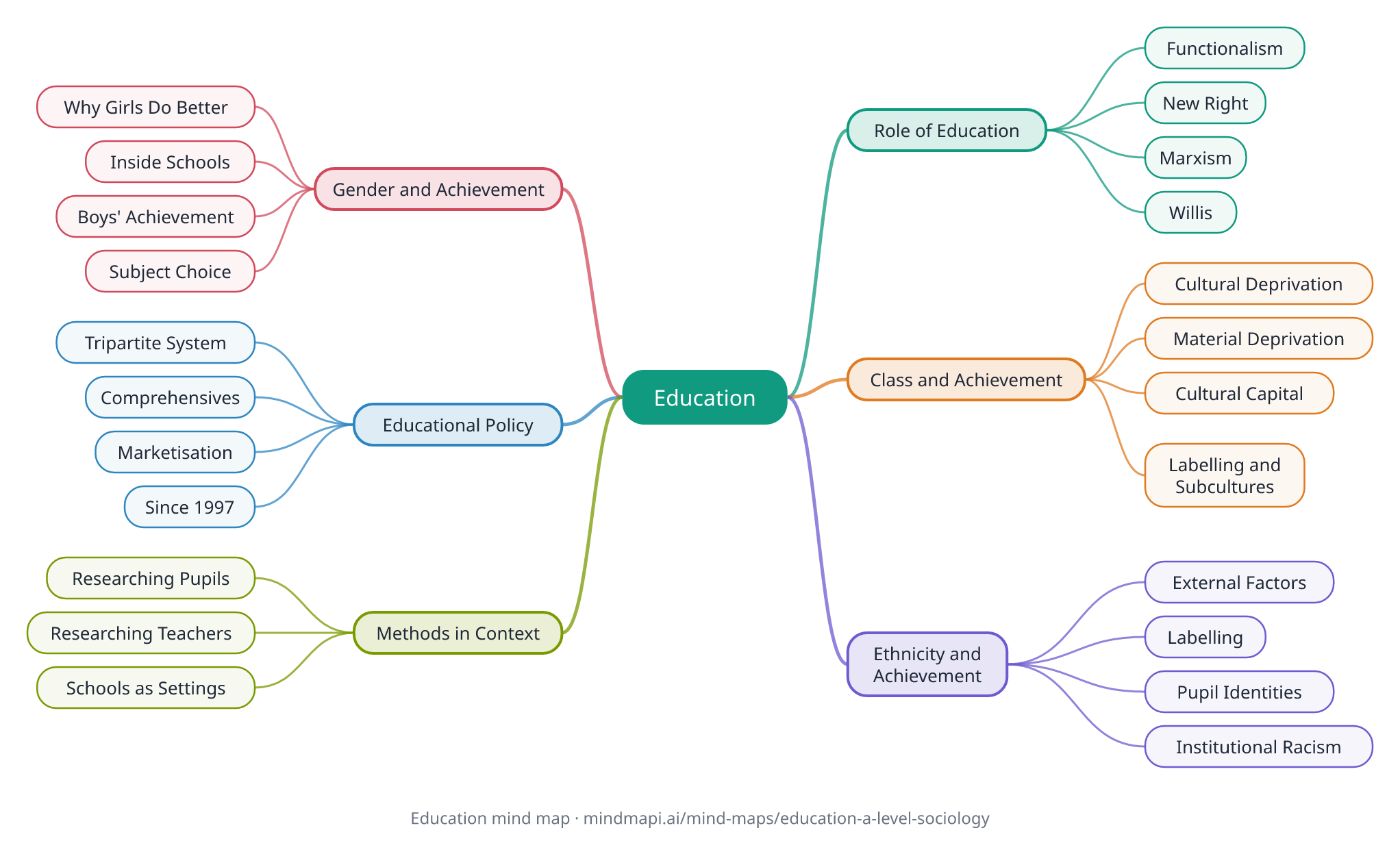
Download this mind map
Print the map with all the notes as a PDF revision sheet, or save the map as an image. Free to use for revision and in class.
Education mind map explained
Role of Education
What education does for society, according to the main perspectives.
Functionalism
Durkheim: education creates social solidarity and teaches specialist skills. Parsons: school is a bridge between family and society, based on meritocracy. Davis and Moore: it sifts and sorts people into roles.
New Right
Education should prepare people for work, and state schools are inefficient. Chubb and Moe argued for marketisation, so schools compete for pupils.
Marxism
Althusser: education is an ideological state apparatus that reproduces class inequality. Bowles and Gintis: the correspondence principle, and the myth of meritocracy.
Willis
Learning to Labour (1977): working-class "lads" formed a counter-school culture that prepared them for manual work, showing pupils can resist.
Class and Achievement
Middle-class pupils achieve more on average. Explanations look outside and inside school.
Cultural Deprivation
Bernstein: working-class pupils use a restricted speech code, while schools use the elaborated code. Douglas: differences in parents' interest in education.
Material Deprivation
Poverty affects housing, diet, and the cost of uniforms, trips and resources.
Cultural Capital
Bourdieu: middle-class families pass on cultural, economic and educational capital, which schools reward.
Labelling and Subcultures
Becker: teachers label pupils by how closely they fit the "ideal pupil", which can create a self-fulfilling prophecy. Lacey: streaming polarises pupils into pro- and anti-school subcultures.
Ethnicity and Achievement
Achievement varies between ethnic groups, and explanations are debated.
External Factors
Cultural deprivation explanations, material deprivation, and racism in wider society.
Labelling
Gillborn and Youdell: teachers expected more discipline problems from Black pupils, leading to more conflict and exclusions.
Pupil Identities
Archer: teachers' views of the "ideal pupil" can exclude some ethnic minority pupils.
Institutional Racism
Critical race theory sees racism built into the system, such as an ethnocentric curriculum and setting, creating what Gillborn calls locked-in inequality.
Gender and Achievement
Girls now outperform boys at most levels, but subject choices remain gendered.
Why Girls Do Better
The impact of feminism, changes in the family and in women's employment, and changing ambitions: Sharpe found girls' priorities shifted from marriage in the 1970s to careers in the 1990s.
Inside Schools
Equal opportunities policies, more female role models, and assessment styles such as coursework.
Boys' Achievement
Explanations include a crisis of masculinity as manual jobs declined, and laddish subcultures that see studying as feminine.
Subject Choice
Early socialisation, gendered subject images and peer pressure steer girls and boys towards different subjects.
Educational Policy
How governments have shaped education since 1944.
Tripartite System
The 1944 Education Act created grammar, secondary modern and technical schools, with selection by the 11-plus exam.
Comprehensives
From 1965, comprehensive schools for all abilities aimed to reduce inequality, though setting and streaming continued.
Marketisation
The 1988 Education Reform Act brought league tables, the National Curriculum and parental choice. Ball and Gewirtz argue it helps middle-class parents most.
Since 1997
New Labour introduced the Education Maintenance Allowance and academies. From 2010, the Coalition expanded academies, created free schools and introduced the pupil premium.
Methods in Context
Applying research methods to education, examined in Paper 1.
Researching Pupils
Pupils are young and less powerful, which raises issues of consent, vulnerability and the way they respond to adult researchers.
Researching Teachers
Teachers are busy and may act differently when observed, presenting a positive image.
Schools as Settings
Gaining access through gatekeepers such as head teachers, and the effect of school rules and routines on the research.
How to revise with this mind map
- Learn a named sociologist for every point, with their key idea. Essays without named studies cannot reach the top bands.
- Evaluate from other perspectives. For example, criticise the functionalist view of meritocracy with Marxist evidence on class inequality.
- Link inside and outside school. For class, ethnicity and gender, know both external factors (home and society) and internal factors (labelling, setting, subcultures).
- Practise methods in context. Take a research method and an education issue, and explain the specific problems of studying pupils, teachers or schools.
- Make it yours. Build your own education map in Mindmapi from your notes, and ask the AI about any sociologist you are unsure of. The answer is saved into that branch's notes for next time.
Frequently asked questions
What is the functionalist view of education?
Functionalists see education as beneficial: Durkheim said it creates social solidarity and teaches specialist skills, Parsons that it is a bridge between family and society based on meritocracy, and Davis and Moore that it allocates people to suitable roles.
What is the correspondence principle?
Bowles and Gintis's Marxist idea that school mirrors the workplace, preparing working-class pupils to accept hierarchy and obedience at work, through a hidden curriculum.
Why do middle-class pupils achieve more?
Explanations include material deprivation, cultural deprivation (such as Bernstein's speech codes), Bourdieu's cultural capital, and processes inside school such as labelling, streaming and pupil subcultures.
Why do girls outperform boys in education?
Sociologists point to feminism, changes in the family and in women's employment, changing ambitions (Sharpe), equal opportunities policies, role models and assessment styles, along with boys' laddish subcultures.
What is marketisation of education?
Introducing market forces such as competition and parental choice into education, especially through the 1988 Education Reform Act. Critics such as Ball and Gewirtz argue it benefits middle-class families most.
How do I make my own sociology of education mind map?
Put education in the centre and add branches for the role of education, class, ethnicity, gender, policy and methods in context, with named sociologists on each. To save time, paste your notes into Mindmapi and it will build a first draft of the map for you to edit.
Turn your own notes into a mind map
Upload your class notes, a PDF or a lecture recording and Mindmapi builds the map for you. Your first map is free.
Try It Free


