Memory Mind Map (A Level Psychology)
A level · Psychology · Checked against AQA · Updated 31 October 2026
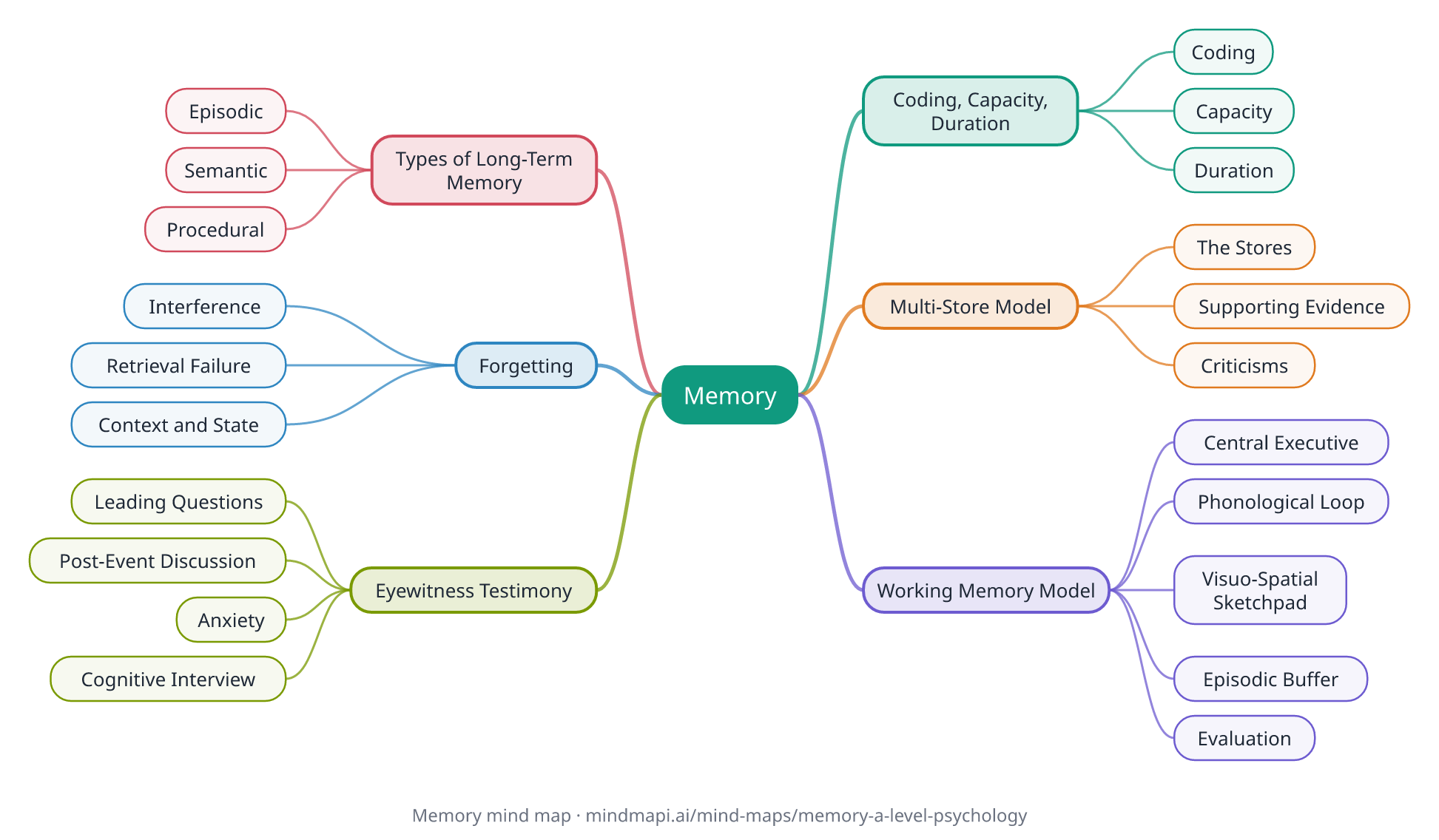
This memory mind map puts the whole topic on one page: the features of short and long-term memory, the multi-store model, the working memory model, types of long-term memory, explanations for forgetting, eyewitness testimony and the cognitive interview, with the key studies for each. Every branch is explained in the notes below the map.
It follows AQA's Paper 1 Memory topic. Exam questions ask you to describe a model or study and then evaluate it, so the notes give both the facts and the evidence for or against.
Download this mind map
Print the map with all the notes as a PDF revision sheet, or save the map as an image. Free to use for revision and in class.
Memory mind map explained
Coding, Capacity, Duration
How short-term memory (STM) and long-term memory (LTM) differ.
Coding
STM is mainly acoustic and LTM mainly semantic (Baddeley, 1966, using acoustically and semantically similar word lists).
Capacity
STM holds about 7 plus or minus 2 items (Miller, 1956); Jacobs (1887) measured it with digit span. LTM capacity is potentially unlimited.
Duration
STM lasts about 18 to 30 seconds without rehearsal (Peterson and Peterson, 1959). LTM can last a lifetime (Bahrick et al., 1975, on recognising classmates' photos).
Multi-Store Model
Atkinson and Shiffrin (1968): memory as three separate stores linked by processes.
The Stores
Sensory register → (attention) → short-term memory → (rehearsal) → long-term memory. Retrieval brings information back from LTM to STM.
Supporting Evidence
Studies of coding, capacity and duration support separate stores. The case of HM, who could not form new long-term memories after brain surgery, suggests STM and LTM are in different brain areas.
Criticisms
Too simple: KF had an impaired STM for verbal but not visual information, suggesting more than one STM store. Rehearsal is not always needed to transfer information to LTM.
Working Memory Model
Baddeley and Hitch (1974): STM as an active system with several parts.
Central Executive
Directs attention and allocates tasks to the slave systems. Limited capacity.
Phonological Loop
Holds sound-based information: the phonological store (inner ear) and the articulatory process (inner voice).
Visuo-Spatial Sketchpad
Holds visual and spatial information (the inner eye).
Episodic Buffer
Added by Baddeley in 2000. A temporary store that combines information from the other parts and links to LTM.
Evaluation
Dual-task studies show two visual tasks interfere but a visual and a verbal task do not, supporting separate slave systems. KF's case also supports it. The central executive is vaguely defined.
Types of Long-Term Memory
Tulving (1985) and others divided LTM into different stores.
Episodic
Memories of personal events, such as your last birthday, with details of time and place. Explicit and needs conscious effort to recall.
Semantic
Knowledge of facts and meanings, such as the capital of France. Explicit.
Procedural
Memory for skills and actions, such as riding a bike. Implicit: recalled without conscious effort.
Forgetting
Two main explanations for why information in LTM is forgotten.
Interference
Proactive interference is when old learning disrupts new; retroactive is when new learning disrupts old. McGeoch and McDonald (1931) found more interference the more similar the material.
Retrieval Failure
Information is there but cannot be accessed without the right cues. Encoding specificity: cues present at learning help recall.
Context and State
Godden and Baddeley (1975): divers recalled words better in the same environment, land or underwater, where they learned them. Carter and Cassaday (1998) showed the same for internal state, using antihistamines.
Eyewitness Testimony
How accurate witnesses are, and how to improve their accounts.
Leading Questions
Loftus and Palmer (1974): participants who heard "smashed" estimated a mean speed of 40.5 mph; those who heard "contacted" estimated 31.8 mph.
Post-Event Discussion
Gabbert et al. (2003): 71% of participants who discussed a crime with a co-witness reported details they had not seen themselves.
Anxiety
Johnson and Scott (1976): in the weapon focus study, 33% identified the man holding a bloody knife, against 49% who saw him holding a pen. But Yuille and Cutshall (1986) found real witnesses to a shooting were highly accurate.
Cognitive Interview
Fisher and Geiselman (1992): report everything, reinstate the context, recall in a different order and change perspective. The enhanced version adds techniques such as building rapport.
How to revise with this mind map
- Learn each model with a diagram. Be able to draw the multi-store and working memory models from memory and label every part.
- Pair every claim with a study. For each feature or explanation, know a named study, its method and its key finding, ideally with a number.
- Practise evaluation with the PEEL structure: point, evidence, explain, link. AQA rewards evaluation that is specific and explained, not a list of strengths and weaknesses.
- Prepare for applied questions. Practise using the models and explanations to explain a scenario in the question, quoting its details.
- Make it yours. Build your own memory map in Mindmapi from your notes, and ask the AI about any study you are unsure of. The answer is saved into that branch's notes for next time.
Frequently asked questions
What is the multi-store model of memory?
Atkinson and Shiffrin's (1968) model of three stores: the sensory register, short-term memory and long-term memory. Attention moves information to STM, rehearsal moves it to LTM, and retrieval brings it back.
What are the components of the working memory model?
The central executive, which directs attention, and its slave systems: the phonological loop for sounds, the visuo-spatial sketchpad for visual and spatial information, and the episodic buffer, added in 2000, which combines information and links to long-term memory.
What are the explanations for forgetting?
Interference, where old or new learning disrupts other memories, and retrieval failure, where the information is stored but the cues needed to access it are missing.
What did Loftus and Palmer find?
That leading questions affect eyewitness memory. Participants asked how fast the cars were going when they "smashed" gave a mean estimate of 40.5 mph, against 31.8 mph for "contacted".
What is the cognitive interview?
A police interview technique developed by Fisher and Geiselman (1992) to improve eyewitness recall: report everything, reinstate the context, recall in a different order and change perspective.
How do I make my own memory mind map?
Put memory in the centre and add branches for coding, capacity and duration, the two models, types of LTM, forgetting and eyewitness testimony, with a study on each branch. To save time, paste your notes into Mindmapi and it will build a first draft of the map for you to edit.
Turn your own notes into a mind map
Upload your class notes, a PDF or a lecture recording and Mindmapi builds the map for you. Your first map is free.
Try It Free


