Families and Households Mind Map (A Level Sociology)
A level · Sociology · Checked against AQA · Updated 31 October 2026
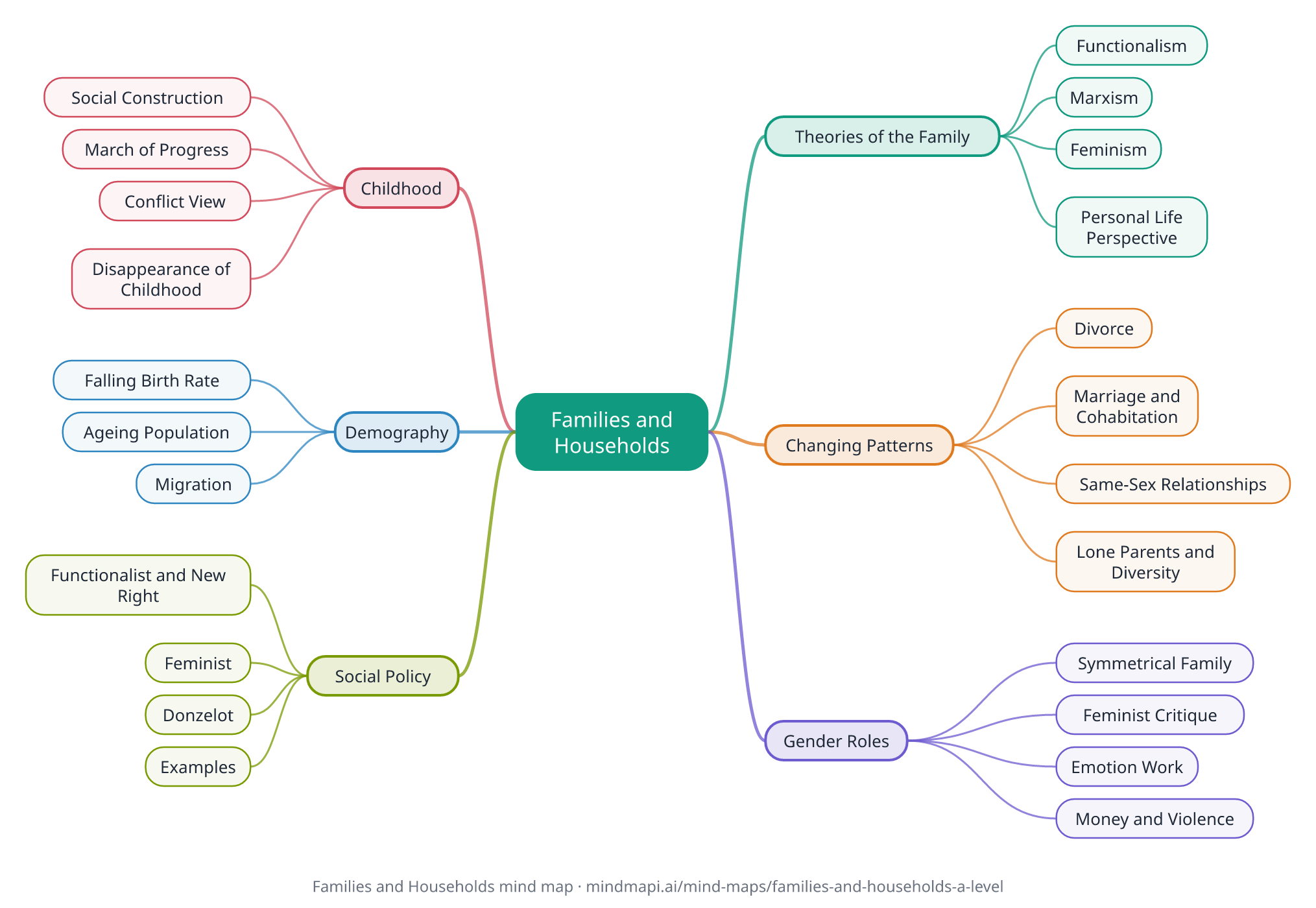
This families and households mind map puts the whole topic on one page: theories of the family, changing patterns of marriage, divorce and family diversity, gender roles and domestic labour, childhood, demographic change, and social policy. Every branch is explained in the notes below the map.
It follows the Families and households option in AQA's Paper 2. Essays need named sociologists, evidence about social change and evaluation from other perspectives, so each branch names the key studies.
Download this mind map
Print the map with all the notes as a PDF revision sheet, or save the map as an image. Free to use for revision and in class.
Families and Households mind map explained
Theories of the Family
What the family does for individuals and society.
Functionalism
Murdock: the family has four functions, sexual, reproductive, economic and educational. Parsons: the nuclear family fits industrial society and has two irreducible functions, primary socialisation and stabilising adult personalities.
Marxism
The family serves capitalism: passing on private property, reproducing an ideology of acceptance, and acting as a unit of consumption. Zaretsky saw it as a refuge from capitalism that cannot really meet people's needs.
Feminism
Liberal feminists see gradual progress towards equality; Marxist feminists link women's oppression to capitalism; radical feminists see the family as patriarchal at its core.
Personal Life Perspective
Smart and others focus on the relationships that matter to people, including friends and fictive kin, rather than only blood or marriage ties.
Changing Patterns
How family life in the UK has changed since the 1960s.
Divorce
Rose after the Divorce Reform Act 1969, which came into effect in 1971. Explanations include easier laws, declining stigma, secularisation, women's financial independence and rising expectations of marriage.
Marriage and Cohabitation
Fewer people marry, and later. Cohabitation has become common, often as a step before or instead of marriage.
Same-Sex Relationships
Civil partnerships were introduced by the Civil Partnership Act 2004, and same-sex marriage began in England and Wales in 2014.
Lone Parents and Diversity
More lone-parent, reconstituted and single-person households. Rapoport identified five types of family diversity: organisational, cultural, class, life-stage and generational.
Gender Roles
How domestic labour, power and decision-making are shared.
Symmetrical Family
Young and Willmott (1973) argued roles were becoming more equal, with couples sharing tasks and leisure.
Feminist Critique
Oakley (1974) found little evidence of symmetry: men's help with housework was limited. Women in paid work may carry a dual burden of paid and domestic work.
Emotion Work
Duncombe and Marsden argued women also carry the emotional work of the family, a triple shift.
Money and Violence
Pahl studied how couples control money. Dobash and Dobash studied domestic violence as an outcome of patriarchal power.
Childhood
Childhood as a social construction that varies between times and places.
Social Construction
Ariès argued that in the Middle Ages childhood as a separate stage barely existed; children were treated as mini-adults.
March of Progress
The view that children today are better cared for, healthier and more protected than ever.
Conflict View
Critics argue children remain controlled and unequal, and that childhood differs by class, gender and ethnicity.
Disappearance of Childhood
Postman argued television blurs the line between childhood and adulthood. Palmer's idea of toxic childhood points to technology and consumer culture.
Demography
Changes in births, deaths and migration, and their effect on families.
Falling Birth Rate
Linked to women's changing position, contraception, lower infant mortality, and children becoming an economic cost rather than an asset.
Ageing Population
Falling death rates and rising life expectancy mean more older people, raising the dependency ratio and creating beanpole families (Brannen).
Migration
Immigration has increased cultural diversity in family types and affected the age structure of the population.
Social Policy
How laws and policies shape family life, seen from different perspectives.
Functionalist and New Right
Functionalists see policy helping families perform their functions. The New Right argues some policies, such as generous benefits, undermine the traditional nuclear family.
Feminist
Feminists argue many policies assume and reinforce a male breadwinner and female carer.
Donzelot
Saw policy as a way of policing families, with professionals such as social workers controlling poorer families in particular.
Examples
The Divorce Reform Act 1969, the Civil Partnership Act 2004 and the introduction of same-sex marriage, changes to maternity and paternity leave, and child benefit rules.
How to revise with this mind map
- Learn a named sociologist and a date for each key idea, and the perspective they belong to. Top-band answers are full of specific references.
- Use statistics on change, such as divorce rates or the age of first marriage, and explain them with sociological reasons rather than common sense.
- Evaluate from other perspectives. Criticise the functionalist view of the family with feminist and Marxist arguments, and vice versa.
- Practise the item-based questions. Use the item's content in your answer: questions often reward pulling ideas from it directly.
- Make it yours. Build your own families map in Mindmapi from your notes, and ask the AI about any study or statistic you are unsure of. The answer is saved into that branch's notes for next time.
Frequently asked questions
What is the functionalist view of the family?
That the family benefits society. Murdock identified four functions: sexual, reproductive, economic and educational. Parsons argued the nuclear family fits industrial society and has two irreducible functions: primary socialisation and stabilising adult personalities.
Why has the divorce rate changed?
Sociologists point to easier divorce laws such as the Divorce Reform Act 1969, declining stigma, secularisation, women's growing financial independence and higher expectations of marriage.
Is the family becoming more symmetrical?
Young and Willmott (1973) argued it was, with more shared roles. Feminists such as Oakley (1974) disagreed, finding women still did most housework, and later research points to a dual burden and emotion work.
What does it mean that childhood is socially constructed?
That ideas about childhood are created by society and vary between times and cultures. Ariès argued that in the Middle Ages children were treated much like small adults.
What is a beanpole family?
A family with several generations but few relatives in each, tall and thin like a beanpole. Brannen linked it to people living longer and having fewer children.
How do I make my own families and households mind map?
Put families in the centre and add branches for theories, changing patterns, gender roles, childhood, demography and social policy, with named sociologists on each. To save time, paste your notes into Mindmapi and it will build a first draft of the map for you to edit.
Turn your own notes into a mind map
Upload your class notes, a PDF or a lecture recording and Mindmapi builds the map for you. Your first map is free.
Try It Free


