A Level Art Coursework Mind Map
A level · Art and Design · Checked against AQA and Edexcel · Updated 31 October 2026
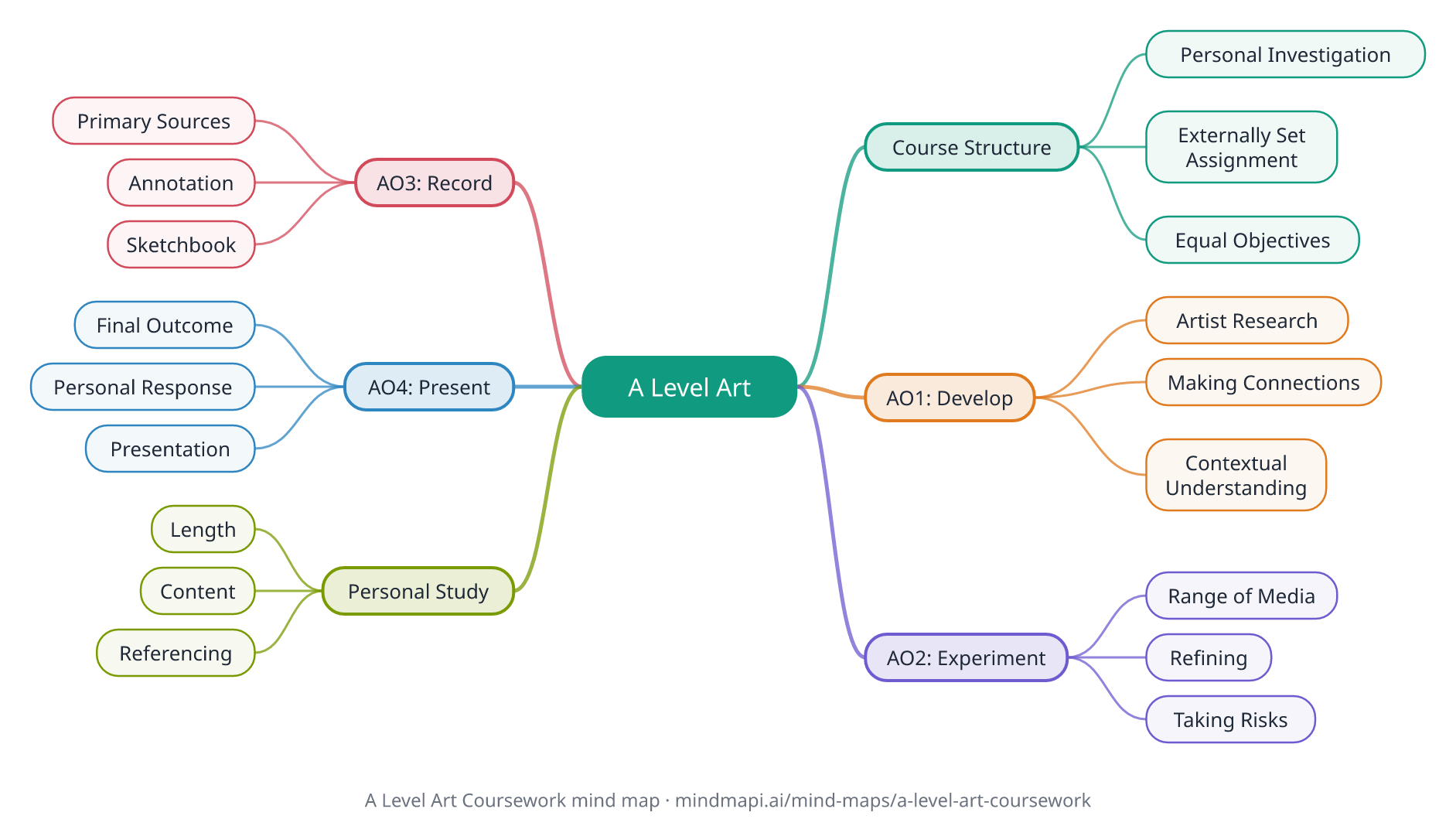
A level Art and Design is assessed through your own work rather than a written exam, so this mind map covers how the course is marked: the personal investigation, the written personal study, the externally set assignment, and the four assessment objectives that every piece is judged against. Every branch is explained in the notes below the map.
It follows AQA's structure; Edexcel's is the same in outline. The four assessment objectives are equally weighted, so a strong final piece is not enough on its own: examiners look for the journey that led to it.
Download this mind map
Print the map with all the notes as a PDF revision sheet, or save the map as an image. Free to use for revision and in class.
A Level Art Coursework mind map explained
Course Structure
Two components, both marked by your teachers and moderated by the exam board.
Personal Investigation
Component 1, worth 60%. A sustained project on a theme you choose, with practical work and a written personal study.
Externally Set Assignment
Component 2, worth 40%. The exam board releases a paper of starting points on 1 February. You prepare, then make your final outcome in 15 hours of supervised time.
Equal Objectives
Each of the four assessment objectives is worth 25% of the marks, in both components.
AO1: Develop
Develop ideas through investigations, informed by contextual and other sources, showing analytical and critical understanding.
Artist Research
Study artists, designers and craftspeople linked to your theme. Analyse how and why they work, rather than copying images and biographies.
Making Connections
Show how each source influences your own ideas and next steps.
Contextual Understanding
Consider the historical, cultural and social context of the work you study.
AO2: Experiment
Explore and select appropriate resources, media, materials, techniques and processes, reviewing and refining ideas as the work develops.
Range of Media
Try different materials and processes, such as paint, print, photography, collage, clay and digital media.
Refining
Develop the most successful experiments further, showing how each one improves on the last.
Taking Risks
Experiments that do not work still earn credit if you reflect on them and show what you learned.
AO3: Record
Record ideas, observations and insights relevant to your intentions, reflecting critically on work and progress.
Primary Sources
Draw and photograph from direct observation: these carry more weight than images found online.
Annotation
Write reflective notes explaining your decisions, what works, what does not and why.
Sketchbook
Your sketchbook should show a clear journey from first ideas to final piece.
AO4: Present
Present a personal and meaningful response that realises your intentions and, where appropriate, makes connections between visual and other elements.
Final Outcome
A resolved piece, or pieces, that clearly grows out of your research and experiments.
Personal Response
Your own voice and ideas should be visible, not just a skilled copy of another artist's style.
Presentation
Present the whole investigation clearly, so a moderator can follow your journey.
Personal Study
The written part of the personal investigation.
Length
AQA requires 1,000 to 3,000 words of continuous prose; Edexcel requires at least 1,000 words.
Content
A critical and contextual study linked to your practical work, using the vocabulary of art and design.
Referencing
Include a bibliography and reference your sources, for example with the Harvard system.
How to revise with this mind map
- Plan around the four assessment objectives. For each stage of your project, check which objective it shows, and make sure all four are equally strong.
- Annotate as you go, not at the end. Reflective notes written while you work show genuine thinking and are much more convincing.
- Use primary sources wherever you can: your own drawings and photographs, taken from life, carry more weight than images from the internet.
- Make your journey visible. Every experiment should lead to the next, so a moderator can trace how your final piece came about.
- Make it yours. Plan your personal investigation as a map in Mindmapi, with branches for artists, experiments and ideas, and ask the AI to suggest artists linked to your theme. The suggestions are saved into that branch's notes.
Frequently asked questions
How is A level Art assessed?
Through two components: a personal investigation worth 60%, with a written personal study, and an externally set assignment worth 40%, ending in 15 hours of supervised time. Both are marked against four equally weighted assessment objectives.
What are the four assessment objectives in A level Art?
AO1: develop ideas through investigating sources. AO2: explore and refine media, materials and techniques. AO3: record ideas and observations and reflect on them. AO4: present a personal, meaningful response that realises your intentions.
How long is the A level Art personal study?
For AQA, between 1,000 and 3,000 words of continuous prose. For Edexcel, at least 1,000 words. It should link to your practical work and include a bibliography.
What is the externally set assignment?
Component 2. The exam board releases a paper of starting points on 1 February. You develop work from one of them during a preparatory period, then produce your final outcome in 15 hours of supervised time.
What makes a good A level Art sketchbook?
One that shows a clear journey: research into relevant artists, drawing from primary sources, experiments with different media, reflective annotation, and refined ideas that lead to the final piece.
How do I plan my A level Art project with a mind map?
Put your theme in the centre and add branches for artists, primary sources, media experiments and ideas for final pieces. Mindmapi can help: build the map from your notes and ask the AI to suggest artists or directions for any branch.
Turn your own notes into a mind map
Upload your class notes, a PDF or a lecture recording and Mindmapi builds the map for you. Your first map is free.
Try It Free


