Othello Mind Map (A Level)
A level · English Literature · Checked against AQA and Edexcel · Updated 31 October 2026
This Othello mind map puts Shakespeare's tragedy on one page: the plot act by act, the main characters, the themes of jealousy, race and reputation, key quotations, the play as a tragedy in its context, and the critics most often quoted in essays. Every branch is explained in the notes below the map.
Othello is a set text on AQA and Edexcel A level English Literature. A level essays reward analysis of Shakespeare's methods and engagement with different interpretations, so the map includes both.
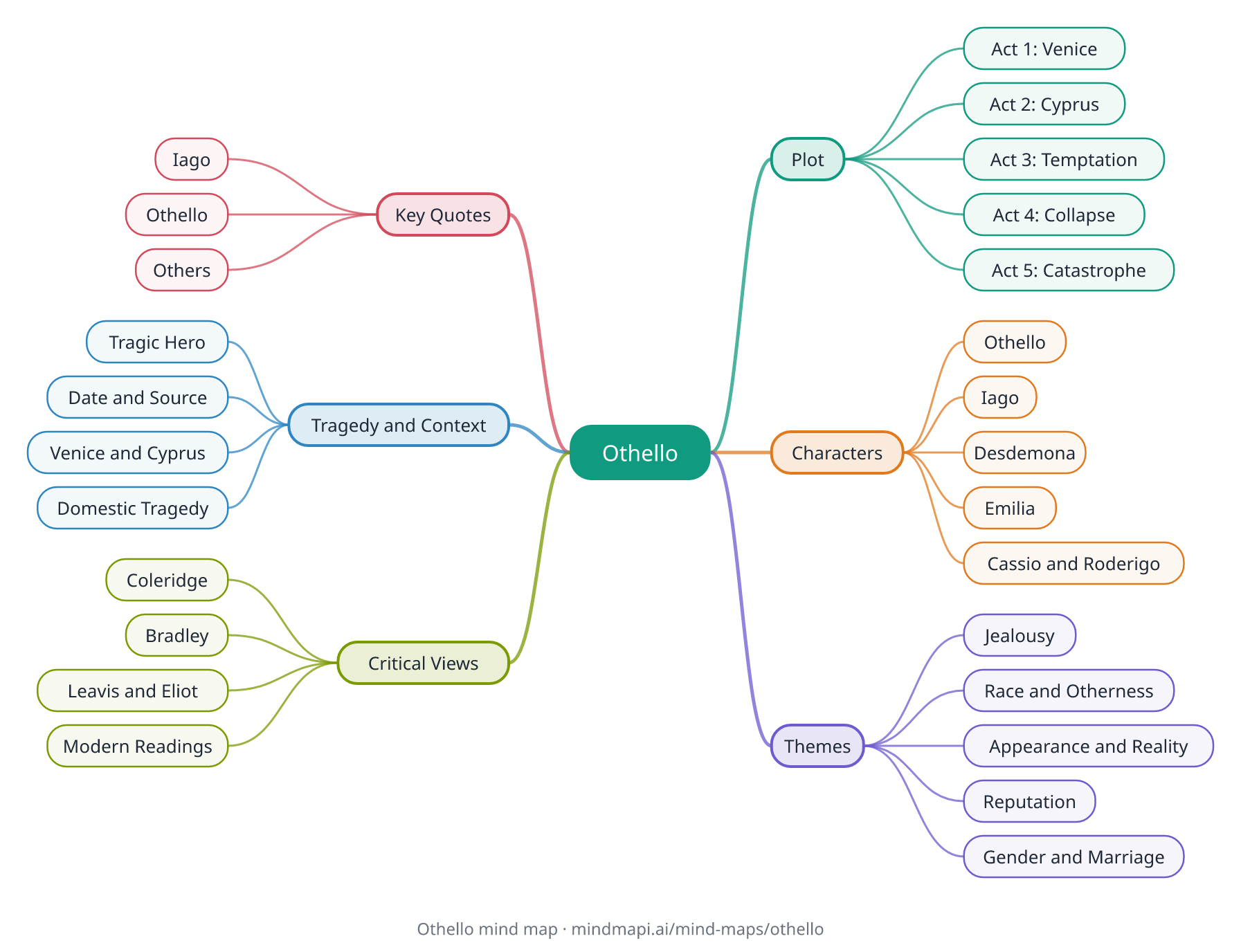
Download this mind map
Print the map with all the notes as a PDF revision sheet, or save the map as an image. Free to use for revision and in class.
Othello mind map explained
Plot
Five acts, moving from Venice to Cyprus.
Act 1: Venice
Iago resents Othello for promoting Cassio over him. Othello has secretly married Desdemona; her father Brabantio accuses him of witchcraft, but the Senate accepts the marriage and sends Othello to defend Cyprus.
Act 2: Cyprus
A storm destroys the Turkish fleet. Iago gets Cassio drunk and into a fight, and Othello dismisses him.
Act 3: Temptation
In the central scene (3.3), Iago plants suspicion that Desdemona is unfaithful with Cassio. Emilia gives Iago Desdemona's handkerchief, which he uses as false proof.
Act 4: Collapse
Othello's language and self-control break down. He strikes Desdemona in public.
Act 5: Catastrophe
Othello smothers Desdemona. Emilia reveals the truth, and Iago kills her. Othello stabs himself; Iago refuses to explain.
Characters
A small cast, dominated by the relationship between Othello and Iago.
Othello
A Moorish general, respected in Venice but an outsider. Noble and eloquent at first; Iago turns his trust and insecurity into destructive jealousy.
Iago
Othello's ensign, known to all as "honest Iago". A brilliant manipulator who gives several motives, none of them fully convincing.
Desdemona
Defies her father to marry Othello. Loyal and loving to the end, she is destroyed by suspicion she does not understand.
Emilia
Iago's wife and Desdemona's companion. Cynical about men, she finally exposes her husband, at the cost of her life.
Cassio and Roderigo
Cassio, the lieutenant, values his reputation above all. Roderigo, who wants Desdemona, is Iago's dupe.
Themes
The ideas the play explores.
Jealousy
Sexual jealousy drives the tragedy, but Iago's envy and resentment come first.
Race and Otherness
Othello is defined by others through his race, often in racist language. Critics debate how far he absorbs Venice's view of him.
Appearance and Reality
"Honest" Iago is the least honest character, and the play shows how easily appearances deceive.
Reputation
Cassio, Othello and Desdemona all depend on how others see them, which makes them vulnerable to Iago's lies.
Gender and Marriage
Women are judged by their chastity and treated as possessions. Emilia's speech in 4.3 challenges this double standard.
Key Quotes
Short quotations that support many essay points.
Iago
- "I am not what I am" (1.1)
- "I hate the Moor" (1.3)
- "O, beware, my lord, of jealousy; / It is the green-eyed monster" (3.3)
- "Demand me nothing. What you know, you know" (5.2)
Othello
- "She loved me for the dangers I had passed, / And I loved her that she did pity them" (1.3)
- "Put out the light, and then put out the light" (5.2)
- "one that loved not wisely but too well" (5.2)
Others
- Brabantio: "She has deceived her father, and may thee" (1.3)
- Cassio: "Reputation, reputation, reputation! O, I have lost my reputation!" (2.3)
- Emilia: "Let husbands know / Their wives have sense like them" (4.3)
Tragedy and Context
The play as a tragedy, and the world it was written in.
Tragic Hero
A great man brought down by a flaw (hamartia), whose fall brings a reversal (peripeteia), a moment of recognition (anagnorisis) and a release of pity and fear (catharsis).
Date and Source
Written around 1603 to 1604, adapted from an Italian story by Cinthio.
Venice and Cyprus
Venice was a wealthy, ordered republic; Cyprus was a frontier against the Ottoman Turks. Leaving Venice, the characters leave order behind.
Domestic Tragedy
Unlike Shakespeare's other great tragedies, the conflict is private, inside a marriage, rather than about the fate of a kingdom.
Critical Views
Interpretations to weigh in essays. Paraphrase them and test them against the play.
Coleridge
Famously described Iago's search for reasons as "the motive-hunting of a motiveless malignity".
Bradley
A. C. Bradley (1904) saw Othello as a noble hero, destroyed by Iago's cunning rather than his own nature.
Leavis and Eliot
F. R. Leavis (1937) argued Othello's jealousy grows from his own self-regard. T. S. Eliot read the final speech as Othello "cheering himself up".
Modern Readings
Postcolonial and feminist critics focus on racism, otherness and the treatment of women in the play.
How to revise with this mind map
- Track Othello's language through the play. His grand, controlled verse in Act 1 breaks into fragments under Iago's influence, and partly recovers in his final speech. This is rich ground for analysis.
- Learn short quotations that serve several themes, such as "I am not what I am", which works for Iago, deception and appearance and reality.
- Engage with critics, then argue back. Use a critical view to open a debate, then test it against the text rather than just quoting it.
- Weave in context where it sharpens your point, such as ideas about race, Venice and the Ottoman threat, or women's position in marriage.
- Make it yours. Build your own Othello map in Mindmapi from your notes, and ask the AI about any scene or critic you are unsure of. The answer is saved into that branch's notes for next time.
Frequently asked questions
What are the main themes in Othello?
Jealousy, race and otherness, appearance and reality, reputation, and gender and marriage. Iago's manipulation of language connects them all.
Why does Iago hate Othello?
He gives several reasons: Othello promoted Cassio instead of him, and he suspects Othello of sleeping with his wife. None is fully convincing, which led Coleridge to describe "the motive-hunting of a motiveless malignity".
Is Othello a tragic hero?
He fits many features of a tragic hero: a great man brought down by a flaw, often seen as jealousy or insecurity, who recognises his mistake too late. Critics disagree on how far he is responsible and how far he is Iago's victim.
What is the significance of the handkerchief?
Othello's first gift to Desdemona, it becomes Iago's false proof of her infidelity. A small object carries huge symbolic weight, showing how Othello comes to trust appearances over Desdemona herself.
What does Emilia represent?
A more cynical, worldly view of marriage. In 4.3 she argues that wives have the same feelings and desires as husbands, and in Act 5 she exposes Iago, choosing the truth over obedience to her husband.
How do I make my own Othello mind map?
Put Othello in the centre and add branches for plot, characters, themes, quotations, context and critics. To save time, paste your notes into Mindmapi and it will build a first draft of the map for you to edit.
Turn your own notes into a mind map
Upload your class notes, a PDF or a lecture recording and Mindmapi builds the map for you. Your first map is free.
Try It Free


