Art Movements Mind Map (A Level Art)
A level · Art and Design · Checked against AQA and Edexcel · Updated 31 October 2026
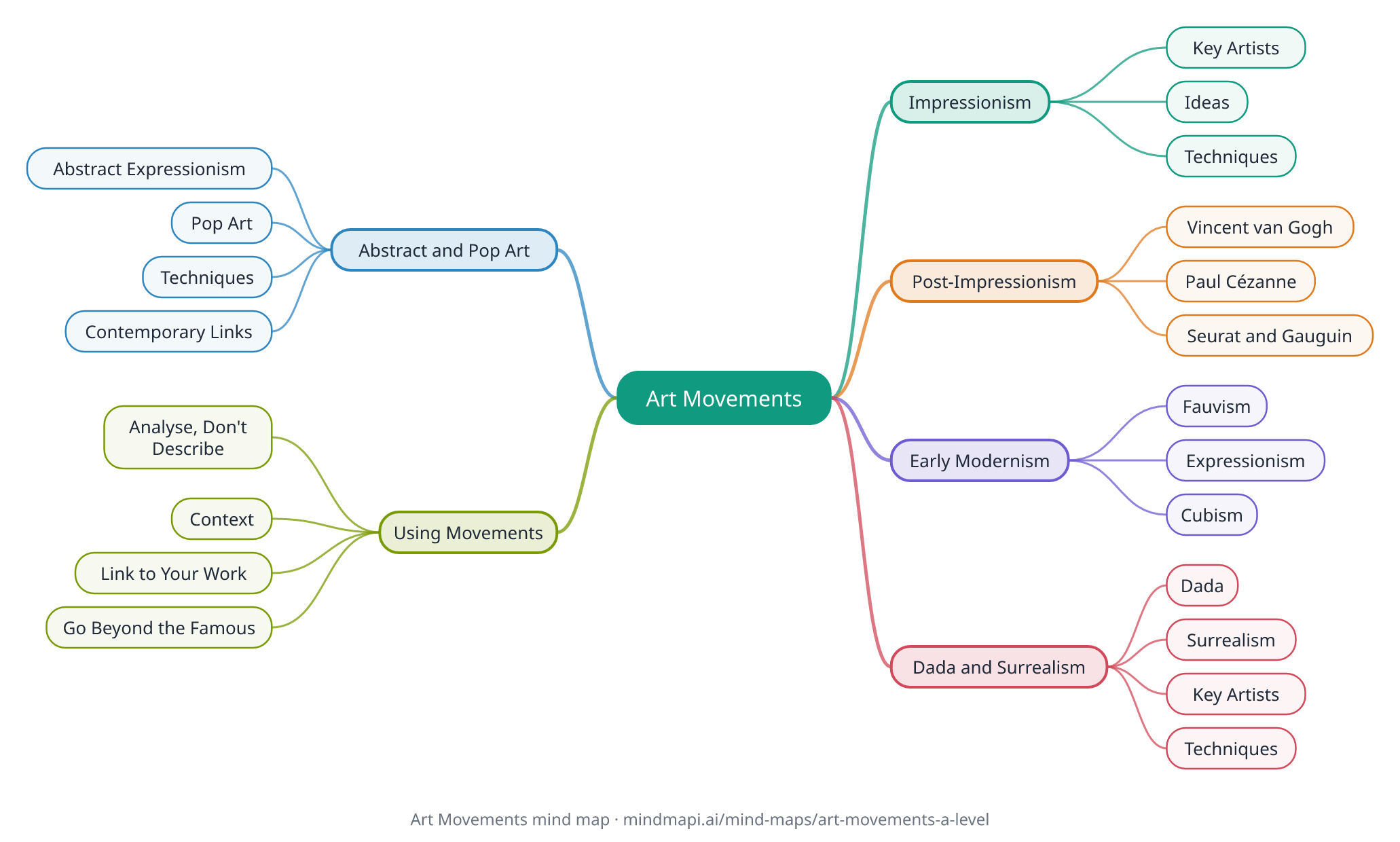
This art movements mind map puts the main modern movements on one page, from Impressionism to Pop Art, with the key artists, ideas and techniques of each, and how to use them in your own research. Every branch is explained in the notes below the map.
It is designed for A level Art and Design students building contextual understanding for AO1 and the written personal study. Use it as a starting point: the strongest research goes deeper into a few artists linked to your own theme.
Download this mind map
Print the map with all the notes as a PDF revision sheet, or save the map as an image. Free to use for revision and in class.
Art Movements mind map explained
Impressionism
France, from the 1870s. Capturing light, colour and a moment in time.
Key Artists
Claude Monet, Pierre-Auguste Renoir, Edgar Degas, Camille Pissarro and Berthe Morisot.
Ideas
Painting modern life and the changing effects of light, often outdoors (en plein air). The name comes from Monet's Impression, Sunrise (1872).
Techniques
Visible, broken brushstrokes, pure colour placed side by side, and coloured shadows.
Post-Impressionism
From the 1880s. Artists built on Impressionism but wanted more structure, emotion or symbolism.
Vincent van Gogh
Expressive colour and swirling brushwork, as in The Starry Night (1889).
Paul Cézanne
Built forms from planes of colour and simplified shapes, paving the way for Cubism.
Seurat and Gauguin
Georges Seurat developed pointillism, painting with dots of pure colour. Paul Gauguin used flat, symbolic colour.
Early Modernism
From about 1905, artists broke decisively with realism.
Fauvism
From 1905, led by Henri Matisse: wild, unnatural colour used for its own sake.
Expressionism
Distorted form and intense colour to express emotion. Edvard Munch's The Scream (1893) was a forerunner; in Germany, Die Brücke formed in 1905.
Cubism
Pablo Picasso and Georges Braque, from about 1907: objects shown from several viewpoints at once and broken into geometric forms. Later Cubism introduced collage.
Dada and Surrealism
Movements that questioned what art could be, and explored the unconscious.
Dada
Began in Zurich in 1916, in reaction to the First World War. Marcel Duchamp's readymade Fountain (1917) challenged the very idea of art.
Surrealism
Launched by André Breton's manifesto in 1924, influenced by Freud's ideas about dreams and the unconscious.
Key Artists
Salvador Dalí, René Magritte, Max Ernst and Frida Kahlo, who is often linked with the movement.
Techniques
Dream imagery, unexpected combinations of objects, automatic drawing, and Ernst's frottage (rubbings from textured surfaces).
Abstract and Pop Art
Post-war art, from abstraction to mass culture.
Abstract Expressionism
New York, 1940s and 1950s. Jackson Pollock's drip paintings and Mark Rothko's colour fields, focused on gesture, emotion and scale.
Pop Art
From the 1950s in Britain and the USA, drawing on advertising, comics and consumer culture. Key artists include Richard Hamilton, Andy Warhol, Roy Lichtenstein and David Hockney.
Techniques
Pop Art used screen printing, bold flat colour, repetition and imagery borrowed from mass media.
Contemporary Links
Later artists, from the Young British Artists of the 1990s to street artists such as Banksy, show these ideas still developing.
Using Movements
How to turn art history into strong AO1 research.
Analyse, Don't Describe
Discuss the formal elements, such as line, colour, form, texture and composition, and explain the effect they create.
Context
Explain how the time, place and events shaped the work, such as the First World War and Dada.
Link to Your Work
Show how each artist influences your own experiments, with a clear next step.
Go Beyond the Famous
Research lesser-known and contemporary artists linked to your theme, not just the most famous names.
How to revise with this mind map
- Start from your theme, not the timeline. Pick two or three movements that connect to your project and research them in depth.
- For each artist, analyse one work closely: its formal elements, techniques, context and meaning, then respond to it in your own practical work.
- Use the vocabulary of art and design in your annotations and personal study. Precise terms show analytical understanding.
- Visit galleries and see work in person when you can. Primary research from real works carries more weight than images online.
- Make it yours. Build a map of artists linked to your theme in Mindmapi, and ask the AI to suggest more artists or explain a movement. The answer is saved into that branch's notes for next time.
Frequently asked questions
What are the main modern art movements?
In rough order: Impressionism (1870s), Post-Impressionism (1880s), Fauvism and Expressionism (from 1905), Cubism (from about 1907), Dada (1916), Surrealism (1924), Abstract Expressionism (1940s) and Pop Art (from the 1950s).
What is the difference between Impressionism and Post-Impressionism?
Impressionists captured fleeting effects of light and colour with loose brushwork. Post-Impressionists such as Van Gogh, Cézanne and Gauguin kept the bright colour but added more structure, emotion or symbolism.
What is Cubism?
A movement developed by Picasso and Braque from about 1907, which showed objects from several viewpoints at once and broke them into geometric forms. Later Cubism introduced collage.
Which artists are linked to Surrealism?
Salvador Dalí, René Magritte and Max Ernst, with André Breton as its founder. Frida Kahlo is often linked with the movement, though she rejected the label.
How should I use art movements in my A level Art project?
Choose movements and artists linked to your theme, analyse specific works rather than describing biographies, explain their context, and show clearly how they influence your own experiments and final piece.
How do I make my own art research mind map?
Put your project theme in the centre and add branches for the movements and artists you are studying, with notes on techniques, context and ideas to try. Mindmapi can suggest artists linked to your theme for any branch.
Turn your own notes into a mind map
Upload your class notes, a PDF or a lecture recording and Mindmapi builds the map for you. Your first map is free.
Try It Free


