Market Failure Mind Map (A Level Economics)
A level · Economics · Checked against AQA and Edexcel and OCR · Updated 31 October 2026
This market failure mind map puts the whole topic on one page: what market failure is, externalities, public goods, information gaps, merit and demerit goods, the ways governments intervene, and how intervention itself can fail. Every branch is explained in the notes below the map.
Market failure appears on AQA, Edexcel and OCR, and it is one of the most heavily examined areas of microeconomics. Essays need diagrams and evaluation, so the notes say which diagram goes with each idea.
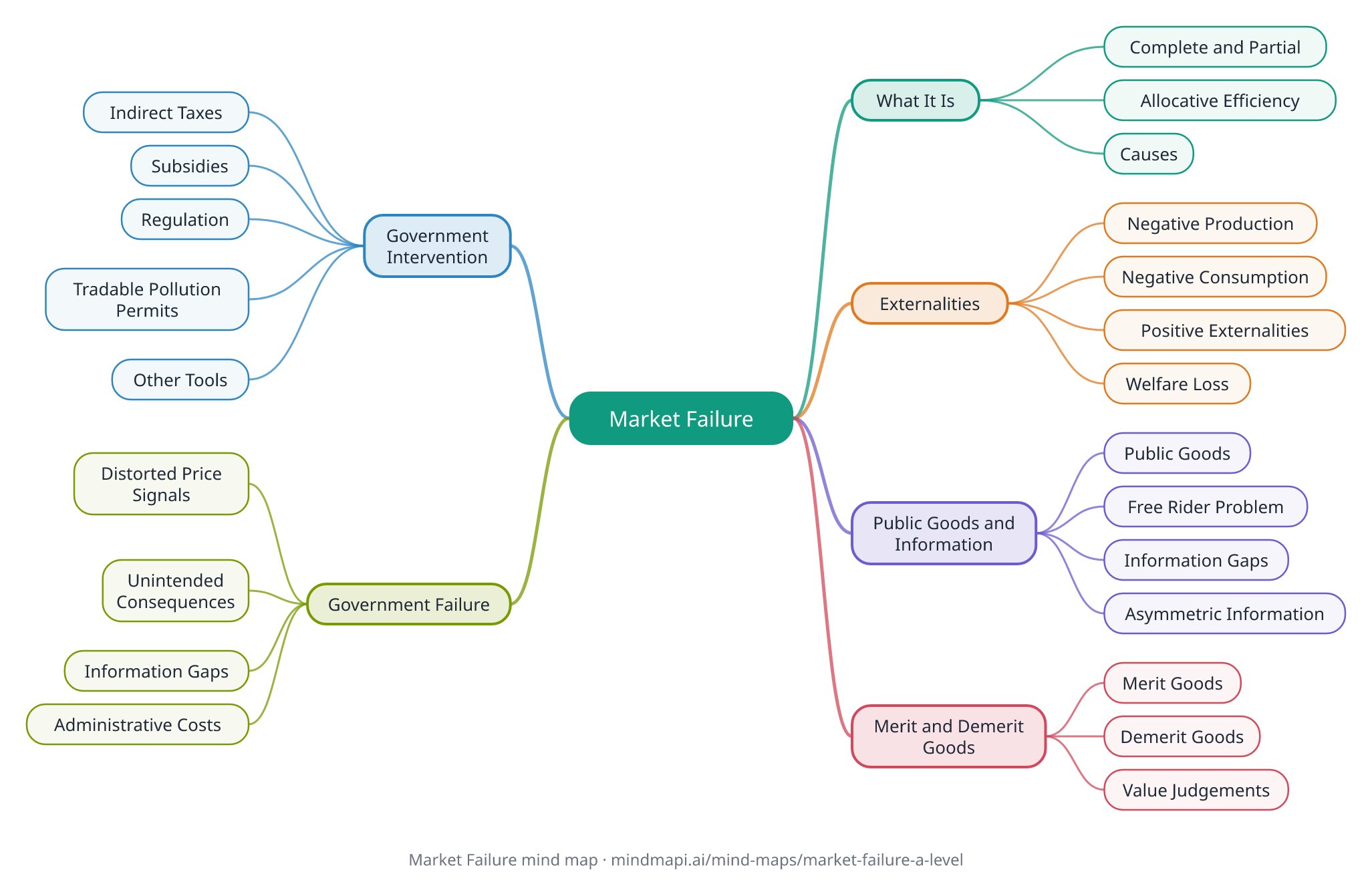
Download this mind map
Print the map with all the notes as a PDF revision sheet, or save the map as an image. Free to use for revision and in class.
Market Failure mind map explained
What It Is
Market failure happens when the free market misallocates resources, so the outcome is not allocatively efficient.
Complete and Partial
Complete failure means a missing market, as with public goods. Partial failure means the market exists but produces the wrong quantity or price.
Allocative Efficiency
Resources go where society values them most: where marginal social benefit equals marginal social cost.
Causes
Externalities, public goods, information gaps, and, in the second year, monopoly power, immobility of factors and inequality.
Externalities
Costs or benefits to third parties, outside the market transaction.
Negative Production
For example, pollution from a factory. Marginal social cost is above marginal private cost, so the good is overproduced and priced too low.
Negative Consumption
For example, passive smoking. Marginal social benefit is below marginal private benefit, so the good is overconsumed.
Positive Externalities
For example, education or vaccination. Marginal social benefit is above marginal private benefit, so the good is underconsumed.
Welfare Loss
On the diagram, the triangle between the free market quantity and the social optimum. Shade it and label it in every externality answer.
Public Goods and Information
Two more reasons markets fail.
Public Goods
Non-rival (one person's use does not reduce another's) and non-excludable (you cannot stop people using it). Examples: street lighting, national defence.
Free Rider Problem
People can benefit without paying, so private firms will not supply public goods: a missing market.
Information Gaps
When buyers or sellers lack full information, they make choices that are not in their best interest.
Asymmetric Information
One side knows more than the other, for example a used car seller (Akerlof's market for lemons). Moral hazard is changing behaviour once insured.
Merit and Demerit Goods
Goods that are under or overconsumed, usually because of information gaps and externalities.
Merit Goods
Underconsumed if left to the market, such as education and healthcare. People underestimate their benefits.
Demerit Goods
Overconsumed, such as cigarettes and alcohol. People underestimate their costs.
Value Judgements
Deciding what counts as a merit or demerit good involves value judgements, which is a useful evaluation point.
Government Intervention
Ways of correcting market failure.
Indirect Taxes
Raise the cost of goods with negative externalities, such as the tax on cigarettes. They work best when the tax equals the external cost, which is hard to measure.
Subsidies
Lower the cost of goods with positive externalities, such as public transport.
Regulation
Laws and limits, such as bans on smoking in public places or limits on emissions.
Tradable Pollution Permits
A cap on total pollution, with permits firms can buy and sell, such as the UK Emissions Trading Scheme.
Other Tools
State provision of public goods, providing information, and price controls such as Scotland's minimum unit price for alcohol.
Government Failure
When intervention makes the allocation of resources worse, not better.
Distorted Price Signals
Taxes and subsidies set at the wrong level can cause overproduction or underproduction of their own.
Unintended Consequences
For example, high taxes can encourage smuggling or black markets.
Information Gaps
Governments rarely know the exact size of an externality, so the right tax or subsidy is hard to set.
Administrative Costs
Running and enforcing a policy can cost more than the benefit it brings.
How to revise with this mind map
- Master the diagrams. Draw externality diagrams with marginal social and private cost or benefit, mark the free market and social optimum, and shade the welfare loss, until you can do it in a minute.
- Use a real example for every point: a tax on sugary drinks, a congestion charge, a minimum unit price for alcohol. Examiners reward application.
- Evaluate every policy. For each intervention, say why it might not work: information gaps, elasticity of demand, unintended consequences, or administrative cost.
- Practise essays that end with a judgement. Weigh which policy is best in the context given, rather than listing them.
- Make it yours. Build your own market failure map in Mindmapi from your notes, and ask the AI about anything you are unsure of. The answer is saved into that branch's notes for next time.
Frequently asked questions
What is market failure?
When the free market misallocates resources, so the outcome is not allocatively efficient. Causes include externalities, public goods, information gaps, merit and demerit goods, monopoly power and immobility of factors.
What is a negative externality?
A cost to a third party not involved in the transaction, such as pollution. The marginal social cost is above the marginal private cost, so the good is overproduced and there is a welfare loss.
Why are public goods not provided by the market?
Because they are non-rival and non-excludable. People can use them without paying (the free rider problem), so private firms cannot make a profit and the market is missing.
What is the difference between a merit good and a public good?
A merit good, such as education, is rival and excludable but underconsumed because people underestimate its benefits. A public good, such as street lighting, is non-rival and non-excludable, so the market does not provide it at all.
What is government failure?
When government intervention makes the allocation of resources worse. Causes include distorted price signals, unintended consequences, information gaps and high administrative costs.
How do I make my own market failure mind map?
Put market failure in the centre and add branches for externalities, public goods and information, merit and demerit goods, intervention and government failure, with a real example on each. To save time, paste your notes into Mindmapi and it will build a first draft of the map for you to edit.
Turn your own notes into a mind map
Upload your class notes, a PDF or a lecture recording and Mindmapi builds the map for you. Your first map is free.
Try It Free


