Macroeconomic Policy Mind Map (A Level Economics)
A level · Economics · Checked against AQA and Edexcel and OCR · Updated 31 October 2026
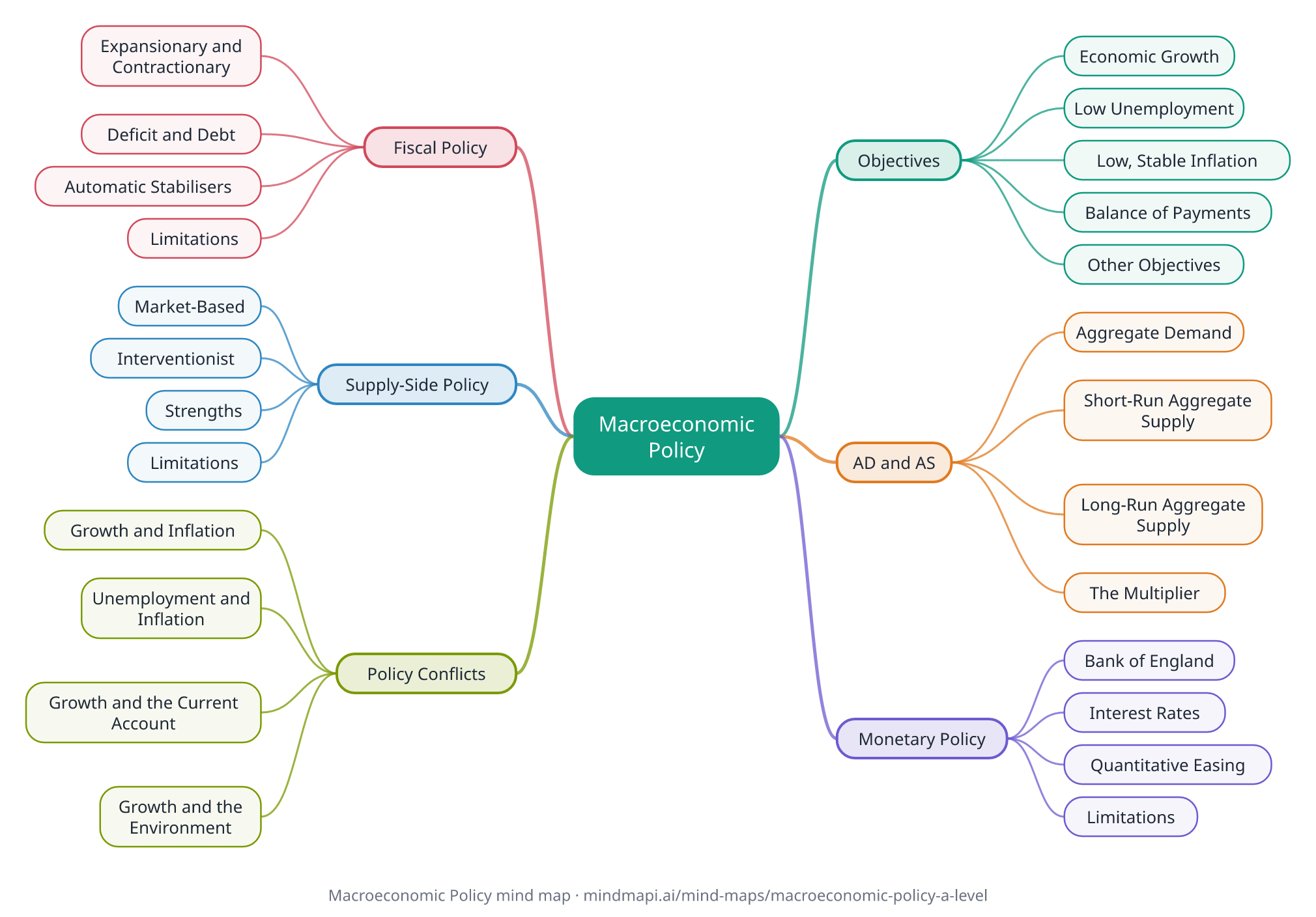
This macroeconomic policy mind map puts the topic on one page: the government's objectives, the aggregate demand and supply framework, monetary policy, fiscal policy, supply-side policies, and the conflicts between objectives. Every branch is explained in the notes below the map.
It covers AQA, Edexcel and OCR, using UK institutions such as the Bank of England. Policy essays need AD/AS diagrams and evaluation, so the notes give the limitations of each policy.
Download this mind map
Print the map with all the notes as a PDF revision sheet, or save the map as an image. Free to use for revision and in class.
Macroeconomic Policy mind map explained
Objectives
What governments aim for in the economy as a whole.
Economic Growth
Sustained growth in real GDP. Actual growth uses spare capacity; potential growth increases the economy's productive capacity.
Low Unemployment
Types include cyclical (demand-deficient), structural, frictional and seasonal unemployment.
Low, Stable Inflation
The UK target is 2% inflation, measured by the Consumer Prices Index (CPI).
Balance of Payments
A sustainable current account position, avoiding large long-term deficits.
Other Objectives
A fairer distribution of income, protecting the environment, and balancing the government's budget.
AD and AS
The framework for analysing every policy.
Aggregate Demand
AD = C + I + G + (X − M): consumption, investment, government spending and net exports.
Short-Run Aggregate Supply
Shifts with changes in costs of production, such as wages, raw material prices and taxes on firms.
Long-Run Aggregate Supply
The economy's productive capacity. Classical economists draw it vertical; Keynesians draw it flat at low output, then vertical at full capacity.
The Multiplier
An initial injection leads to a bigger final rise in national income, because one person's spending becomes another's income.
Monetary Policy
Changing interest rates and the money supply to manage demand.
Bank of England
Independent since 1997. Its Monetary Policy Committee sets Bank Rate to meet the 2% inflation target.
Interest Rates
Higher rates make borrowing dearer and saving more attractive, reducing consumption and investment and lowering inflation. They also tend to raise the exchange rate.
Quantitative Easing
The Bank creates money to buy assets such as government bonds, lowering long-term interest rates. First used in the UK in 2009.
Limitations
Time lags of up to two years, uncertain effects on confidence, and a floor near zero for interest rates.
Fiscal Policy
Changing government spending and taxation.
Expansionary and Contractionary
Raising spending or cutting taxes boosts aggregate demand; cutting spending or raising taxes reduces it.
Deficit and Debt
A budget deficit is when spending exceeds tax revenue in a year. The national debt is the total accumulated borrowing.
Automatic Stabilisers
In a downturn, tax revenue falls and benefit spending rises automatically, cushioning the fall in demand.
Limitations
Time lags, the risk of crowding out private investment, and the cost of rising debt. The UK followed austerity policies from 2010 to cut the deficit.
Supply-Side Policy
Increasing the economy's productive capacity, shifting long-run aggregate supply to the right.
Market-Based
Cutting income and corporation tax, deregulation, privatisation and labour market reforms that increase incentives and competition.
Interventionist
Government spending on education and training, infrastructure, and research and development.
Strengths
They can raise growth without increasing inflation, and improve competitiveness.
Limitations
Long time lags, high costs, and market-based policies may increase inequality.
Policy Conflicts
Achieving one objective can make another harder.
Growth and Inflation
Rapid growth in demand can push up inflation as the economy nears full capacity.
Unemployment and Inflation
The short-run Phillips curve suggests a trade-off: lower unemployment may come with higher inflation.
Growth and the Current Account
Rising incomes increase spending on imports, which can worsen the current account.
Growth and the Environment
Higher output can mean more pollution and resource use.
How to revise with this mind map
- Draw an AD/AS diagram for every policy, showing which curve shifts and what happens to the price level and real output.
- Know the transmission mechanism for interest rates: how a change in Bank Rate affects consumption, investment, the exchange rate and finally inflation.
- Evaluate every policy: time lags, the size of the multiplier, the state of the economy, and side effects on other objectives.
- Use recent UK examples, such as quantitative easing since 2009 or austerity from 2010, and current figures for inflation and interest rates.
- Make it yours. Build your own macro policy map in Mindmapi from your notes, and ask the AI for the latest UK figures on any branch. Its answers can search the web and are saved into that branch's notes.
Frequently asked questions
What are the main macroeconomic objectives?
Economic growth, low unemployment, low and stable inflation (2% CPI in the UK), and a sustainable balance of payments. Others include a fairer income distribution and protecting the environment.
What is the difference between fiscal and monetary policy?
Fiscal policy uses government spending and taxation, set by the government. Monetary policy uses interest rates and the money supply, set in the UK by the independent Bank of England.
How does raising interest rates reduce inflation?
Borrowing becomes more expensive and saving more attractive, so consumption and investment fall. The exchange rate also tends to rise, making imports cheaper. Lower aggregate demand reduces inflationary pressure.
What are supply-side policies?
Policies that increase the economy's productive capacity, shifting long-run aggregate supply to the right. Market-based examples include tax cuts and deregulation; interventionist examples include spending on education, training and infrastructure.
What is quantitative easing?
When the central bank creates money to buy assets such as government bonds, lowering long-term interest rates and increasing the money supply. The Bank of England first used it in 2009.
How do I make my own macroeconomic policy mind map?
Put macroeconomic policy in the centre and add branches for objectives, AD and AS, monetary, fiscal and supply-side policy, and conflicts. To save time, paste your notes into Mindmapi and it will build a first draft of the map for you to edit.
Turn your own notes into a mind map
Upload your class notes, a PDF or a lecture recording and Mindmapi builds the map for you. Your first map is free.
Try It Free


