Water and Carbon Cycles Mind Map (A Level Geography)
A level · Geography · Checked against AQA and Edexcel · Updated 31 October 2026
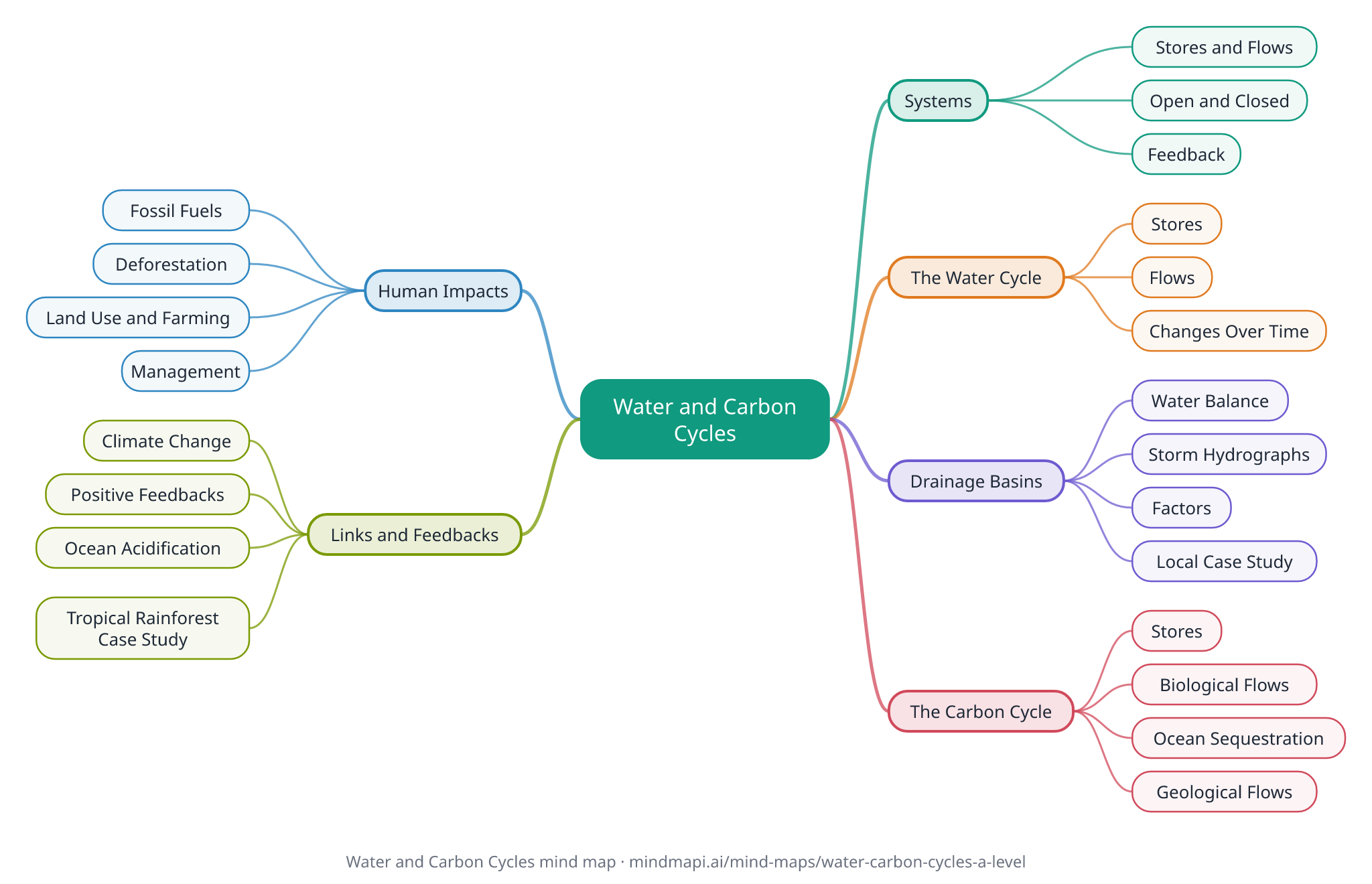
This water and carbon cycles mind map puts the topic on one page: the systems approach, water stores and flows, drainage basins and storm hydrographs, carbon stores and flows, how natural events and people change the cycles, and how the two cycles affect each other. Every branch is explained in the notes below the map.
It covers AQA's compulsory Water and carbon cycles topic, and Edexcel's water and carbon content. Exam answers reward systems language and case study detail, such as the effect of deforestation in the Amazon on both cycles.
Download this mind map
Print the map with all the notes as a PDF revision sheet, or save the map as an image. Free to use for revision and in class.
Water and Carbon Cycles mind map explained
Systems
Both cycles are studied as systems of stores and flows.
Stores and Flows
Stores hold water or carbon; flows (transfers) move it between stores.
Open and Closed
At the global scale both cycles are closed systems: the amount stays the same. A drainage basin is an open system, with inputs and outputs.
Feedback
Positive feedback amplifies a change; negative feedback reduces it, helping keep the system in dynamic equilibrium.
The Water Cycle
How water moves between the oceans, ice, land and atmosphere.
Stores
The oceans hold about 97% of the Earth's water. Most fresh water is locked in ice (the cryosphere) or underground. Rivers, lakes and the atmosphere hold only a tiny fraction.
Flows
Evaporation, condensation, precipitation, transpiration, interception, infiltration, percolation, throughflow, overland flow and groundwater flow.
Changes Over Time
Seasonal changes, such as snowmelt, and long-term changes, such as the growth and melting of ice sheets.
Drainage Basins
The area of land drained by a river and its tributaries.
Water Balance
Precipitation = runoff + evapotranspiration ± change in storage.
Storm Hydrographs
Show how a river's discharge responds to a storm. Key features are lag time, peak discharge, and the rising and falling limbs.
Factors
Drainage basin size and shape, rock and soil type, vegetation, antecedent rainfall and land use. Urban surfaces shorten lag time and raise peak discharge.
Local Case Study
AQA requires a case study of a river catchment at the local scale, showing how the water cycle works and changes there.
The Carbon Cycle
How carbon moves between rocks, oceans, living things and the atmosphere.
Stores
Rocks (the lithosphere) hold by far the most carbon, then the oceans. Smaller stores are soils, vegetation and the atmosphere.
Biological Flows
Photosynthesis takes carbon out of the atmosphere; respiration and decomposition return it.
Ocean Sequestration
Oceans absorb carbon dioxide. The biological pump moves carbon to the deep ocean in sinking organisms; the physical pump moves it in sinking cold water.
Geological Flows
Weathering and the slow formation of sedimentary rocks store carbon; volcanic eruptions release it.
Human Impacts
Human activity is changing both cycles.
Fossil Fuels
Burning coal, oil and gas moves carbon from long-term geological stores into the atmosphere.
Deforestation
Removing forests cuts photosynthesis and transpiration and releases stored carbon, as in the Amazon.
Land Use and Farming
Urbanisation, ploughing and drainage change infiltration, runoff and soil carbon.
Management
Afforestation, wetland restoration, and reducing emissions protect both cycles.
Links and Feedbacks
The two cycles affect each other and the climate.
Climate Change
More carbon dioxide warms the atmosphere, which increases evaporation and changes rainfall patterns.
Positive Feedbacks
Melting permafrost releases methane and carbon dioxide, causing more warming. Melting ice exposes darker surfaces that absorb more heat.
Ocean Acidification
Oceans absorbing more carbon dioxide become more acidic, harming corals and shell-forming organisms.
Tropical Rainforest Case Study
AQA requires a tropical rainforest case study showing how the two cycles interact, and how human activity affects them.
How to revise with this mind map
- Use systems language throughout: stores, flows, inputs, outputs and feedback. It is what examiners look for in this topic.
- Practise drawing and annotating storm hydrographs, and explain how each factor changes the lag time and peak discharge.
- Learn the stores and flows of each cycle as a diagram, then add arrows to show how human activity changes them.
- Link the two cycles in every long answer. Explaining how a change in one affects the other is what lifts answers to the top bands.
- Make it yours. Build your own cycles map in Mindmapi from your notes, and ask the AI for up-to-date figures or examples. Its answers can search the web and are saved into that branch's notes.
Frequently asked questions
What are the main stores in the water cycle?
The oceans hold about 97% of the Earth's water. Most of the rest is fresh water locked in ice or held underground, with only a tiny fraction in rivers, lakes and the atmosphere.
What are the main carbon stores?
Rocks in the lithosphere hold by far the most carbon, followed by the oceans. Smaller stores are soils, vegetation and the atmosphere.
What affects the shape of a storm hydrograph?
Drainage basin size and shape, rock and soil type, vegetation, how wet the ground already is, and land use. Urban areas and impermeable rock shorten the lag time and raise the peak discharge.
How are the water and carbon cycles linked?
Plants connect them through photosynthesis and transpiration. Rising carbon dioxide warms the climate, increasing evaporation and changing rainfall, and the oceans absorb carbon dioxide, becoming more acidic.
How does deforestation affect the water and carbon cycles?
It reduces interception and transpiration, increasing runoff and flood risk, and releases stored carbon while reducing the forest's ability to absorb carbon dioxide.
How do I make my own water and carbon cycles mind map?
Put the two cycles in the centre and add branches for systems, water stores and flows, drainage basins, carbon stores and flows, human impacts and links. To save time, paste your notes into Mindmapi and it will build a first draft of the map for you to edit.
Turn your own notes into a mind map
Upload your class notes, a PDF or a lecture recording and Mindmapi builds the map for you. Your first map is free.
Try It Free


