Simplify Research with Mind Mapping: A Step-by-Step Guide
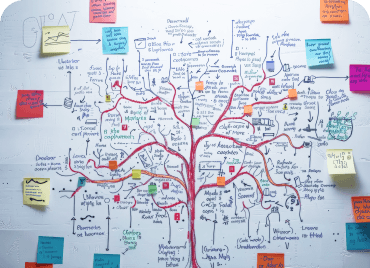
Ever felt lost in a maze of research papers? Whether you're working on a term paper, thesis, dissertation, or professional research project, organizing multiple sources and connecting ideas can feel like solving a complex puzzle with pieces scattered everywhere.
Traditional research methods (highlighting articles, creating endless document folders, and writing disconnected notes) often leave you with information silos that don't talk to each other.
What if you could see all your research in one place, with connections automatically highlighted? That's where AI-powered mind mapping transforms the research process.
Why Mind Mapping Works for Research
Research mind mapping isn't just another note-taking method. It's a visual thinking strategy backed by cognitive science. Here's why it's particularly powerful for research:
Visual Connections Make Research Clearer
Your brain processes visual information 60,000 times faster than text. Mind maps tap into this by creating a spatial representation of information, making complex relationships between concepts immediately visible.
Overcome Information Overload
Research projects often involve dozens or even hundreds of sources. Mind maps help you organize this wealth of information hierarchically, preventing cognitive overload and helping you see both the forest and the trees.
Find Gaps in Your Research
When your research is visually laid out, you can quickly identify areas that need more development or sources that contradict each other, aspects that might remain hidden in traditional linear notes.
With AI-powered mind mapping, these benefits are amplified. AI can analyze multiple sources simultaneously, extract key concepts, identify connections, and organize everything into a coherent mind map in seconds, which would take hours to do manually.
The 7-Step Research Mind Mapping Process
Step 1: Define Your Research Question
Start with a clear, focused research question at the center of your mind map. This becomes your anchor and helps prevent scope creep.
AI Advantage: Upload your research proposal or initial ideas to our AI tool, and it will help refine your research question, suggesting potential angles and identifying whether your scope is too broad or too narrow.
Step 2: Create Main Branches for Key Themes
Branch out from your central question with major themes or aspects of your research. For a literature review, these might be different theoretical perspectives; for experimental research, they could be methodology, previous findings, and hypotheses.
AI Advantage: Our AI can analyze your initial collection of research papers and automatically identify the major themes emerging across them, creating a structured framework for your continued research.
Step 3: Add Research Sources as Sub-branches
As you review each research paper, article, or book, add its key points as sub-branches under the relevant themes. Include citation information directly on the mind map to keep track of your sources.
AI Advantage: Simply upload PDFs, research papers, or even links to online articles. The AI will extract key findings, methodologies, and conclusions, organizing them under the appropriate themes while automatically adding proper citation information.
Step 4: Use Color Coding for Categorization
Assign different colors to various types of information: perhaps green for supporting evidence, red for contradicting findings, blue for methodologies, and orange for theoretical frameworks.
AI Advantage: Our AI automatically color-codes different types of information, distinguishing between facts, opinions, methodologies, and conclusions. It can also highlight conflicting findings across different studies.
Step 5: Connect Related Ideas Across Branches
One of the most powerful aspects of mind mapping is the ability to draw connections between ideas that might not be immediately obvious. Use dotted lines or connectors to link related concepts across different branches.
AI Advantage: The most impressive feature of our AI mind mapping tool is its ability to identify non-obvious connections between concepts across different sources. It can detect when different researchers are discussing related ideas, even when they use different terminology.
Step 6: Identify Gaps and Questions
As your mind map grows, areas needing more research will become evident. Add question marks or special nodes to mark gaps that require additional sources or clarification.
AI Advantage: Our AI analyzes the distribution of information in your mind map and identifies areas that appear underdeveloped compared to others. It can even suggest specific types of sources you might want to find to fill these gaps.
Step 7: Transform Your Mind Map into an Outline
When you're ready to write, your mind map provides a ready-made structure for your paper. Follow the branches to create a logical outline that ensures a coherent flow of ideas.
AI Advantage: With a single click, our AI can convert your mind map into a detailed outline for your paper, complete with section headings, key points to address in each section, and suggestions for where to incorporate specific sources and citations.
Real-Life Examples: Mind Mapping in Action
Case Study: Literature Review Transformation
Sarah, a doctoral student in psychology, was struggling with a literature review covering 75+ papers on cognitive behavioral therapy. After switching to AI-powered mind mapping, she identified three previously unnoticed subtopics that became central to her dissertation's unique contribution. Her advisor noted that the resulting literature review was exceptionally well-organized and showed impressive analytical depth.
Case Study: Cross-Disciplinary Research Made Simple
Professor Martin was conducting research at the intersection of environmental science, public policy, and economics. Using AI mind mapping, he uploaded papers from all three disciplines and immediately saw connections that had been missed by others in his field. The visualized connections led to a breakthrough paper that has since been cited over 200 times.
Mind Mapping Best Practices for Serious Researchers
Keep Your Mind Map Dynamic
Unlike static notes, mind maps should evolve as your research progresses. Regularly update your map with new findings, reshape branches as your understanding deepens, and don't be afraid to reorganize major sections as patterns emerge.
Use Icons and Images for Memory Retention
Adding simple icons or images to key nodes can boost recall by up to 40%. Visual cues make it easier to navigate your map and remember complex information during writing.
Create Sub-Maps for Deep Dives
For complex research projects, create a master map for the big picture, then link to more detailed sub-maps for specific sections. This hierarchical approach prevents overwhelm while maintaining comprehensive organization.
Schedule Regular Review Sessions
Set aside time each week to review and refine your research mind map. This practice reinforces your understanding of the material and often sparks new insights about connections between sources.
Ready to Transform Your Research Process?
Research doesn't have to be overwhelming. AI-powered mind mapping offers a structured, visual approach that can dramatically improve how you gather, organize, and connect information from multiple sources.
Stop drowning in disconnected notes and fragmented ideas. Start seeing the big picture of your research while maintaining access to all the important details.
Try Mindmapi.ai today to experience the power of AI-enhanced research mind mapping. Upload your sources (PDFs, articles, notes, or even videos) and watch as our intelligent system transforms them into a clear, connected visual map that strengthens your research and saves you countless hours.
Your best research is just one mind map away!
Try it with your own material
Mindmapi.ai can build a mind map like the ones described here from your own notes, PDFs, recordings and more. These guides show you how:



