Are Mind Maps Good for Studying?
Mind maps are an amazing technique for studying because they can help you organize everything you need to know into one visually appealing diagram. They are incredibly simple to create, work for any subject, and can even make studying fun.
Without a method like this, studying can often feel overwhelming: scattered notes, disconnected ideas, and too much information to handle. The more you try to make sense of it all, the harder it gets, leaving you stressed and stuck, especially as you get closer to exam season.
Deadlines creep closer, and the fear of falling behind can make studying feel impossible. But this isn't your fault. Traditional methods like linear notes or flashcards don't help you see how everything connects together and that's exactly why mind maps stand out.
What Is a Mind Map?
A mind map is a visual diagram that starts with a central/main idea and branches out into related topics and subtopics. It's a powerful way to represent information visually, making it easier for your brain to process.
Here's how it works:
- Main Topic: Start with your main idea
- Branches: Draw branches out for the main subtopics
- Sub-Branches: Each main branch has smaller branches for details
- Notes Section: Leave space near each topic for additional notes or visuals
This structure matches how your brain naturally works, by connecting different ideas instead of listing them in a straight line.
Why Mind Maps Work So Well
1. They Help You Remember Better
Studies have shown that people remember information better when it's presented visually. Mind maps use images, colors, and keywords to create memorable connections. Instead of just reading words, you're actively engaging your brain by associating those words with visuals, which helps lock them into your memory.
2. They Make Learning Simpler
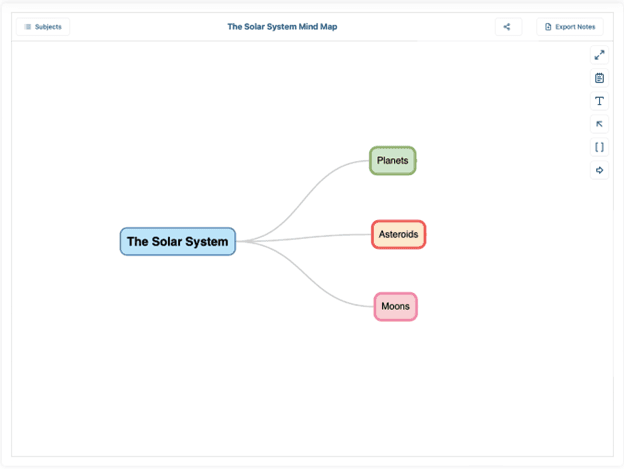
Mind maps break down difficult topics into smaller, easy-to-handle pieces. Imagine trying to learn about the entire Solar System from a long chapter in a textbook. With a mind map, you can take the main idea, like “The Solar System,” and break it into branches for 'Planets,' 'Moons,' 'Asteroids,' etc.
3. They Encourage Active Learning
Mind maps force you to engage with what you're learning. You can't make a mind map without thinking about the material, reorganizing it, and deciding what's important. This type of active learning helps you understand the content deeply, rather than just skimming through it.
4. They Make Studying Fun
Studying doesn't have to be boring. When you use bright colors, drawings, and arrows, studying becomes more like an art project. Would you rather look at a long piece of black and white text, or a colorful diagram? This makes it easier to stay focused.
5. They Save Time
Because mind maps are about capturing key ideas in short words or phrases, you don't waste time writing long sentences. It's a quick, effective way to get to the heart of a topic without all the filler words.
How Do Mind Maps Work for Different Subjects?
Mind maps aren't limited to just one kind of topic. They work for almost every subject and kind of information. Here's how they can help:
Science and Math
Mind maps make it easier to understand complicated processes and formulas.
For example:
- Biology: You can map out processes like photosynthesis. Start with “Photosynthesis” in the center, and create branches for “Light Reaction” and “Dark Reaction.” Add sub-branches for details like “Chlorophyll,” “ATP,” and “Oxygen Production.”
- Math: Use mind maps to memorize formulas or to understand problem-solving steps. If you're studying algebra, you could have branches for “Quadratic Formula,” “Linear Equations,” and “Factorization,” with sub-branches for specific examples and key concepts.
Literature and Writing
Mind maps are perfect for breaking down books or planning essays. Here's how:
- Book Analysis: When reading a novel, you can create a mind map for characters, themes, and settings. For example, if you're studying The Great Gatsby, your main topic could be the book's title, with branches for characters like Gatsby, Daisy, and Tom. Then add sub-branches for their motivations, relationships, and key quotes.
- Essay Planning: Use a mind map to outline your essay. Start with your thesis in the middle, then create branches for each main argument. Add sub-branches for evidence and examples you'll use to support each point.
Languages
If you're learning a new language, mind maps can help organize all those new words:
- Vocabulary: Group words by category, like “Food,” “Colors,” and “Animals.” Add branches for words within each category, with pictures to help you remember them.
- Grammar: Map out grammar rules, such as verb conjugations or sentence structures, to make them easier to follow and remember.
Real-Life Examples of Mind Mapping Success
High School Literature Class
Problem: A student struggled to organize their thoughts for an essay on Romeo and Juliet.
Solution: They used a mind map to outline the key themes (like love and conflict), characters, and important scenes.
Result: The student found it easier to structure the essay, which helped them write more clearly and confidently.
College Chemistry Exam
Problem: A college student had trouble remembering chemical processes.
Solution: They created a mind map for “Organic Chemistry” with branches for different reactions and sub-branches for the steps of each reaction.
Result: Instead of flipping through dense notes, they could easily review everything at a glance and remember key details better.
Nursing Internship
Problem: A nursing student found it hard to connect what they learned in class with real-life patient care.
Solution: They used a mind map to connect symptoms, diagnoses, treatments, and outcomes for different conditions.
Result: The mind map helped them see the bigger picture and improve their critical thinking skills, making them more effective during their internship.
Common Mistakes to Avoid
- Adding Too Much Information: It's easy to get carried away, but adding too many details can make your map cluttered. Stick to the key points.
- Skipping Colors and Images: One of the strengths of mind maps is their use of visuals. Don't skip this part: colors, icons, and simple drawings make your mind map more effective and memorable.
- Writing Full Sentences: Mind maps are meant to be quick to create and easy to review. Stick to keywords or short phrases instead.
- Ignoring Connections: Mind maps are about linking ideas. Make sure the branches show how each topic is related.
Getting Started with Mind Mapping
Ready to give mind mapping a try? Here's what you can do today:
- Pick a Topic: Choose something you're currently studying
- Grab a Tool: Use paper and markers or try a digital tool
- Start Mapping: Write the main idea and let your creativity flow
Mind maps can transform the way you learn. If you want a tool made for this, Mindmapi builds mind maps for students from your notes, PDFs and lectures. Give it a try, and see how much more effective your study sessions become.
Try it with your own material
Mindmapi.ai can build a mind map like the ones described here from your own notes, PDFs, recordings and more. These guides show you how:



